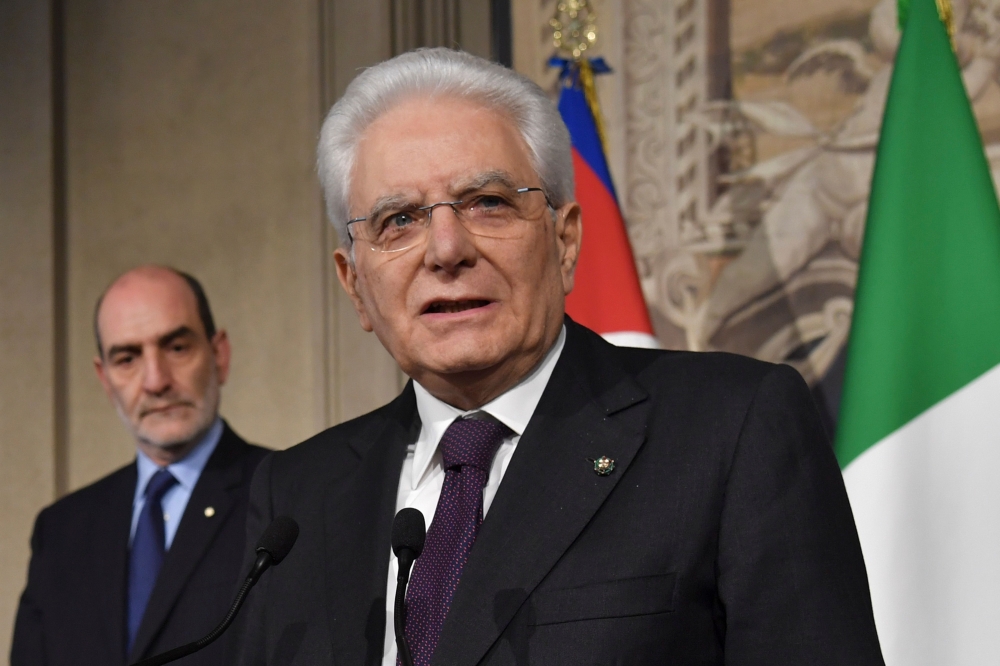
:Italian President Sergio Mattarella addresses journalists after consultations with political parties, on May 7, 2018 at the Quirinale palace in Rome. AFP / Andreas SOLARO
Rome: Italy is facing the prospect of fresh polls just two months after inconclusive elections as bickering political parties failed to come to an agreement to form a government.
The March 4 vote saw a right-wing coalition led by the far-right League party top the polls, while the anti-establishment Five Star Movement (M5S) became Italy's largest single party.
No party obtained the numbers to form a majority and the country has been scrambling to form a government ever since.
Here are the possible scenarios to break the deadlock.
What the president wants - Faced with a political impasse, President Sergio Mattarella says he wants to nominate a "neutral" government to steer the country until December.
The as yet unnamed caretaker government would allow the country to meet several deadlines, including approval of its 2019 budget before the end of the year.
Fresh elections would then be held at the beginning of 2019, most likely after a new electoral law, which would allow for a clearer majority, has been passed.
But parliamentary approval for a government proposed by Mattarella looks unlikely, as the leaders of the M5S, and the League, have both said they would not back it.
A political accord - In his plans, the president has not ruled out an eventual accord between the different political groups.
Although plausible, this scenario looks unlikely as the parties have so far failed to set their differences aside despite several rounds of consultations.
In the case of an eventual agreement, the caretaker government would step aside, and the political government would govern until the end of its mandate in 2023.
A return to the polls? - If a caretaker government fails to get parliamentary approval, the country would have no choice but to return to the polls.
This option is supported by the League and M5S who are pushing for a vote as early as July and have declared they are back on the campaign trail.
But Mattarella has warned that a summer vote in Italy carries the risk of a high abstention rate, and, without a new electoral law in place, the country could likely find itself gripped by the same political deadlock.
The president, who is the only one with the power to dissolve parliament, could put off the vote until the autumn, the time to put in place a new electoral law, but this could jeopardise a vote on the country's budget by the end of the year.
Faced with a critical situation, Mattarella has called on the warring parties to show "responsibility" and support his caretaker government, "in the interest of Italy."