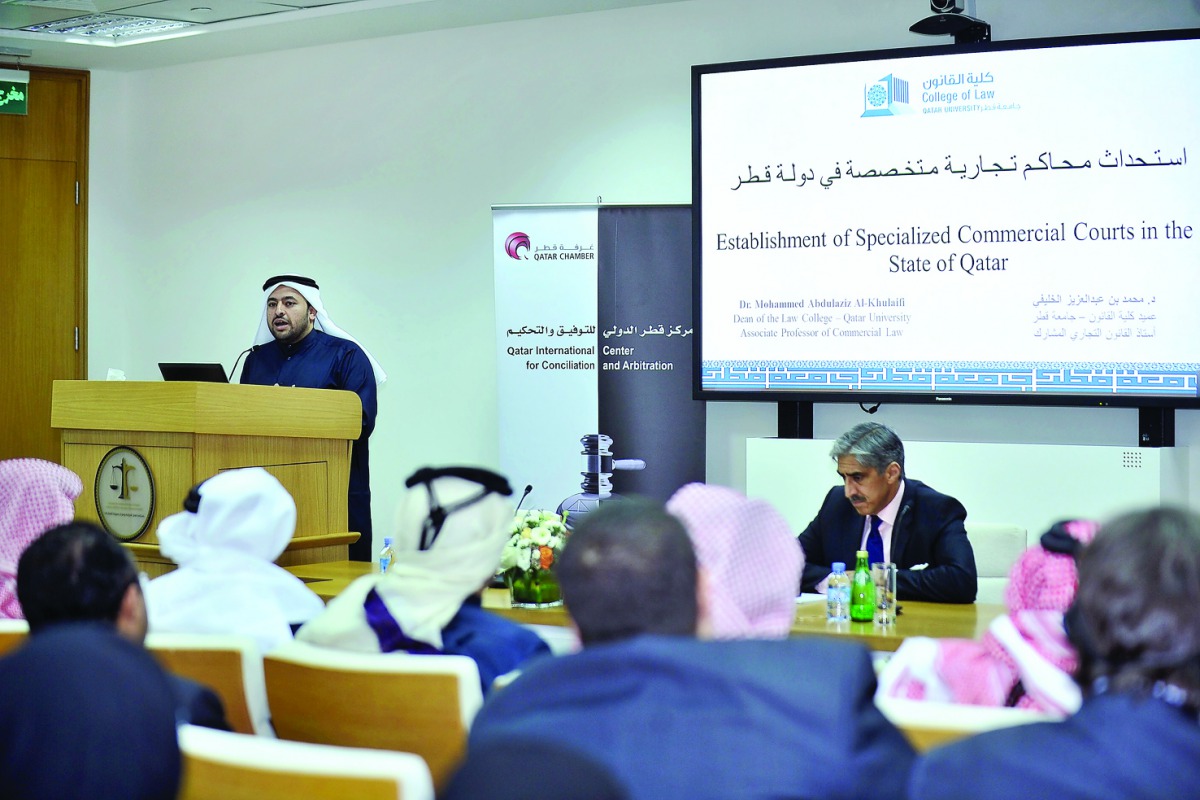
Mohammed Abdul Aziz Al Khulaifi, Dean of Law College at QU and Associated Professor of Commercial Law, addressing the seminar in Doha yesterday. Pic: Baher Amin/ The Peninsula
Qatar International Court and Dispute Resolution Center (QICDRC) has settled commercial dispute cases having financial involvement of more than QR1.5bn in 2016, said a senior official.
"Qatar has the potential and has become suitable to be one of the international centres for settling commercial and economic disputes," said Sheikh Thani bin Ali Al Thani, board member of Qatar International Center for Conciliation and Arbitration (QICA), while talking to The Peninsula.
He said that the number of cases was increasing every year and the centre was not only receiving cases from Qatar-based companies but also from abroad and international companies.
To meet the increasing demand, he said, QICDRC was training every year a number of arbitrators in collaboration with the GCC Commercial Arbitration Center. "The first phase of this year course ended last week hosting around 62 trainees," he noted.
Regarding the Qatari arbitration law, Sheikh Thani pointed out that the law would be issued soon as announced by H E Dr Hassan Lahdan Saqr Al Mohannadi, Minister of Justice, stated during the Second International Conference on International Arbitration held in Doha last October.
There is need for establishment of specialised commercial courts to make Qatar a business hub, said senior Qatar legal expert. “I support the idea of establishing specialised courts in order to have accurate and speedy settlements of commercial and financial disputes," said Mohammed Abdul Aziz Al Khulaifi, Dean of Law College at Qatar University and Associated Professor of Commercial Law.
Speaking yesterday at a seminar organised by QICDRC in collaboration with Qatar International Center for Conciliation and Arbitration Qatar (QICCA), Al Khulaifi said there was no need to expand the establishment of administrative committees with judiciary authorities instead "we need specialised courts".
“I see no need for expansion in existing committees for settling disputes such as the committee for settling rental disputes, the committee at the General Authority for Retirement and the Central Committee for Grievance on Property Confiscation for Public Interest”.
He pointed out that those committees have been granted judicial powers exceptionally, therefore, no need for expansion in those kind of committees. "Courts have the right of the general jurisdiction and have the responsibility to settle any kind of dispute," he added.
"There is a need to enhance the role of courts in settling commercial and economic disputes what necessitate the establishment of specialised courts including appeal court to deal with different types of disputes such a the Islamic financial system," he noted.
He noted that now Qatar is attracting more investments from around the world and different type of business, financial, commercial and economic activities were taking place.
In the seminar on the theme "Importance of Role of Specialised Courts in Resolving Economical and Financial Disputes", Prof Khawar Qureshi, QC Chair of McNair Chambers, presented his paper highlighting some successful examples of specialised courts which were playing important role globally in settling different type of commercial and economic dispute cases.
He mentioned courts in England, Singapore, India and Bahrain. Specialised courts in Qatar can play similar global role as the country has the potential.
"Ruwanda was suffered from genocide in the nineties of the past century. After establishing such specialised courts the country has now become one of the most attractive destination for business in Africa," he said, while presenting it as a case study.
“Key attributes of a successful specialised courts are its expertise, credibility, established with positive track record, effective and cost-effective resolution of disputes and enforcement of decisions in accordance to the 2005 Hague Convention on choice of court agreement," he said, while outlining the powers and characteristics of courts to which businesses used to go for settlement of disputes.