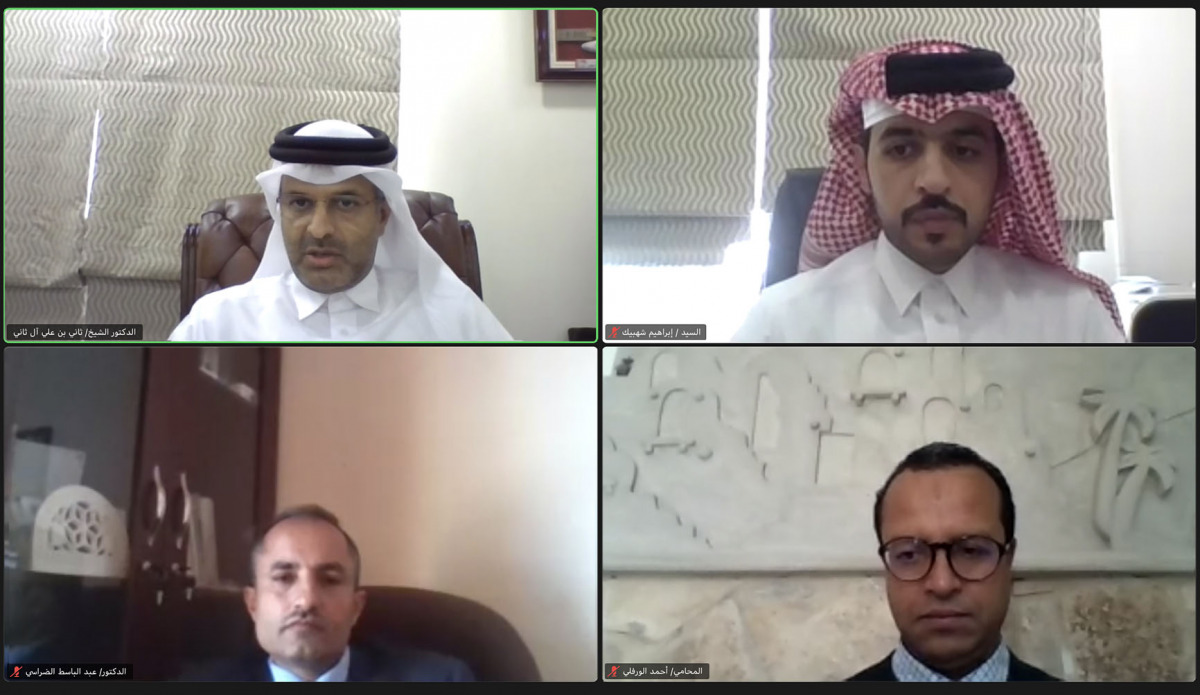
QICCA Board Member for International Relations Sheikh Dr. Thani bin Ali Al Thani and other participants during the ‘Legal Week’ webinar.
Doha: The Qatar International Center for Conciliation and Arbitration (QICCA) at Qatar Chamber yesterday held the third day of its ‘Legal Week’, which will run until tomorrow, with a webinar titled ‘Features of Arbitration in the Arab World’.
The webinar touched on the challenges facing remote arbitration during the COVID-19 pandemic including arbitration agreement, proceedings of arbitration institutions, as well as international judiciary during the crisis and Arab arbitration and foreign investment. QICCA’s Assistant Secretary-General Ibrahim Shahbeek moderated the webinar.
Speaking during the event, QICCA Board Member for International Relations Sheikh Dr. Thani bin Ali Al Thani said that on the heels of the spread of COVID-19, some international arbitration centers and law firms have issued many regulations and guidelines for remote arbitration throughout the use of modern technologies and communication platforms.
He added that QICCA depended on modern technologies, especially after the pandemic, noting that since March 2020, the center has received a number of electronic arbitration requests, and issued 20 arbitration awards.
Professor of Commercial Law at Saba University, Dr. Abdel Basset Abdel Wasea, highlighted COVID-19 and the arbitration agreement, and added that despite the negative impact of the pandemic on arbitration - with social distancing measures preventing the meeting of arbitration committees and tribunals, travel restrictions and others - it, however, has had a positive impact on the arbitration system.
He said the crisis proved that arbitration could adapt to circumstances and challenges, indicating that the pandemic resulted in increasing the number of cases referred to arbitration centers.
Professor of Commercial Law and Arbitration at Saba University, Dr. Yousef Al Sulaili, talked about Arabic arbitration and foreign investment, noting that Arab countries always strive to improve their legislative environments and find systems that contribute to attracting foreign investments. He added that Arab countries have been keen to introduce arbitration as a mechanism for settling commercial disputes and have issued laws in this regard.
During the event, Lawyer Ahmed Al Werfalli also delivered a presentation on arbitration dispute.