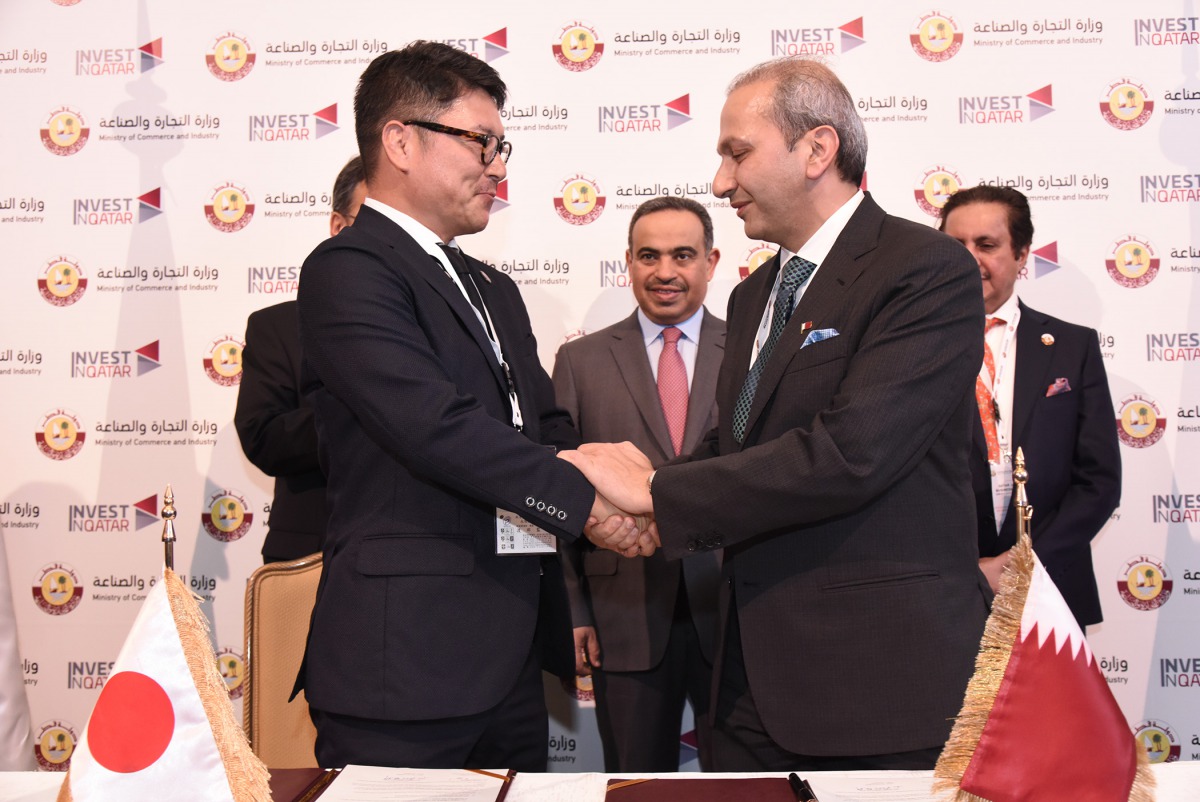
H E Ali bin Ahmed Al Kuwari (centre), Minister of Commerce and Industry, during the signing of an agreement between Qatari and Japanese businessmen, on the sidelines of Qatar-Japan Business Forum held in Tokyo, yesterday.
H E Ali bin Ahmed Al Kuwari, Minister of Commerce and Industry has said Qatar is looking to expand its cooperation with its long-time partner Japan, in the areas of renewable energy, advanced technology, innovation, industry, SME sector and other fields.
Qatar is on the cusp of a major economic diversification. The development of these sectors falls in line with Qatar’s strategies of economic policies, he said.
Chairing Qatar-Japan Business Forum in Tokyo yesterday, which coincided with the visit of Amir H H Sheikh Tamim bin Hamad Al Thani, the Minister underlined importance of four decades of historic and strategic Qatari-Japanese partnerships, which he said reflect the keenness of both countries to bolster bilateral ties across various fields.
The event was organised by the Ministry of Commerce and Industry and the Japan Cooperation Center for the Middle East, in cooperation with the Qatar Chamber, the Qatari Businessmen Association and Japan’s Ministry of Economy and Trade.
The Minister noted that the development of trade cooperation with Japan has reflected positively on bilateral trade, which grew by 22 percent in 2018 to $16bn. Today, Japan ranks as Qatar’s first trading partner, accounting for 13.8 percent of Qatar’s global trade volume. He added that Japanese companies continue to play a leading role in supporting the development of Qatar, particularly in the information technology sector, energy and mining industries, and infrastructure development, namely the Qatar Rail project.
More than 35 fully owned Japanese companies are currently operating in Qatar with a capital of $410m, in addition to 23 joint Qatari-Japanese firms with a total capital of $2.2bn. Qatar and Japan are also bound by several memoranda of understanding and agreements that contribute to the promotion of bilateral ties, he said, emphasizing the importance of breathing life into the existing agreements and ratifying new ones.
In this context, the Minister, urged the ratification of an agreement on the mutual protection and promotion of investments, which will pave the way for new Qatari-Japanese private sector partnerships and joint investments that benefit both countries.
Al Kuwari said “today’s gathering comes amid growing concerns over slowing global economic growth in 2019 due to trade wars and rising interest rates.Now more than ever, both Qatar and Japan need to come together and join efforts to create new partnership opportunities, consolidate economic and investment alliances, and strengthen bilateral trade.”
He invited Japanese companies to take advantage of the business and investment-friendly environment that Qatar offers to foreign investors as evidenced by the country’s ranking by some the world’s most prestigious international institutions.
Globally, Qatar ranks first in terms of low inflation rates, sixth in terms of the effect of taxes on competition, eight in terms of venture capital availability, and ninth in terms of financing small and medium enterprises (SMEs), Al Kuwari said , citing the World Economic Forum’s Global Competitiveness Report 2018.
Qatar’s significant success in this regard has been driven by the integrated policies established by the country’s wise leadership to open the economy, and attract investments into industries and sectors that will cement Qatar’s position as a leading regional trade and investment hub.
Foreign companies that choose to set up shop in Qatar will find a multitude of investment opportunities to tap, he said, referring to development projects being undertaken within the framework of the Qatar National Vision 2030 and ahead of preparations to host the 2022 FIFA World Cup.
With reference to the investment incentives that Qatar offers to Japanese investors, the Minister said foreign investors are allowed up to 100 percnet ownership across various sectors and industries among other incentives that will enable companies to expand their businesses to regional markets, by taking advantage of Qatar’s strategic location between East and West.
Qatar has also been keen on protecting intellectual property rights and guaranteeing investors the freedom to transfer capital from and to the country in addition to developing an advanced network of free zones and logistics and industrial areas in line with the highest international standards.
These facilities have positioned Qatar as an attractive destination for foreign direct investments, which increased by $7.8bn to $186bn at the end of the first quarter of 2018 from $178bn at the end of 2017.
The Minister added that Qatar’s gross domestic product (GDP) rose to $ 222bn in 2017 from $ 218bn in 2016, growing at an annual rate of 1.6 percent.
According to the World Bank, the Qatari economy grew by 2.3 percent in 2018 and is expected to grow at 2.7 percent in 2019 and 3 percent in 2020, partly driven by Qatar’s success in attracting foreign direct investments and bolstering trade, he said.
The Minister noted that Qatar’s foreign trade also witnessed remarkable growth in 2018 as exports increased by 25 percent while the trade balance hit a surplus of $ 52.5bn, an increase of 40 percent compared to 2017.
The Minister expressed hope that the forum will encourage businessmen to promote joint cooperation, benefit from the positive investment climate and establish strategic joint investments and projects to the benefit of both countries.
H E Ali Shareef Al-Emadi, Minister of Finance; and H E Saad bin Sherida Al-Kaabi, Minister of State for Energy Affairs, attended the opening ceremony of the forum along with Sheikh Khalifa bin Jassim bin Mohammed Al-Thani, Chairman of Qatar Chamber and Sheikh Nawaf bin Nasser Al Thani, Board Member of the Qatari Businessmen Association.
The Japanese participating delegation included Tatsuya Terazawa, Vice-Minister for International Affairs at Japan’s Ministry of Economy, Trade and Industry, Kazuo Matsunaga, Chairman of the Japan Cooperation Center for the Middle East, and Toshio Mita, Chairman of the Japan-Qatar Friendship Association.
Over 300 Qatari and Japanese senior officials, businessmen and investors also attended the forum.
Ali bin Ahmed Al-Kuwari witnessed the signing of an agreement between Qatari and Japanese businessmen. Hussain Fikri, CEO of Fikri Group, signed an agreement with representatives of Japanese company, Nagata Shigyo.
Kansho Watanabe, advisor to Nagata Shigyo Co, signed on behalf of Kotaro Nagata, President of Nagata Shigyo who was present at the ceremony along with Minoru Yanai, an advisor to the Japanese company.
The business forum featured four panel discussions. The first session touched on the advanced legislative framework, infrastructure and business and investment opportunities that Qatar offers to Japanese companies.
Abdul Basset Taleb Al Ajji, Director of the Business Development and Investment Promotion Department at the Ministry of Commerce and Industry, Fahd Rashid Al Kaabi, CEO of Economic Zones (Manateq), Captain Abdullah Al Khunji, CEO of Qatar Ports, and Abdullah Al Misnad, deputy CEO of the Free Zones Authority participated in the session.
The second session on business investment opportunities in the energy and power fields in Qatar brought together Khaled Jolo, CEO of Nebras Power, Hiroyuki Shimizu, Vice President, Operations Director and Energy Project Operations Division at Chiyoda Corporation, and Mr. Yoshiki Yokota, Executive Officer and Chief Operating Officer, of the Power Business Division at Marubeni Corporation.
The third session, which touched on the challenges and opportunities for joint investments, ventures and partnerships in Qatar was attended by Mansoor bin Ebrahim Al-Mahmoud, CEO of
Qatar Investment Authority, Akbar Al Baker, CEO of Qatar Airways, Abdullah bin Hamad Al Attiyah, CEO of Qatari Diar, and Hamad Abdulla Al-Mulla, CEO of Katara Hospitality.
The fourth and final session focused on infrastructure projects in Qatar in preparation for the 2022 FIFA World Cup.