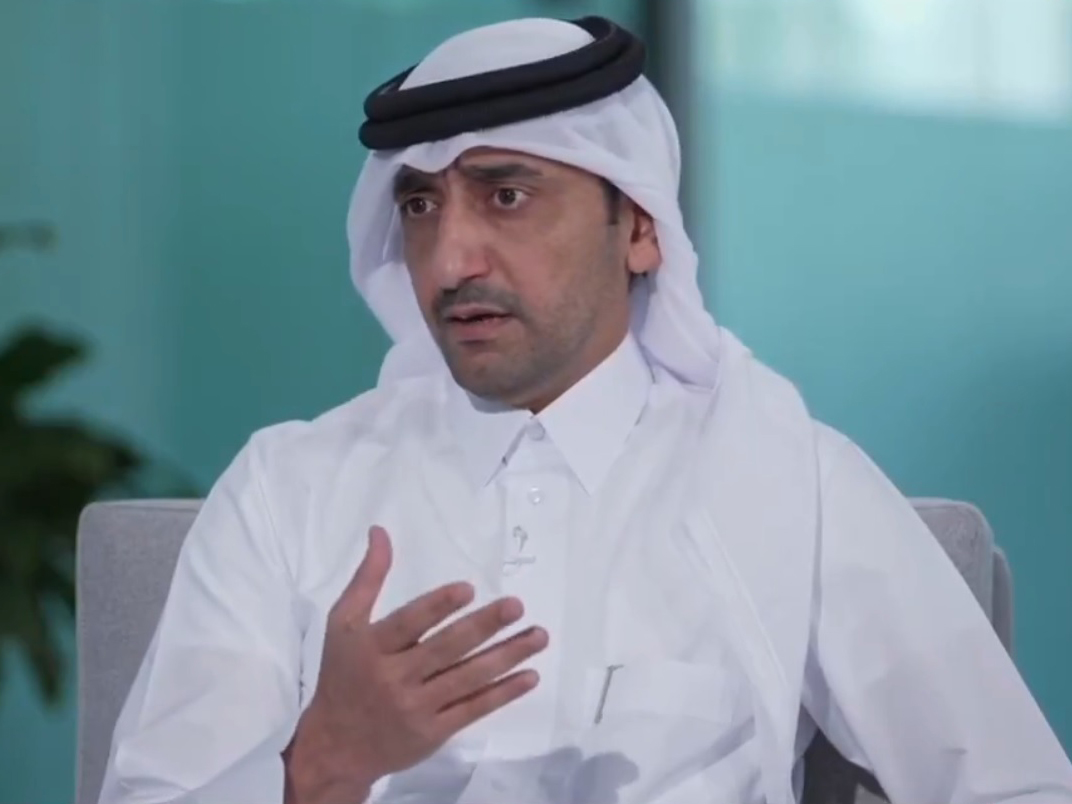
Minister of Justice and Minister of State for Cabinet Affairs H E Ibrahim bin Ali bin Issa Al Hassan Al Mohannadi
Doha, Qatar: Minister of Justice and Minister of State for Cabinet Affairs H E Ibrahim bin Ali bin Issa Al Hassan Al Mohannadi has affirmed that Qatar has successfully managed an exceptional period marked by rapid developments, evolving challenges, and regional uncertainties, demonstrating high levels of preparedness, flexibility, and institutional efficiency.
In an interview with Qatar TV yesterday, the Minister stated that the region is currently undergoing a unique and complex phase characterized by fast-changing developments and multiple challenges. Despite this, he emphasized, Qatar under the wise leadership of Amir H H Sheikh Tamim bin Hamad Al-Thani, has succeeded in managing this crisis with the highest levels of efficiency, competence, awareness, and transparency.
He clarified that the transition from normal working conditions to remote work was not a sudden or improvised decision. “Rather, it was based on pre-designed government work models developed in advance as part of national preparedness plans,” said Al Mohannadi.
He noted that before the crisis, a partial remote work system had already been implemented during the holy month of Ramadan, which served as a practical foundation for scaling up to a more comprehensive model suited to the exceptional circumstances.
Al Mohannadi explained that the General Secretariat of the Cabinet played a central role in determining the most appropriate work model for each phase, working closely with the Civil Service and Government Development Bureau and coordinating with all relevant authorities.
He said that at the forefront of these efforts was the Qatar Civil Defence Council, the central body responsible for crisis management and situation assessment, ensuring that decisions were based on accurate evaluations and aligned with national priorities.
He stressed that the implementation of remote work, both during Ramadan and throughout the crisis, did not affect productivity or disrupt service delivery.
“On the contrary, government entities demonstrated exceptional levels of institutional flexibility, commitment, and national responsibility. Employees across all levels showed dedication and discipline, reflecting both the efficiency of the government system and the strong national spirit prevailing in the country,” said Al Mohannadi.
The Minister underlined that decisions regarding transitions between different work models are guided by established methodologies within comprehensive frameworks for business continuity and crisis management.
He said that these decisions are not reactive or improvised, but rather part of a structured system that ensures readiness and adaptability. He added that all decisions continue to undergo regular evaluation to assess their effectiveness and alignment with evolving conditions.
Highlighting the phased return to normal operations, Al Mohannadi pointed to the decision to resume on-site work at 30 percent capacity as a key step in the transition process.
This decision, he explained, was based on security assessments indicating that risks had subsided and that the situation had stabilized sufficiently to allow for a gradual return.
“The objective was to prepare government entities for a full return to normal operations in a controlled and organized manner while maintaining productivity, ensuring service quality, and safeguarding employee well-being,” said Al Mohannadi.
He confirmed that Qatar has since successfully completed the transition back to full operational capacity, with 100 percent on-site work restored without any negative consequences.
This achievement, he noted, reflects the effectiveness of the country’s planning and the flexibility of its institutional framework, which allows for smooth transitions between different operational models.
The Minister emphasized that Qatar’s strong digital infrastructure played a pivotal role in ensuring continuity of services throughout the crisis.
He noted that the country is not merely working to develop digital services, but rather capitalizing on long-term investments made in earlier stages. “As a result, all government entities were able to continue delivering their services electronically without interruption.”
He cited several examples of government platforms, including the Metrash application of the Ministry of Interior, which provides more than 480 services, as well as platforms developed by the Ministry of Commerce and Industry offering over 500 services.
“The Ministry of Justice’s Sak application provides approximately 137 services, while municipal services are delivered through the Oun platform. In addition, judicial services, including remote litigation, continued seamlessly through digital systems implemented by the Supreme Judiciary Council,” said Al Mohannadi.
These platforms, he noted, enabled citizens, residents, and businesses to access a wide range of services, from judicial and municipal services to commercial, security, electricity, water, housing, and employment services, from anywhere, ensuring uninterrupted service delivery.
Addressing the education sector, Al Mohannadi described it as a fundamental national priority closely linked to student safety and family cohesion.
He explained that the decision to shift to remote learning was part of a broader set of coordinated measures aimed at safeguarding students and educational staff.
“The transition was implemented by the Ministry of Education and Higher Education in coordination with the Ministry of Communications and Information Technology, ensuring the readiness of digital learning platforms and the continuity of the educational process,” said Al Mohannadi.
He praised the efforts of teachers, administrative staff, and parents for their cooperation and commitment during this period, noting that their contributions were essential to the success of the remote learning system. “Following comprehensive assessments confirming the safety and readiness of schools, in-person education slated to be resumed from today, marking a return to normalcy in the sector,” said Al Mohannadi.
Looking ahead, the Minister reaffirmed that Qatar’s national priorities are guided by the Qatar National Vision 2030 and the Third National Development Strategy (2024–2030).
“These frameworks focus on achieving sustainable economic growth, targeting an annual growth rate of 4 percent, promoting economic diversification, and enhancing food security, among other key objectives,” said Al Mohannadi.
He added that the Cabinet is currently prioritizing the continuity of operations in vital sectors, particularly healthcare, education, energy, and transportation, to ensure the uninterrupted delivery of essential services and the regular functioning of public facilities.
“At the same time, efforts continue to enhance the efficiency of government services and maximize the benefits of digital infrastructure to deliver more accessible and user-friendly services.”
Al Mohannadi also expressed appreciation for the efforts of the armed forces, security agencies, and all relevant government entities for their high level of readiness and professionalism in maintaining security and stability.
He commended the strong public awareness demonstrated by the community, noting that adherence to official guidance reflects the values and cohesion of Qatari society.
In conclusion, the Minister emphasized that Qatar’s response to the crisis is rooted in well-established institutional frameworks rather than temporary or reactive measures.
Decision-making processes, he explained, are part of an integrated system characterized by both firmness in implementation and flexibility in responding to changing circumstances. He highlighted that all decisions pass through a structured process led by the Qatar Civil Defence Council, with input from security, military, and specialized entities before being approved by the Cabinet.
“These decisions are continuously monitored and evaluated to ensure they achieve their intended objectives and remain aligned with evolving conditions.”
Al Mohannadi concluded by underscoring three key pillars that guide all government decisions: ensuring the safety and security of all individuals, preserving family cohesion as a national priority, and guaranteeing the uninterrupted delivery of government services.
These principles, he affirmed, remain central to Qatar’s approach as it continues to navigate challenges while maintaining stability, resilience, and sustainable development.