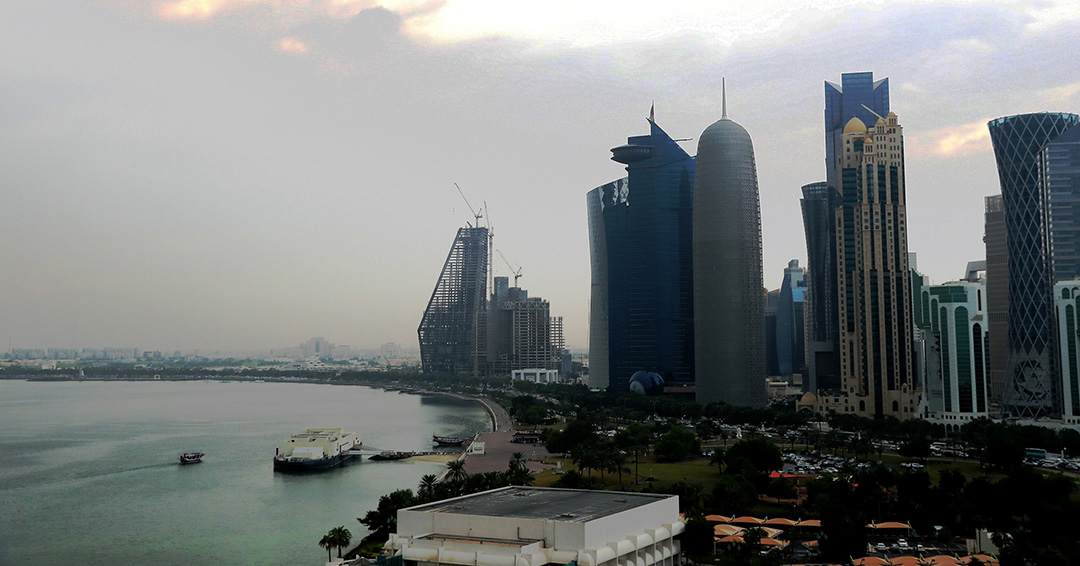
Qatar skyline
At least nine Mena oil exporters would see a fall of an estimated $192bn in their hydrocarbon earnings in 2020, nearly 11 percent of their combined GDP. Consequently, the cumulative current account balance would shift from a surplus of $65bn in 2019 to a deficit of $67bn in 2020, and the fiscal deficit would widen from 2.9 percent of GDP to 9.1 percent, the Institute of International Finance (IIF), noted in its Mena Economic update.
The IIF made the forecast based on its baseline scenario of an average oil price of $40/bbl. Unlike the previous four years, more than two-thirds of the financing need would be raised domestically and by tapping large financial buffers, particularly Sovereign Wealth Funds (SWFs), its analysts said.
According to IIF, the quarantines, disruption in supply chains, the crash in oil prices in light of the breakdown of Opec+, travel restrictions, and business closings point to a recession in the Mena region, the first in three decades.
Governments are trying to mitigate the economic damage with stimulus packages, but many are starting from a weak position. Central banks in the region have cut policy rates and announced plans to provide liquidity to financial institutions, particularly those lending to SMEs, the Institute of International Finance (IIF), noted in its Mena update.
Hydrocarbon exporters in the region face an additional direct hit from the crash in oil prices. The service sector activity will be hit the hardest as a result of containment efforts and social distancing. All exporters are likely to record large fiscal deficits due to the collapse in oil revenue, leading to a rise in public debt.
Liquidity in banks could tighten as oil-related bank deposits decline, and NPLs could rise. Still, most GCC banks are well-positioned to absorb the shocks.
On Qatar, the IIF noted, the Qatar Central Bank (QCB) has reduced the lending rate by 100bps to 2.50 percent and reduced the repurchase rate (repo) by 50bps to 1.00 percent. The central bank will also provide additional liquidity to local banks and set up a mechanism to encourage banks to postpone private sector loan repayments for six months. The government announced a 3-year stimulus package in the amount of $ 20.6bn (12.5 percent of GDP) to the private sector to mitigate the effects of the spread of the coronavirus.
“We expect growth in Mena oil importers to decline by 2.4pps to 0.8 percent in 2020, the lowest since the early 1990s. The potential benefits of lower oil prices are unlikely to overcome the drag from dramatic limits on movement of people and goods within national borders to prevent unchecked spread of the virus, along with deep ties to oil exporters in the region as well as to economies elsewhere that are already seeing rapid contraction,” IFF said.
Non-resident capital flows to the Mena region are expected to decrease from $182bn in 2019 to $101bn in 2020, on the back of lower equity and debt flows. As in 2008 and 2009, resident outflows (mostly in the form of SWFs) will also decline sharply (from $215 in 2019 to $136bn in 2020) reflecting the increasing need to tap SWFs to finance the large deficits. Nonetheless, official reserves are expected to drop by $120bn.