Doha: Qatar’s Newborn Screening Program (QNSP) has enabled the early diagnoses of over 850 babies born with various diseases and disorders, since 2003.
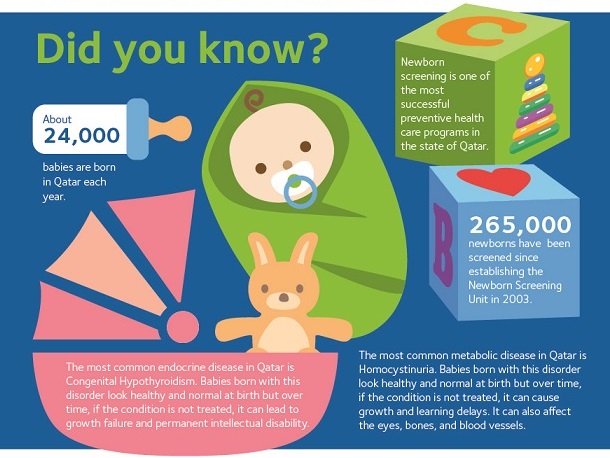
To date, the newborn heel prick test, which is generally administered within 72 hours of a baby’s birth, has been administered to over 265,000 newborns across the country.
Dr Hilal Al Rifai, Director of Qatar’s Newborn Screening Program and Medical Director of the Women’s Wellness and Research Center, said the newborn screening program plays an often lifesaving role in detecting and treating serious illnesses that would otherwise go undiagnosed or have delayed diagnoses.
Dr Al Rifai added that the number of diseases and disorders diagnosed to date demonstrates the importance of parents consenting to the newborn screening.
“The Newborn Screening Program allows us to start treatment before a disease or disorder progresses. The program, which offers free disease screening for all children born in Qatar, currently screens for more than 30 disorders, most of which are autosomal recessive, meaning both of the baby’s parents are carriers of the gene that causes the disorder. It allows us to detect disorders, including those among babies that may seem healthy at first, before they progress to serious illness. This is significant as many of these newborn babies may initially appear healthy, however, the illnesses can progress very quickly,” said Dr Al Rifai.
According to Dr Ghassan Abdoh, Senior Consultant of Pediatric Neonatology and Head of HMC’s Newborn Screening Unit, which is based at the Women’s Wellness and Research, a disease diagnosis can be overwhelming at any age, but the diagnosis is particularly difficult when the patient is a newborn.
Dr Ghassan Abdoh says his team is committed to both educating parents about the importance of the screening test and also about what a positive result would mean for their family.
Qatar’s Newborn Screening Program is divided into three components; the Newborn Screening Unit, which works with maternity units and primary health care teams to coordinate testing and follow up of results, the specialised laboratory that conducts the testing, and the teams that provide treatment to affected babies, both short- and long-term.
Also the newborn screening program is going beyond diagnosis and treatment and is actively conducting research and introducing the latest evidence-based treatment protocols.
The program has introduced genomic technology through its partnership with Germany’s University of Heidelberg Hospital, noting that through more advanced technology, it may be possible to identify even more infants for whom early interventions can prevent serious illnesses or disability.