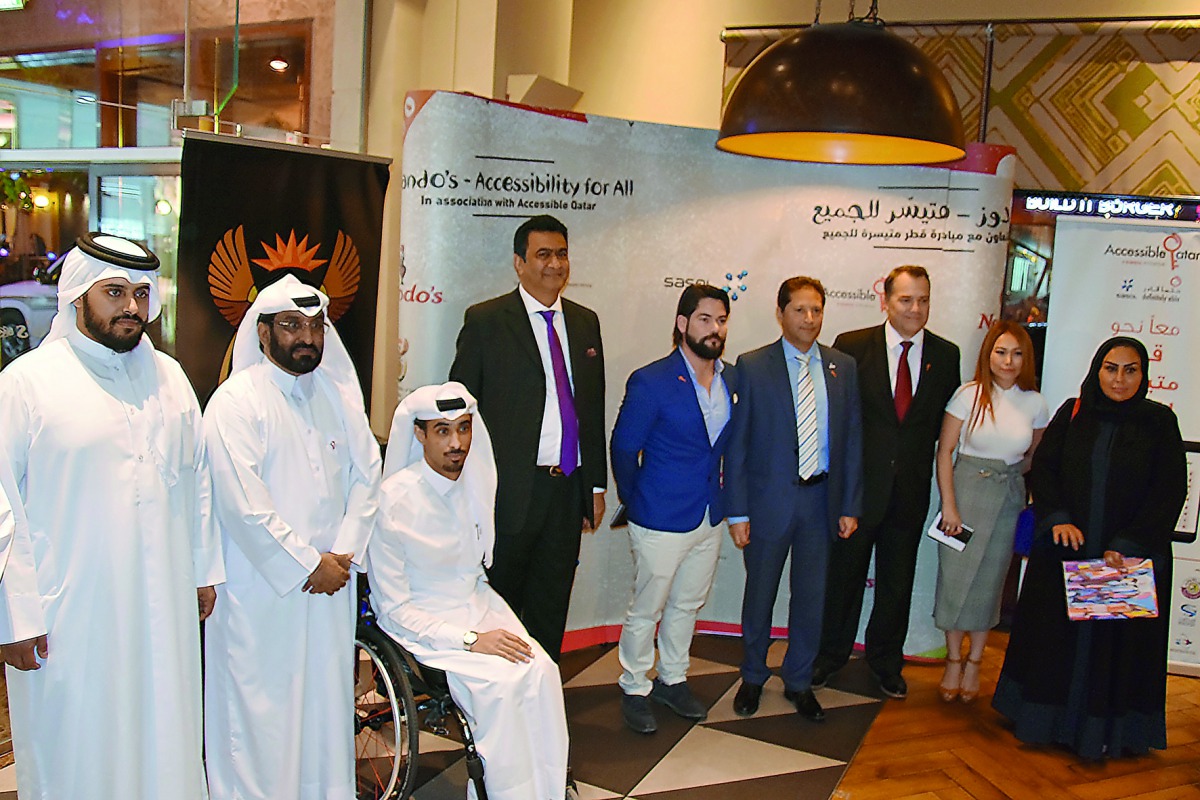
Prof. Shirish Soni, Ambassador Extraordinary and Plenipotentiary of South Africa to Qatar, senior management of Sasol and Nando’s, Accessible Qatar initiative ambassadors and members from the community attending the function.
In an initiative to encourage accessibility within Nando’s restaurants across Qatar, the South African Embassy combined between Sasol’s efforts to promote accessibility in the country and Nando’s willingness to create accessible restaurants.
The event was organised by the two South African companies, and was attended by Prof. Shirish Soni, Ambassador Extraordinary and Plenipotentiary of South Africa to Qatar, Sasol and Nando’s senior management, media representatives, Accessible Qatar initiative ambassadors and members from the disabled community, said a statement.
Sasol, the international integrated chemicals and energy company, through its Accessible Qatar initiative, has shared expertise and insights gained from its ongoing support of accessibility in Qatar, conducted an official accessibility audit of the Nando’s premises, and advised Nando’s on how to achieve an accessible restaurant, through staff training on how to deal and communicate with people with disabilities, braille menus, in addition to physical venue accessibility.
Nando’s, part of the Oryx Group for Food, has committed to making their restaurants in Qatar accessible to people with disabilities.
The restaurant has nine branches across Qatar and has begun adopting accessibility criteria at its Pearl-Qatar branch which has been certified as accessible by Accessible Qatar’s auditors. A similar audit will be performed at all other branches in the coming months.
Nando’s is now offering both its Arabic and English menus in braille. In a bid to be more inclusive, staff at the Pearl branch received training on how to best serve customers with disabilities, and this training will be cascaded to other branches. In addition to that, Nando’s is offering an exclusive 20% discount to all people with disabilities and their companions.
The Embassy launched the initiative in support of the annual observance of the International Day of Persons with Disabilities on December 3, which aims to promote an understanding of disability issues; the rights of persons with disabilities; and the integration of persons with disabilities in every aspect of the political, social, economic and cultural life of their communities.
Prof. Shirish Soni said: “We are proud to join with Nando’s and Sasol to make an important difference this Disability Awareness Month. Accessibility leads to empowerment, and helps people with disabilities to take advantage of opportunities, become agents of change, and embrace an active role in their communities. Together, we can create a more accessible Qatar for everyone.”
Phinda Vilakazi, President of GTL Ventures at Sasol commented: “Sasol is proud to see a positive and tangible impact of our Accessible Qatar initiative. Accessible Qatar is Sasol’s commitment to building an inclusive society in Qatar. ”
From his side, Christopher Clark, Chief Operating Officer of Oryx Group for Food Services said: “We believe that supporting people with disabilities, even in the smallest possible ways is a privilege. At Nando’s we believe in passion, pride, courage, integrity and family.”
Also speaking at the event, Accessible Qatar Ambassador Ahmed Al Shahrani said: “Disability is part of the human condition, and many of us will become disabled to one degree or another during the course of our lives. With partnerships like the one today, we are taking small but important steps to make everyone feel welcome in the community, and raising awareness against the stigma and loneliness that is felt by many people with disabilities.”
December 3 marks the beginning of the Disability Awareness Month in South Africa. The day provides an opportunity to mobilise action to achieve the goal of full and equal enjoyment of human rights and participation in society by persons with disabilities, established by the World Programme of Action concerning Disabled Persons, adopted by the United Nations General Assembly in 1982.