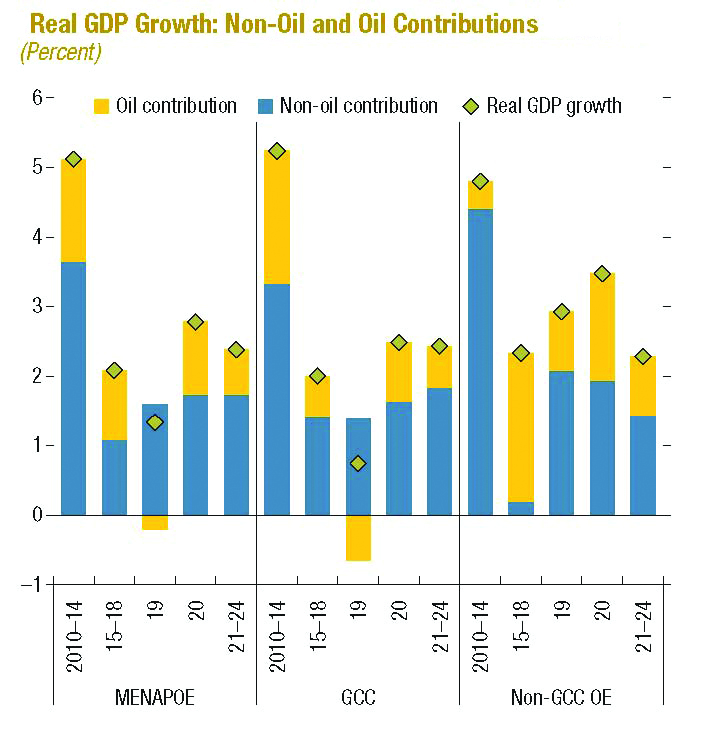
Driven by a recovery in real oil GDP growth, the GCC economy is projected to rebound 2.5 percent in 2020. The growth in the GCC countries is projected to be 0.7 percent in 2019, down notably from 2 percent in 2018.
IMF’s Middle East and Central Asia Regional Economic Outlook released yesterday projected a 1.9 percent growth in GCC real oil GDP, compared to –1.4 percent in 2019 and 2.5 percent in 2018. This reflects a mix of rising oil production in Kuwait and some GCC countries, and a pickup in gas output in Qatar and Oman.
However, it is uncertain whether the Opec+ agreement in place will expire by March 2020. Non-oil GDP growth (increasing to 2.8 percent in 2020 from 2.4 percent in 2019) will be supported by infrastructure spending in Qatar, given its preparations towards hosting 2022 World Cup; Kuwait and another neighbouring country seeing a boost to tourism, IMF noted.
Potential non-oil GDP growth has slowed, reflecting diminishing productivity growth in non-GCC oil exporters, persistently negative productivity growth in GCC oil exporters, and declining capital accumulation across MENAP oil exporters. Dominant public sectors in GCC countries continue to skew incentives for investment toward nontradables, weighing on diversification and productivity growth. Against this background, activity is expected to remain subdued over the medium term.
IMF observed that the banking sector in GCC countries is adjusting to the decline in real estate prices by reducing credit allocation to construction and real estate sectors in countries such as Qatar, while mortgage lending is increasing in some neighbouring countires from a low base. Although the banking sector remains healthy, safeguarding the stability of the financial system will require continued effective monitoring of emerging trends in the real estate sector and exploring the scope for continued use of macroprudential measures to contain risks as needed.
MENAP (Middle East, North Africa, Afghanistan and Pakistan) oil exporters have taken significant steps to improve non-oil revenue mobilization. However, there is scope to further augment tax revenues by undertaking comprehensive tax reforms. The strategy could be to prioritize measures to broaden the base by gradually reducing exemptions, eliminating loopholes in tax legislations, and strengthening tax administration. Some countries like Qatar, Kuwait and Oman would benefit from introducing a value-added tax to enhance domestic revenue mobilization. In addition, consideration could be given to introducing other measures, including income and property taxes.
MENAP oil-exporting countries are benefiting from supportive global financial conditions. Interest rate cuts by major central banks (matched in most GCC countries), and the inclusion of GCC countries in global equity and bond indices, boosted debt and equity flows to many countries in the region in 2019.