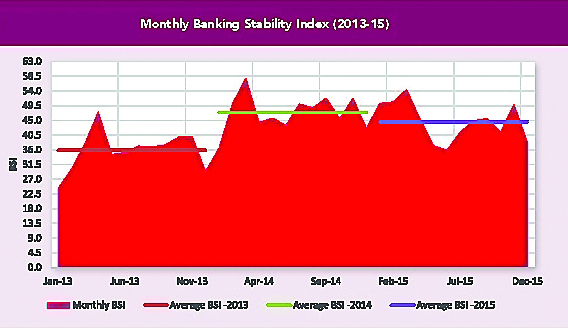
DOHA: Qatar’s Banking Stability Index (BSI), the risk index constructed based on five risk factors in the banking sector including soundness, fragility, liquidity, profitability and inefficiency, decreased marginally in 2015 indicating lower risk profile for the banking sector.
The index, which showed increasing trend towards the second half of 2014, continued the trend for the first four month of 2015. Thereafter, the index moderated and remained range bound for most of the second half of 2015.
Towards the closing months of the year, the index edged upwards a tad; it however remained below the average by year-end. The monthly movements in the risk index of the banking sector suggest a downward trend in the overall risk, going forward, Qatar Central Bank (QCB) noted in its latest Financial Stability Review.
A detailed analysis on the sub-indices shows risk from liquidity and soundness increased in 2015 as compared to last two years. The risk indices of these two factors were in fact started increasing in 2014 itself. Given the banking sector’s strong efficiency profile and low fragility, banks were able to mobilise high quality stable funds in their endeavor to strengthen the capital and liquidity requirements to support the increasing credit requirements.
The survey results indicate that the confidence of the banking sector in the overall financial stability either increased or remained the same. Above 80 percent of the banks responded that market risk as well as systemic risk in general was not increased in 2015. As regards to overall credit and liquidity risk around 40 percent of the banks responded an increase in risk in 2015.
The risk perception of the banks have increased in 2016 as more number of banks (above 50 percent) responded an increase in the overall risk across all risk factors.
Banks perception of risk in the next year (2017) moderated as around two third of the respondents opined that overall systemic risk and market risk will either remain the same or decrease.
However, more than 50 percent of the banks believe that liquidity and credit risks will increase in 2017.
The Survey also sought the banks to rank the key global and macro-economic risks factors that have impacted Qatar financial system according to their opinion. The results are provided in the following heat map.
As observed, weaker commodity prices is considered among top 3 ranks by a larger number of banks across all years.
In 2015, more than 80 percent of banks considered political unrest in the region as a major risk; this appears to have since subsided. Among the macroeconomic risks, persistent low oil prices and decline fiscal balance were mentioned among the top three risks.
Banks have also reported major risk elements of their balance sheet which are more susceptible to risk. The majority of them responded by stating that the intensity of risk from all the given factors remained the same in 2015 and is expected to remain unchanged in 2016 and the year ahead. In most cases, number of banks responded an increase in risk were below 40 percent.
The survey also required the banks to rank the major balance sheet risk (credit, liquidity, market and operational risk) from the list of given risks. The analysis suggests risk from Credit card borrowing is ranked among top risks by more than 50 percent of respondents in 2015. However, for 2016 and 2017 more than 50 percent of the banks consider credit risk emanating from real estate to be a major risk among others. Among the liquidity risks, deposit withdrawals from wholesale depositors is considered a major risk by more than 70 percent of respondents in both 2015 and 2016.
Risk from equity market upheavals is considered a major concern by more than 50 percent of the banks in 2015. Even in the current year, the trend continues to remain the same. However, in 2017, participants feel that that this risk will not be so overwhelming. Regarding operational risk, risk of fraud is considered to be the prime concern.