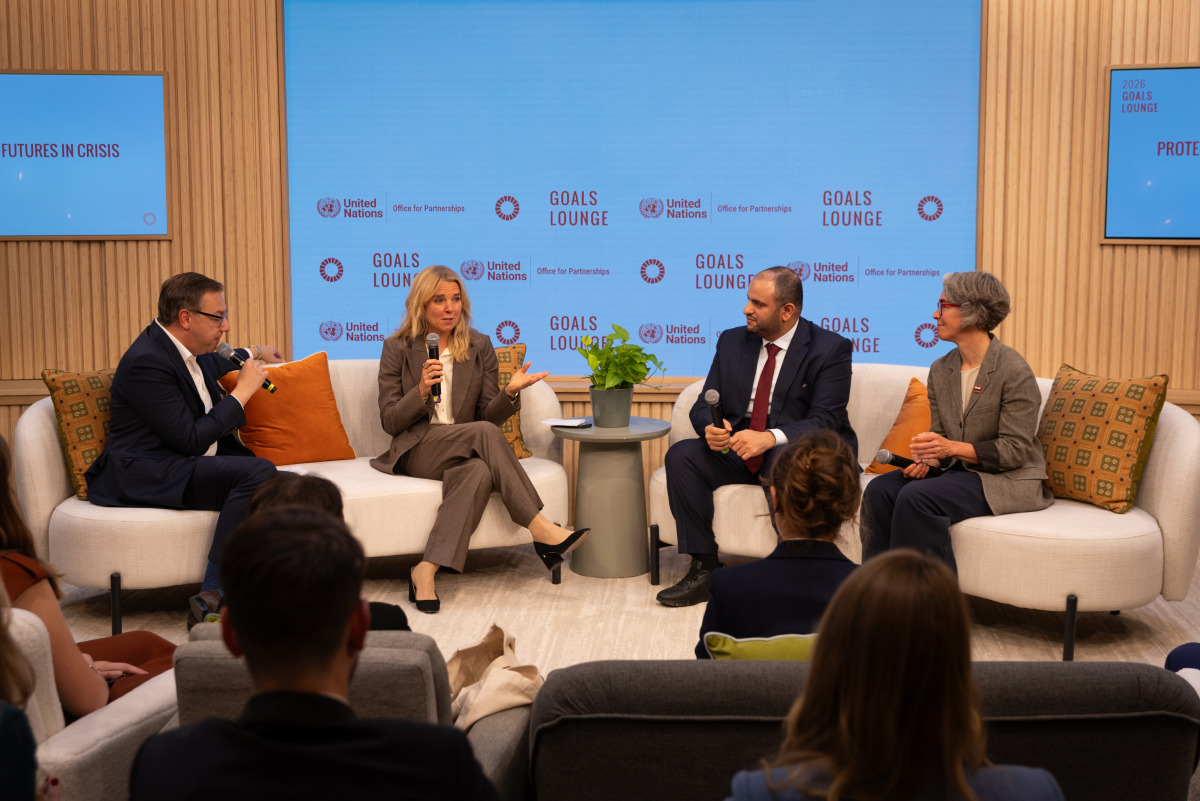
Panellists during a discussion.
New York: Education Above All (EAA) Foundation, a global education foundation, placed the protection and continuity of education in crisis situations and the advancement of innovative approaches to mobilise additional financing for education at the centre of its engagement at the 81st United Nations General Assembly (UNGA81).
Across nine high-level engagements from September 21 to 24, EAA Foundation joined governments, United Nations agencies, development finance institutions, philanthropies, businesses and humanitarian organisations to address two interconnected challenges: protecting education when children and young people are affected by conflict, displacement and other crises, and mobilising the resources needed to ensure they can access and remain in education.
The discussions came against a worsening global financing environment: UNESCO’s 2026 Global Education Monitoring Report estimated an annual US$97 billion financing gap for low- and lower-middle-income countries to reach their education targets by 2030, while aid to education fell by 8% between 2023 and 2024 and aid to basic education fell by 16%. UNESCO has also projected that aid to education could decline by up to 30% between 2023 and 2027.
At the same time, attacks on education continue to threaten children’s access to learning. The Global Coalition to Protect Education from Attack recorded 9,259 attacks on education in 2024 and 2025, more than 50% higher than in the previous two-year period, with at least 10,600 students, teachers, professors and education personnel harmed.
Protecting education in crisis was the defining strand of EAA Foundation’s UNGA81 engagement. At the UN Goals Lounge session, Protecting Futures in Crisis: Building Resilience through Education and Mental Health in Humanitarian Settings, CEO Mohammed Al-Kubaisi joined humanitarian leaders, policymakers, foundations and technology partners to examine how education, mental health and psychosocial support can be integrated more effectively into humanitarian response.
EAA Foundation emphasised that education must be protected and funded as an essential component of humanitarian action, not treated as a secondary need. The discussion highlighted the need to connect learning with psychosocial well-being, child protection and support for teachers, caregivers and humanitarian workers, while ensuring that emergency education creates pathways back into recognised education, further learning and economic opportunity.
Drawing on EAA Foundation’s experience in crisis settings, including its partnership with War Child in Yemen and support for learning continuity in Gaza, the Foundation highlighted the importance of ensuring that children affected by conflict and displacement can continue learning despite disruption.
The discussion reinforced EAA Foundation’s broader advocacy for protecting schools, students and educators and for ensuring that education responses in emergencies address both immediate learning continuity and longer-term recovery and opportunity.