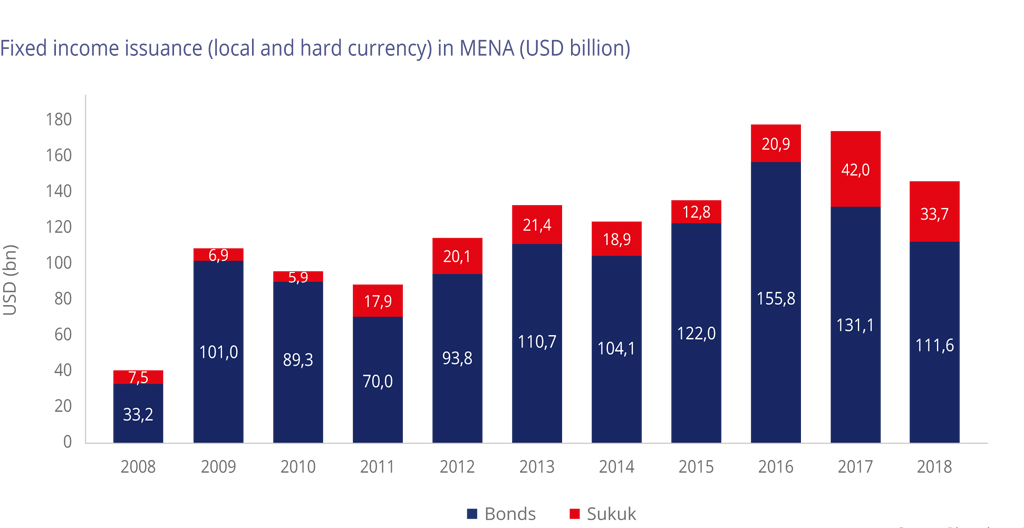
Mena fixed income space remained relatively calm against volatile market moves in 2018. The GCC benchmark index returned 0.30 percent in 2018 compared to -1.72 percent for the emerging market benchmark JP Morgan CEMBI Index and -1.20 percent for the Bloomberg Barclays Global Aggregate Index. Looking ahead to 2019, despite likely challenges, international bond investors can still benefit from a higher allocation to Mena markets.
KAMCO Research in its annual report on ‘MENA Debt’, attributed the region’s ‘economic liberalisation’ and regulatory reforms to compelling reasons for the institutional investors to invest in the region.
According to KAMCO, the GCC’s share of global GDP is expected to increase from 1.8 percent in 2015 to 2.0 percent in 2019, while its share of emerging markets GDP is expected to increase from 4.7 percent to 5.0 percent. Debt-to-GDP ratios among most GCC issuers remain very healthy, especially when compared to similarly rated emerging market peers, despite some having risen sharply.
GCC bonds’ inclusion in the JP Morgan EMBI will result in increased foreign participation. Reforms have also been aimed at increasing transparency to boost investor confidence and at the same time provide ample supervision and oversight to protect investors. These changes have helped, to a great extent, in limiting the impact of political events and decorrelating them from financial markets.
“2018 was a landmark year for GCC fixed income, where it outperformed emerging market (EM) peers despite heightened oil price volatility, providing a safe haven during the EM sell-off. For 2019, we think risks are more balanced, and investors will need to be more discerning in credit selection. While risks stem from further oil price volatility, increased issuance and geopolitical uncertainty, investors may benefit from attractive risk premiums, improving fundamentals and benefits of index inclusion”, said a Fund Manager.
Faisal Hasan, CFA CBDO and Head of Investment Research, KAMCO noted: “A number of reforms being implemented across Mena makes the region an attractive investment destination for foreign investors. This should drive economic growth and make it more sustainable as the countries, especially oil exporters, prioritize non-oil investments.
“The PPP model is one such opportunity, along with other regulatory changes targeting international institutional investors. Although regional geopolitical issues have affected perceptions, significant buffers, strong government support and resilient corporate profitability have helped to offset most investor concerns.”
In terms of issuance, the recent decline in oil price has once again highlighted the importance of sovereign issuances. “We can expect to see more issuance next year, in both the conventional and Shari’a compliant markets. This will also add depth to the regional yield curve,” he added.
For 2019, Fisch Asset Management remains positive because of EMBI technicals and the recent index inclusion. “We still like the support of the local investor base, but depending on oil prices, this support could vary through the course of the year. We expect companies from non-oil sectors to issue bonds, and these may originate from the telecom, F&B and consumer sectors,” said Philipp Good, CEO and Head of Portfolio Management, Fisch Asset Management.
Overall indebtedness in the region is increasing, from a previously very comfortable level. The region will be able to source financing, but over the medium-term the discount to other global emerging markets will probably fade. Fisch expects the spread curve to steepen, particularly in an environment of lower oil prices. The local investor base is certainly still a plus, Good said.