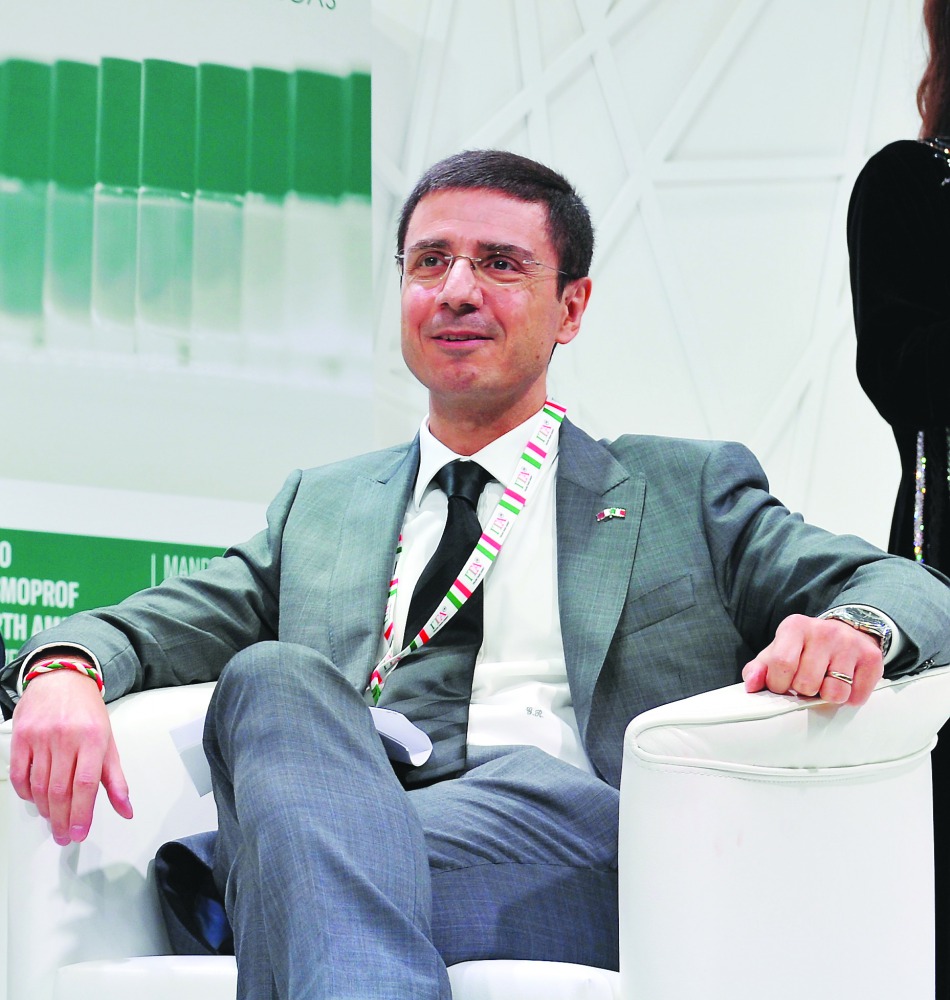
Italian Trade Commissioner to Qatar, Giosafat Rigano’, attending an event during the Heya Arabian Fashion Exhibition at the DECC on Friday. Pic: Salim Matramkot / The Peninsula
Italy is now the second leading cosmetics exporter to Qatar and holds about 10 percent of the market share for the country’s growing beauty industry, Italian Trade Commissioner to Qatar, Giosafat Rigano’ has said.
Italian cosmetics exports to Qatar increased by eight percent to €50m during the first six months of this year compared to the same period last year. Italian cosmetics exports accounted to eight percent of the market share for beauty products in Qatar last year at €30m, which was a 12 percent increase compared to the previous year, Rigano’ said while talking to mediapersons on the sidelines of the Cosmoprof Worldwide Bologna 2020 roadshow in Qatar recently.
Total trade volume between Qatar and Italy increased by 23 percent to about €1.36bn during the first half of 2019 compared to the same period last year. Italian exports to Qatar, including cosmetics products, also rose by 38 percent to €680m during the first six months of this year compared to the same period last year, Rigano’ said in a previous interview with The Peninsula.
“This year, we already hold 10 percent of the market share in the cosmetics industry during the first half of 2019, and overtook the US. We’re now the second main cosmetics exporter to Qatar. Italian cosmetics products imported by Qatar are mainly skin and hair care products, perfume, beauty, make-up, and hygiene products, essential oils, as well as shaving and deodorant products,” said Rigano’, adding that France is still the leading cosmetics exporter to Qatar.
Rigano’ was speaking at a Cosmoprof roadshow which was held during the Heya Arabian Fashion Exhibition at the Doha Exhibition & Convention Center (DECC), to invite Qatari companies to participate at Cosmoprof Worldwide Bologna which will be held in Italy in March next year. The annual trade fair, now on its 53rd edition, is billed as the world’s biggest international trade show for the beauty industry.
Globally, the beauty market is now valued at around $532bn. In Qatar, the development of the cosmetics market was driven by high purchasing power of the residents, who favoured luxury malls with premium and high-end perfumery brands, against the development of mass market brands. In recent years, the growth of international tourism also strengthened the sales trend, said Cosmoprof in a statement.
The increase in the employment rate of the female population was also an important factor, with women called upon to look after their image in work activities outside their home. This situation has led to higher sales for specific products with natural ingredients, to mitigate harmful effects of pollution, sun, dust, especially in the high temperature and dry environs in Qatar. Most popular products include make-up and colour, ethnic products, specific for the hue and characteristics of the skin of the Middle Eastern populations, and Halal cosmetic products.
“Qatar offers important business opportunities for many cosmetics companies, involved in the international community of Cosmoprof Worldwide Bologna. The meeting in Doha lays the foundations for new collaborations and new developments, for the growth of the entire beauty sector,” said Cosmoprof in a statement.
During the event, Ashraf Abu Issa, Chairman of Abu Issa Holding, which owns Blue Salon, Highland, Karisma, and The Face Shop in Qatar, proposed to have the next Cosmoprof event in Qatar. He added that Qatar started importing cosmetics and perfume products in the 1950s. And big stores representing some of the popular beauty brands started to be established after the oil boom in the 1970s.
“Now all the department stores in Qatar carry all the brands. The market today is about specialisation. Smaller brands are also breaking out into the industry. The major players in the past are no longer the only ones in the market. A lot of new and upcoming brands which are very trendy are now competing with the big brands, which is good news. Because it’s good to have variety, and it became easier for anyone to enter the business,” Abu Issa added.
Abu Issa Holding is now in the process of building a perfumery museum at The Pearl Qatar, which will feature perfume bottles from the 1890s to 1960s. “The museum will also feature a new technology that we discovered which will help visitors learn how to make personalised perfume at home. Because we believe personalisation is now the way forward. We will also soon announce a new company particularly dedicated to healthcare,” Abu Issa added.