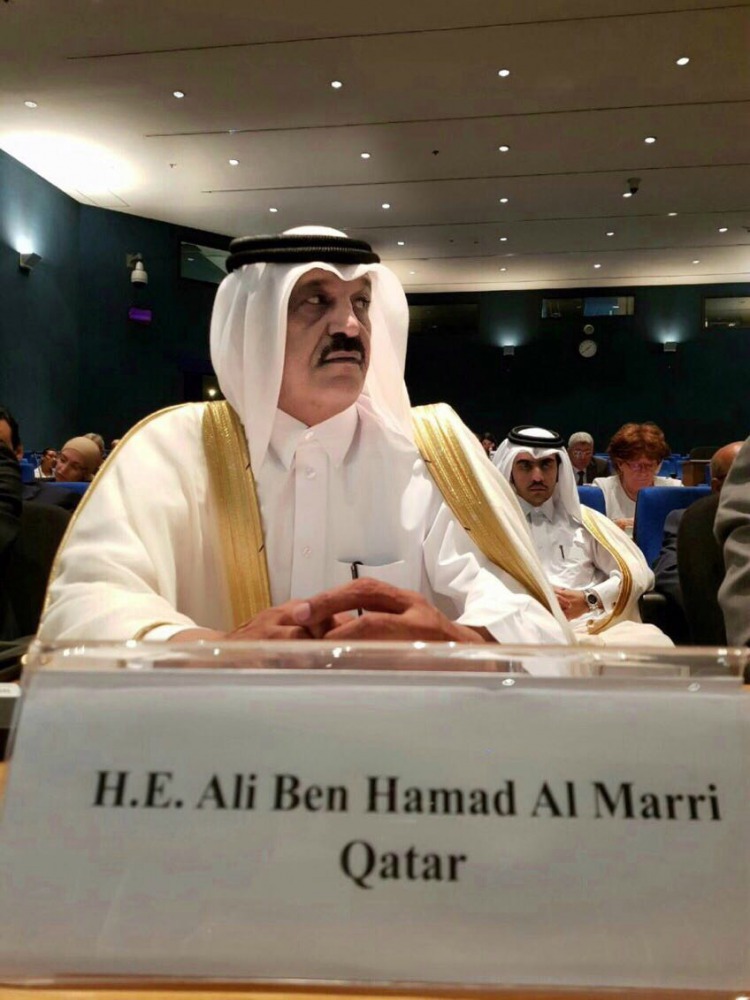
Qatar’s Ambassador to the Republic of Lebanon, Ali bin Hamad Al Marri.
Beirut: The State of Qatar stressed that the best preventive solution for the issue of refugees and migrants is to uproot its causes in terms of conflicts, marginalisation, economic and social weaknesses, and instability that all force people to leave their countries in search for better lives.
The remarks came during the State of Qatar’s address before the opening session of the regional consultative meeting on international migration in the Arab region as part of preparation for the international agreement on safe, organised and systematic migration, which was held at the United Nations Economic and Social Commission for Western Asia’s (ESCWA) headquarters in Beirut. The speech was given by the State of Qatar’s Ambassador to the Republic of Lebanon, Ali bin Hamad Al Marri.
The Ambassador said the State of Qatar will continue to positively support the negotiations as well as the efforts of ESCWA, the Arab League and International Organization for Migration (IOM) in order to reach global consensus in this matter in favour of the international community.
Al Marri extended thanks and recognition for the joint efforts of ESCWA, the Arab League and IOM to organise the meeting on the negotiations of New York Declaration for Refugees and Migrants, which is ratified as a consensual resolution by the UN General Assembly in September 2016 at the level of heads of states and governments, which shows the importance of the international agenda and its relation to the achievement of sustainable development in line with the international agenda for development.
The Qatari Ambassador pointed to the Doha declaration issued by ESCWA’s ministerial session in December 2016, which recommended that member states follow on the important articles related to the achievement of development in the region, which Qatar supports as it chairs the current ministerial session.
The wide movements of refugees and migrants has become a serious challenge to the region because of the repercussions of conflicts and the threat to international peace and security, which led millions of people to seek a better future to ensure their safety and the protection of their families, Al Marri said.
“While we welcome the efforts of neighboring countries and Mediterranean countries to absorb millions of migrants and refugees,” Al Marri said, “we note with concern the dangers facing these victims, including exclusion, discrimination and the difficulty to adapt to their new environment, especially as they arrive in an urgent and unorganized manner.”
The Ambassador added that this situation “called for the adoption of a global regulatory instrument for such cases,” highlighting the extreme concern due to “their exploitation” by illegal migration mobs.
Al Marri said that protecting human rights according to international law and humanitarian law should be the cornerstone in handling this phenomenon, noting that international cooperation is the best way for that. “We in the state of Qatar believe that non-citizen residents can play a role in the development of their home countries.”
He said that more than two million residents in Qatar contribute to the development of their home nations through financial transfers estimated by IOM at $12bn every year, while they have a share in the development of the country through their contributions to the fields of education, health and infrastructure.
Qatar’s ambassador to Lebanon added that such complementary relationship based on mutual respect and the preservation of human rights can contribute to a positive view towards expatriates and helping them to integrate into their environment the same way as citizens. He noted that this complementary relationship requires political will, which the State of Qatar has done under the wise leadership of Emir H H Sheikh Tamim bin Hamad Al Thani and according to its development plan stipulated in Qatar National Vision 2030.
Al Marri said that 2018 will be a quantitative leap in the international community’s understanding of migration and refuge because it will be the time for adopting an international instrument to regulate migration and another to the issue of refuge.