DOHA: China’s growth is likely to slow going forward, despite the recent rebound, as the authorities aim to cool the property market, reign in leverage in the shadow banking sector, and further cut capacity in old industries, noted the QNB’s latest economic commentary on the world’s second largest economy.
QNB expects growth to slow from 6.9 percent in 2017 to 6.4 percent in 2018 and 6.1 percent in 2019. China’s potential GDP growth is on a downward trend due to demographic headwinds (working age population peaked in 2014), and slowing productivity. Nevertheless, GDP growth edged higher to 6.9 percent in 2017 from 6.7 percent in 2016, marking the first acceleration in annual growth since 2010.
The acceleration was driven by a turnaround in the contribution of net exports on the back of a strong recovery in the global economy and trade volumes.
The pickup in net exports more than offset a continued slowdown in the domestic economy. Investment contributed 2.2 pps (percentage points) to growth in 2017, down from 2.8 pps the year before and consumption contributed 4.1 pps in 2017 from 4.3 pps the previous year, reflecting a slowdown in auto sales, which grew 13.7 percent in 2016 on the back of a temporary sales tax cut for small cars which was gradually phased out in 2017.
However, the latest activity data suggests that the economy slowed towards the end of 2017 and in early 2018. Industrial production growth was down to 6.2 percent year on year in December 2017 from a peak of 7.6 percent in June 2017.
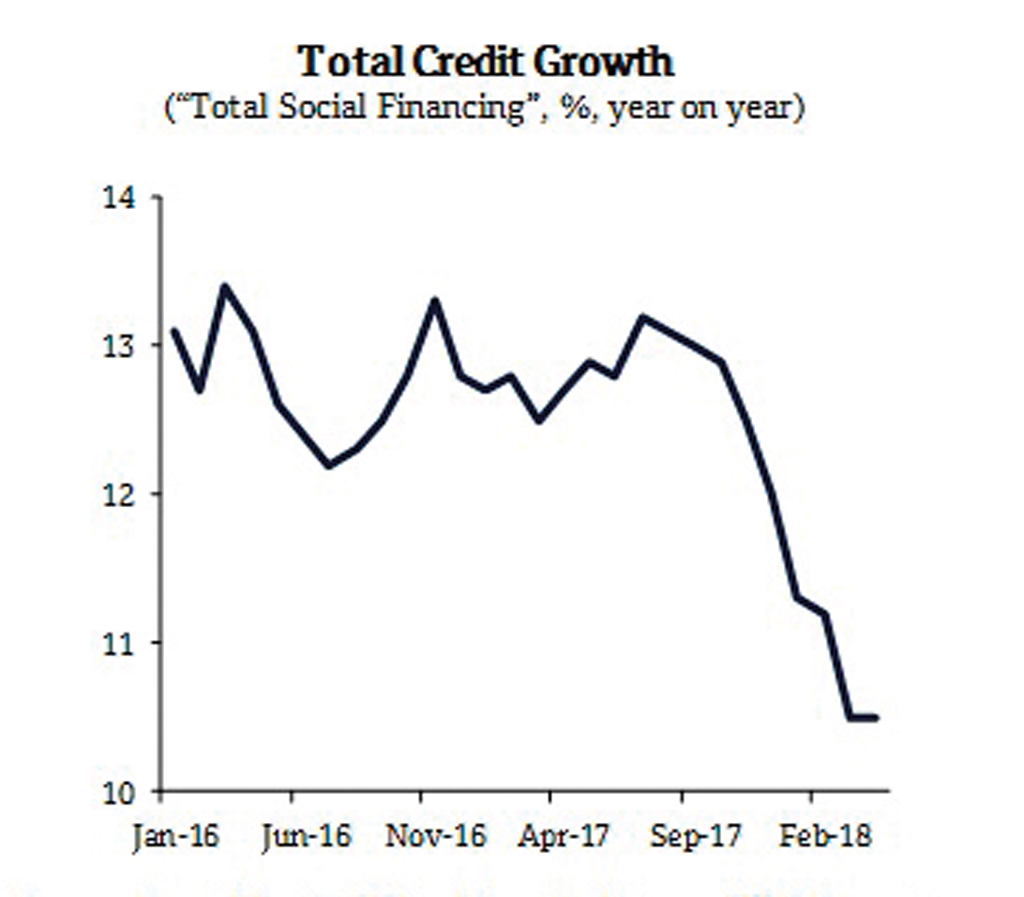
Retail sales slowed to 9.6 percent year on year in December 2017 from a peak of 10.9 percent in September 2017. The official manufacturing PMI fell to 51.4 in April 2018, down from 52.4 in September 2017. Finally, credit growth slowed to 10.5 percent in April 2018 from a peak of 13.2 percent in July 2017.
Going forward, growth is expected to slow further as the authorities focus policy on improving the “quality” and “sustainability” of the economy. This suggests that the authorities will address imbalances in the economy such as elevated property prices, rising financial risks in the shadow banking sector, and a still-high share of investment in the economy, all of which imply slower growth.
Our forecast sees GDP growth slowing on the back of policy tightening measures designed to address imbalances in the economy. First, the property market should continue to cool due to tighter macro-prudential regulations that began to be implemented in the third quarter of 2016.
Examples include tighter down-payment requirements, home purchase restrictions, higher mortgage rates and financing restrictions for property developers. These measures have already slowed property price growth and investment in the property sector.
Second, the authorities are expected to tighten oversight of the shadow banking system in the face of rising leverage in the economy, and to raise the cost of funding for the financial system as a whole, leading to a continued slowdown in credit growth.
Third, fiscal policy should turn marginally restrictive as the size of the “augmented” fiscal deficit declines from an estimated 12.6 percent of GDP in 2017 to 12.1 percent in 2018.
Finally, growth in investment should continue to slow, as has been the case over the last several years, on the back of continued reduction in excess capacity in old industries such as steel, coal, and plastic industries, although this impact should be partially offset in 2018 by private investment in “new economy” sectors such as machinery, electronics and IT on the back of robust export demand.
Overall, we expect China’s growth to slow to 6.4 percent in 2018 and 6.1 percent in 2019 as these tightening measures are implemented by the authorities. To reverse the long-term downward trend, an increase in growth in the working age population or productivity is required.