Doha, Qatar: In recent years, the US dollar has faced mounting pressure from structural headwinds, including an overvalued real exchange rate, persistent fiscal and trade deficits, and the gradual diversification of international reserves by central banks.
These factors have led many analysts to question the sustainability of the dollar’s long-term strength. In spite of this, the US dollar has remained resilient against most major currencies. This resilience reflects the continued strength of cyclical factors, which have helped offset longer-term structural pressures, QNB said in its economic commentary.
Although structural factors are likely to shape the US dollar’s trajectory over the longer term, exchange rates are primarily driven by cyclical forces over shorter horizons. In particular, interest rate differentials have traditionally been the single most important cyclical driver of the currency, influencing global capital flows and portfolio allocation. More recently, the resilience of the US economy and the AI-driven investment boom have provided additional support to the currency by reinforcing foreign demand for US financial assets. In this article, we discuss three factors that continue to underpin the US dollar strength despite the headwinds.
First, interest rate differentials continue to provide support for the US dollar. Exchange rates are strongly influenced by the relative return investors can earn on financial assets across countries, making monetary policy a key driver of currency movements. When US interest rates rise relative to those in other advanced economies, dollar-denominated assets become more attractive, increasing demand for the currency. Consequently, periods of higher US interest rates have historically been associated with a stronger US dollar.
Recent shifts in the US Federal Reserve’s policy stance have reinforced the role of interest rate differentials in supporting the US dollar. At the beginning of the year, financial markets anticipate the Federal Reserve to reduce interest rates by around 50 basis points during 2026.
However, persistent inflationary pressures, resilient economic activity, and the Federal Reserve’s shift towards a more hawkish stance under Chair Kevin Warsh have led to a significant reassessment of the policy outlook. Financial markets now expect policy rates to remain higher for longer and assign a meaningful probability to additional rate hikes.
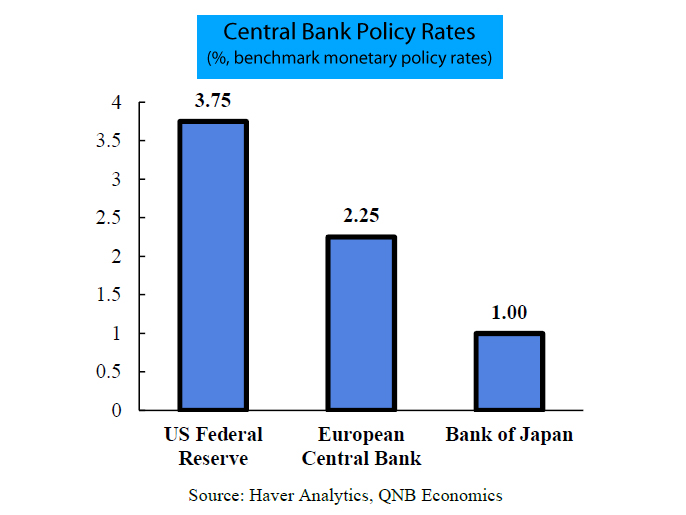
As a result, US policy rates would remain well above those in other major advanced economies, with the Federal Funds target range at 3.50–3.75%, compared with the ECB’s deposit facility rate at 2.25% and the Bank of Japan’s policy rate at 1.00%. These wide interest rate differentials are expected to remain an important source of strength for the US dollar.
Second, AI and technology-driven stock market performance continues to reinforce foreign demand for US financial assets. The expanding adoption of AI has triggered a massive wave of investment in digital infrastructure, including semiconductors, data centres, cloud computing, and electricity networks. As the global leader in AI innovation, the United States has attracted a disproportionate share of this investment, supporting strong corporate earnings, and continued equity market outperformance.
Third, US economic growth continues to outperform other advanced economies, reinforcing the US dollar. While growth has moderated from the exceptionally strong pace recorded in recent years, activity indicators continue to point to stronger economic momentum than in other major advanced economies. In particular, the US composite PMI has remained comfortably above the 50-point expansion threshold, signaling growth in both services and manufacturing, while the Euro Area composite PMI has hovered close or below the stagnation threshold. In addition to boosting demand for US financial assets, the AI investment boom is also benefiting the real economy through record capital expenditure. Over time, these investments are expected to support productivity growth and strengthen the US economy’s long-term growth potential.
All in all, while mounting structural headwinds continue to point to a gradual US dollar depreciation over the longer term, cyclical factors are set to remain the dominant drivers of the currency in the near term. Higher US interest rates, sustained foreign demand for US financial assets, and continued US economic outperformance are expected to remain important sources of strength for the US dollar.