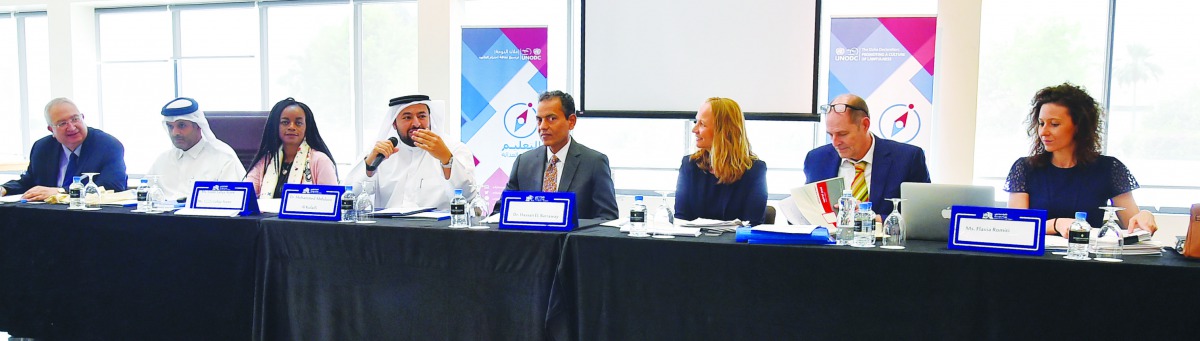
The legal experts at the conference.
DOHA: Qatar University College of Law (QU-LAWC) held the international conference on “Exploring and Countering the Linkages between Organised Crime and Terrorism”, in collaboration with the United Nations Office on Drugs and Crime (UNODC) yesterday.
The conference brought together legal experts from QU, Beijing Normal University, City University of New York, European University Institute, Hassan II University, Nanyang Technological University, Nigerian Institute of Advanced Legal Studies, Universidad Carlos III of Madrid, University of Massachusetts Lowell, University of National and World Economy, University of Northampton, University of Oxford, University of Sussex, University of Waikato, and Yarslov Mudryi National Law Univeristy. Discussions focused on the background of the fight against organized crime and terrorism from the UN perspective and on the E4J teaching modules for tertiary education.
The program agenda featured an overview of the literature review and educational paper conducted by the UNODC on the linkages between organized crime and terrorism. It also included a presentation by LexisNexis Legal & Professional on the transitional organized crime and terrorism initiative and on Qatar’s regulatory authority for charitable activities.
In his remarks, LAWC Dean Dr Mohammed Abdulaziz Al Khulaifi said: “This is no doubt an important issue in today’s world. LAWC appreciates very much the collaboration with the United Nations Office on Drugs and Crime in holding this forum. We believe that organized crime and terrorism are serious international crimes that are a threat to the international community, hence they should be confronted and eliminated.”
He added: “Qatar has taken serious measures to combat both crimes on the legislative and institutional levels. On the legislative level, Qatar passed the law no3 of 2004 on Combating Terrorism, which was amended on July 12, 2017, the Law on Combating Money Laundering and Terrorist Financing No 4 of 2010 and the Law No 15 of 2011 on Combating Human Trafficking. On the institutional level, Qatar established the National Committee for Combating Terrorism, the National Committee for Anti-Money Laundering, and Anti-Terrorist Financing, and the National Committee for Combating Human Trafficking, and the Authority for Charitable Activities to ensure that charitable contributions are not used for illegal purposes.”
UNODC Chief of Organized Crime and Illicit Trafficking Branch, Division for Treaty Affairs, Loide Loide Lahja Aryee said: “No state, no matter how powerful, can defeat organized crime and terrorism alone, nor the nexus between these two crimes.”