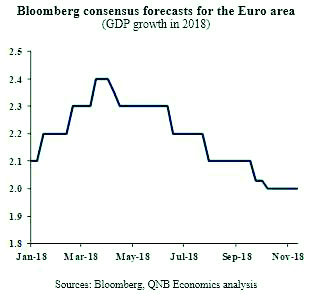
Doha: Economic recovery in the Euro area is under a ‘slower normal’ as GDP growth performance has weakened further in recent months. Activity has softened significantly over the last three quarters to the latest downward surprise in Q3, when the Euro area faced the slowest expansion in nearly 4 years, QNB noted in its weekly ‘economic commentary’, yesterday.
After surging from 1.6 percent to a peak of 2.4 percent early this year, the Euro zone 2018 Bloomberg consensus forecasts have started to slip in April and are now at 2.0 percent. Our analysis focuses on the drivers of the recent performance.
Five factors contributed to the recent weakness.
First, the Euro area has been hit by a manufacturing slump associated with environmental regulation changes. Adaptations to the recently imposed Worldwide Harmonized Light Vehicle Test Procedure (WLTP) have led to a sharp contraction in the European auto-sector.
Indeed, the WLTP is the main culprit for the markedly poor Euro area growth performance in Q3, as y/y passenger car production for the quarter was down by 20 percent in Germany. Importantly, motor vehicle production accounts for over 10 percent of Germany’s total manufacturing output or 4 percent of the total industrial production in the Euro area.
Second, net exports have been affected by the current slowdown in global trade and lagged effects of the EUR 14 percent appreciation against the USD in 2017. Seasonally adjusted exports of goods and services have slowed y/y to 3.8 percent in Q2, against 6.3 percent in Q4 2017 and 3.8 percent in Q1 2018.
Export data is still not available for Q3, but further weakening should take place as disruptions in motor vehicle exports are expected to more than offset the effect of this year’s EUR depreciation.
Third, rising political uncertainty has been a negative influence on business and consumer sentiment, dragging on growth. The news based economic uncertainty index for Europe is up 20 percent year-to-date. Negative events include the budget dispute between Italy and the European Commission (EC) and US threats to impose auto tariffs against European partners.
The stand-off between Brussels and Rome is particularly challenging. As Italy has proposed an expansionary fiscal plan that the EC has rejected on the basis of debt sustainability concerns, sovereign 10Y BTP Italy-German Bund spreads spiked by 200bps since May.
Fourth, supply-side constraints have been mounting in key Euro area countries as GDP growth is still above potential. Currently, the GDP growth potential for the Euro area is low around 1-1.5 percent per year, against 2.4 percent growth last year and the 2.0% expected for 2018.
The slowdown in activity diminishes the GDP gap (difference between growth potential and current growth) and eases pressures on capacity constraints, wage growth and inflation.
Fifth, the Euro area has been hit by unusual, idiosyncratic and rather temporary headwinds. These temporary factors include high levels of sick-leaves, cold winter weather conditions, and industrial strikes. Industrial strikes and adjustments to the new tax framework weighted on growth in France. An unusually virulent influenza season and high levels of sick-leaves affected Germany.
Despite all the temporary headwinds and cyclical factors affecting the performance of the Euro area, the outlook still points to a continuous recovery and above potential growth. Bloomberg consensus forecasts estimate growth at 1.7 percent in 2019, much above the actual GDP growth average of 0.4 percent per year for 2008-2016.
Private consumption is still growing strongly as household income supports solid employment gains and a robust acceleration in wage growth. Credit conditions are loose and positive for the private sector.
The European Central Bank continues to provide an accommodative monetary policy and the normalization process is expected to be slow and gradual. We expect quantitative easing tapering to start in Q4 2018 and gentle rate lifts by end-2019 or early-2020.
Fiscal policy should finally turn into moderately expansionary in 2019. Moreover, despite the global growth slowdown, net exports are expected to be supported by the lagged effects of the 7.4 percent EUR depreciation against the USD after April 2018.