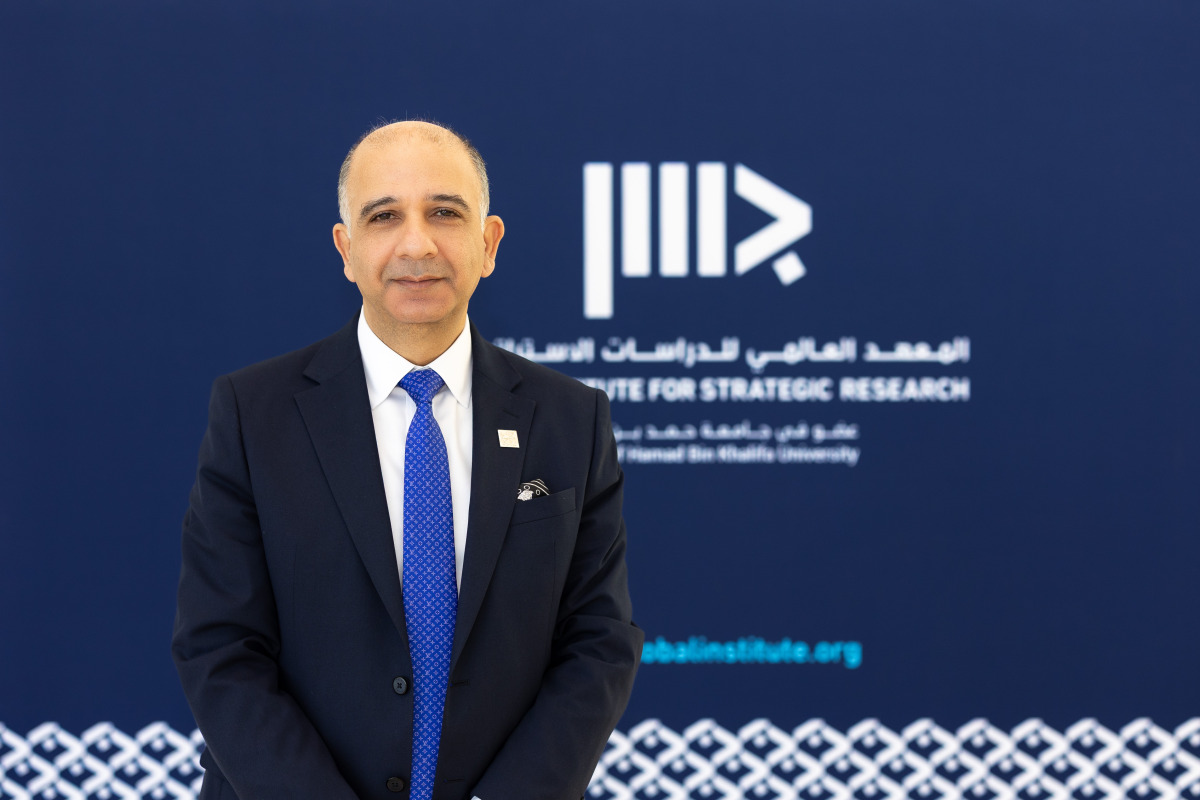
Executive Director of the Global Institute for Strategic Research (GISR) at Hamad Bin Khalifa University Dr. Mohamed Ali Chihi
Doha, Qatar: The regional security landscape is undergoing a fundamental transformation towards a multipolar system, with Gulf countries increasingly looking to strengthen self-reliance and expand cooperation with emerging international players, according to Executive Director of the Global Institute for Strategic Research (GISR) at Hamad Bin Khalifa University Dr. Mohamed Ali Chihi.
Speaking to The Peninsula on the sidelines of the Global Security Forum 2026, Chihi said the war involving the United States and Iran had transformed the region’s security framework, marking a shift away from an arrangement largely dependent on Washington.
“The American-Iranian war transformed the framework of the security in the region,” he said, adding that the attacks on Gulf countries had underscored the need for greater regional self-reliance.
While the United States is expected to remain a major security player, Chihi said its position would no longer be as dominant as before, with countries increasingly considering broader partnerships involving China, European nations and other regional powers.
He said the emerging framework would require stronger cooperation among Gulf states, rather than an all-or-nothing approach to security partnerships.
Chihi also pointed to Qatar’s potential role as a hub for a new defence system, including the development of military industries and greater cooperation in producing weapons and defence systems.
The evolving security landscape, he said, could involve a wider group of regional players beyond the Gulf Cooperation Council (GCC), including Türkiye and Pakistan, alongside Saudi Arabia, Qatar and the UAE.
He stressed that the success of such a framework would depend on information-sharing, a common understanding of security threats and sustained diplomatic engagement.
“It’s very important now to start negotiations, to start contacts and to think about one framework that can really avoid any new crisis here,” he said, emphasising that maintaining peace and stability in the region should be the central objective.
On Qatar’s international diplomatic role, Chihi described the country as a success story in mediation, saying its experience in handling complex conflicts positioned it to continue making a significant contribution to international peace efforts.
“Mediation is in the constitution of Qatar. Qatar will continue to play a major role in mediation in the world,” he said.
He added that Qatar’s ability to understand complicated political situations would support its future mediation efforts, although success would also depend on the willingness of conflicting parties to engage and seek a resolution.
Reflecting on this year’s Global Security Forum, Chihi said the event was particularly significant as it took place amid a major regional war and a period of heightened international uncertainty.
He said the conflict had implications extending beyond the region, affecting the global economy and military calculations, making discussions on possible solutions and the wider international situation increasingly important.
Chihi, whose institute held a panel on the emerging regional security framework, described the current international environment as a period of “global disorder” rather than the emergence of a clearly established new world order.
“The old order is really dying,” he said, arguing that the international community was yet to see a stable replacement capable of addressing the growing number of conflicts.
He warned that the present situation bore similarities to the period preceding the Second World War, when an established international order was weakening while a new one had yet to emerge.
For the region, he said, the priority should be to develop a security framework that prevents further escalation and provides a basis for peaceful relations among neighbouring countries.
Looking ahead, Chihi predicted that the world could face more crises over the next one to two years, citing ongoing conflicts and the absence of an effective international mechanism to resolve them.
Referring to conflicts in Sudan, parts of Africa and Asia, the Russia-Ukraine war, and the confrontation involving Iran, Israel and the United States, he said the international community was facing multiple challenges simultaneously.
He also expressed concern over the United Nations’ limited role in resolving current conflicts, warning that the combination of a weakening international order and rising geopolitical tensions could produce further instability.
Chihi said preventing additional conflicts would require sustained international engagement and, particularly in the Gulf, a cooperative regional security arrangement capable of addressing shared threats.