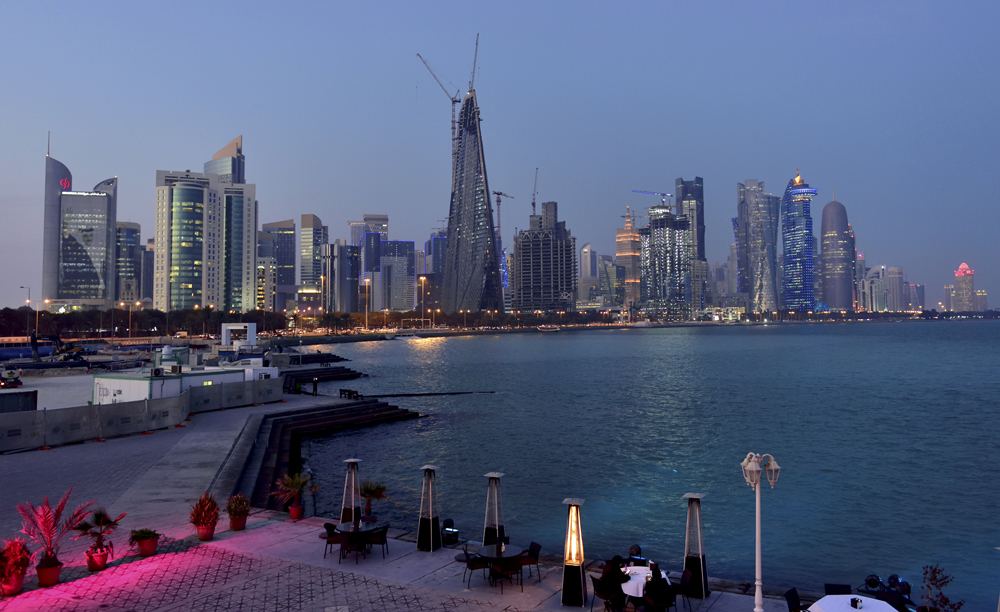
Photo by Abdul Basit © The Peninsula
Qatar’s economy will continue to expand steadily this year, and while an increase in COVID-19 infections and hospitalisations triggered tighter restrictions, these measures will only weigh on the short-term economic outlook, according to the latest Middle East Economic Update report for the first quarter of 2021, from Oxford Economics which was commissioned by the Institute of Chartered Accountants in England and Wales (ICAEW).
According to the report, Qatar’s non-oil sector, which grew by an average of 1.2 percent per annum in 2017 to 2019 and contracted by an estimated 3.9 percent in 2020, is expected to grow by 3.3 percent in 2021.
It added that an increase in vaccination rates and the expansion of vaccination centres distributing both the Pfizer and Moderna vaccines will facilitate the lifting of restrictions by the second half of 2021 and lead to a re-acceleration in economic growth. So far, about 15 percent of the Qatari population have received at least one vaccine dose, according to the country’s Ministry of Public Health.
Overall, the report forecasts GDP growth of 2.8 percent this year, after an estimated 3.1 percent fall in 2020. It also states that growth will continue to expand steadily because of ongoing investment ahead of World Cup 2022 and rising gas production.
The impact of the decline in non-oil GDP on jobs has been relatively modest. Qatar stands out for its dependence on the contribution of expats, who account for over 90 percent of the population. However, while the expat population declined by around 4.5 percent between March 2020 and January 2021, it is expected to gradually return as the economy recovers from the pandemic.
Although trade performance remains disappointing, vaccination progress globally will support external demand as the need for social distancing restrictions fades and borders re-open. This combined with the recent increase in natural gas prices should also support a recovery in export and budget receipts in the coming months.
Qatar has based its 2021 budget on a conservative assumption of a $40 per barrel (pb) oil price, slightly above the fiscal break-even point recently estimated by the IMF (about $38pb in 2021, the lowest in the GCC). This will lead to another year of deficit, with low oil and gas prices continuing to take a toll and government spending rising. However, spending restraint (particularly project spending) limited the deterioration in public finances in 2020, which will likely cap the budget deficit to around 4 percent of GDP.

Michael Armstrong (left), and Scott Livermore
Michael Armstrong, FCA and ICAEW Regional Director for Middle East, Africa and South Asia (Measa), said: “While the oil sector remains a drag on overall growth for the Qatar economy, preparation for the 2022 World Cup could play a huge role in an economic rebound. With COVID-19 vaccine drive underway, the Qatar government must continue to ramp up economic diversification efforts by developing sectors and industries that generate net value for economy and foster innovation, in line with Qatar National Vision 2030.”
Scott Livermore, ICAEW Economic Advisor and Chief Economist at Oxford Economics, said: “We are encouraged to see the important steps that the GCC and Egypt have taken in amending their ties with Qatar. Although the Qatari economy had adapted well to the economic consequences of the blockade, a rebound in visitor numbers from the rest of the GCC would stimulate the post-COVID recovery.
He added: “The political disjoint in the GCC has also weighed on foreign investment in the region. More harmony in the GCC would boost the region’s attractiveness to foreign investors as the global economy recovers. While the upside potential would be greatest for Qatar, the benefits could accrue in the rest of the region too.”