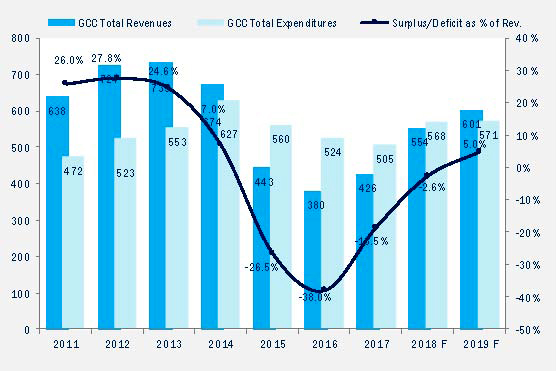
DOHA: Driven by a higher forecasted oil prices, the GCC region’s fiscal balance is expected to swing to surplus in 2019, to $30bn or 1.7 percent of GDP, as against earlier expectations of a surplus only in 2020.
Budget deficits for the region in 2018 are forecasted to reduce to $14bn or -0.9 percent of GDP reflecting 82 percent reduction from 2017 budget deficits of $79bn, a GCC economic update by KAMCO Research noted.
The KAMCO research note based on their analysis of IMF’s general government fiscal balance estimates said that the lower deficit is largely ascribed to higher oil prices expected for 2018 and over the medium term, and the ongoing revenue side initiatives and expense side optimisation undertaken by GCC governments.
Consensus of oil price forecasts and oil price futures point towards $70/barrel or higher, and this should aid GCC budgets in KAMCO analysts’ view. Based on IMF’s World Economic Outlook projections released in October, Qatar, Kuwait and UAE are expected to report budget surpluses in 2018 and 2019. Current account surpluses are also expected in the GCC over 2018 and 2019, and is expected to average over 7 percent of GDP over the period.
KAMCO Research sees better flexibility for fiscal and debt management for the region in 2019. The second quarter 2018 (Q2, 18) real GDP estimates of GCC countries point towards growth for the region in 2018, from both oil and non-oil sectors. The backdrop of higher oil prices will also aid the expansionary budgets for 2019.
“The announcement of pro-expansionary budgets coupled with higher prevailing oil prices are positive in our view and shows commitment towards diversification efforts and improving non-oil economic growth.
“However, going forward the nature of the OPEC+ agreement in 2019 and global trade developments will be significant for oil prices and its impact for the GCC region,” KAMCO analysts said.
Citing Qatar’s Ministry of Development Planning and Statistics (MDPS) data KAMCO Research said Qatar’s current account surplus grew in GDP terms from 6.4 percent of GDP in Q4 2017 to 7.3 percent of GDP in Q1, 18.
Qatar reported a fiscal surplus of QR1.04bn in Q1, 18 after posting fiscal deficit of QR35bn in 2017. The surplus came in Q1,18 came in as a result of 22.3 percent QoQ growth in revenues while expenditure went down by 4.8 percent over the same period.
Qatar’s first quarter 2018 fiscal surplus came in at 0.6 percent of GDP. Total credit facilities as of August 2018 cooled off from record high levels seen in Q1,18 (QR937.41bn) and declined by 1.2 percent over the period.
Public sector credit growth went down sequentially and declined by 5.4 percent from the start of the year until August18, while the Private sector grew by 1.2 percent over the period, as per data from the Central Bank of Qatar.