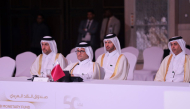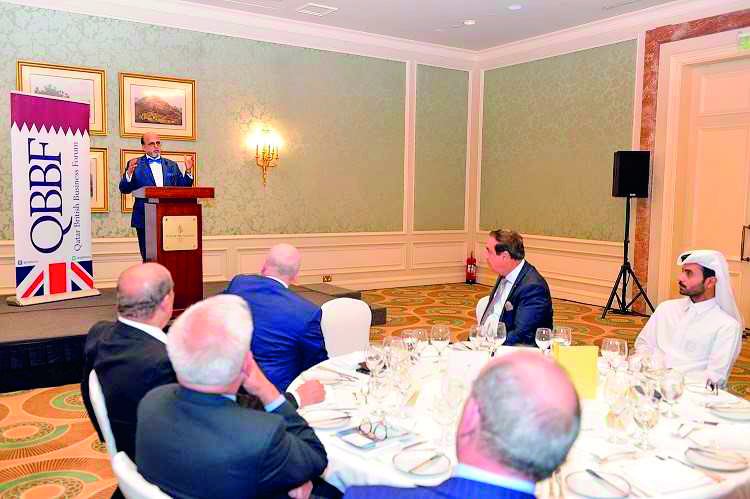
Dr. R Seetharaman, Chief Executive Officer of Doha Bank, speaking during a luncheon hosted by the Qatar British Business Forum, yesterday.
DOHA: Qatar’s resilient economy is capable of offering a bigger investment opportunity in bilateral terms, said Dr. R Seetharaman, Chief Executive Officer of Doha Bank. He was speaking on the “Impact of the blockade on the financial sector within Qatar, a year on”, during a luncheon hosted by the Qatar British Business Forum, yesterday.
The opening speech was delivered by Emad Turkman, Chairman of Qatar British Business Forum. The forum was attended by key dignitaries and professionals from top corporates in Qatar.
Dr Seetharaman noted IMF expects Qatar to report GDP growth of 2.6 percent and 2.7 percent in 2018 and 2019 respectively. Qatar’s banking system needs no further support from the central bank and sovereign wealth fund as the decline in non-resident liabilities of lenders have subsided, according to the International Monetary Fund (IMF). As per Moody’s, Qatar injected $38.5bn of its $340bn reserves into economy to cushion the impact on account of embargo. Qatar has made alternate arrangements for supplies, the Omani port was used for shipping supplies and Doha’s own port was also opened successfully.
The 2018 budget assumes the same conservative oil price of $45/barrel as used for the 2017 budget. Revenue is estimated to reach QR175.1bn, up by 2.9 percent, compared with 2017, mainly due to an expected increase in non-oil revenue. Spending is expected to total QR203.2bn ($55.8bn), up 2.4 percent from the budget plan for 2017, with the deficit declining 1.1 percent to QR28.1bn. The deficit will be financed through the issuance of debt.
On the UK economy Dr. Seetharaman said IMF revised UK economy to grow lower by 1.4 percent in 2018 and pick up to 1.5 percent in 2019. IMF also expects the UK to report Current account deficit of 3.8 percent and 3.4 percent in 2018 and 2019 respectively. The total bilateral trade between Qatar and UK amounted to £5bn in 2016. UK can be partner in Qatar’s FIFA 2022 World Cup projects, especially in stadium and cyber security. Qatar’s resilient model is a bigger opportunity in bilateral terms.