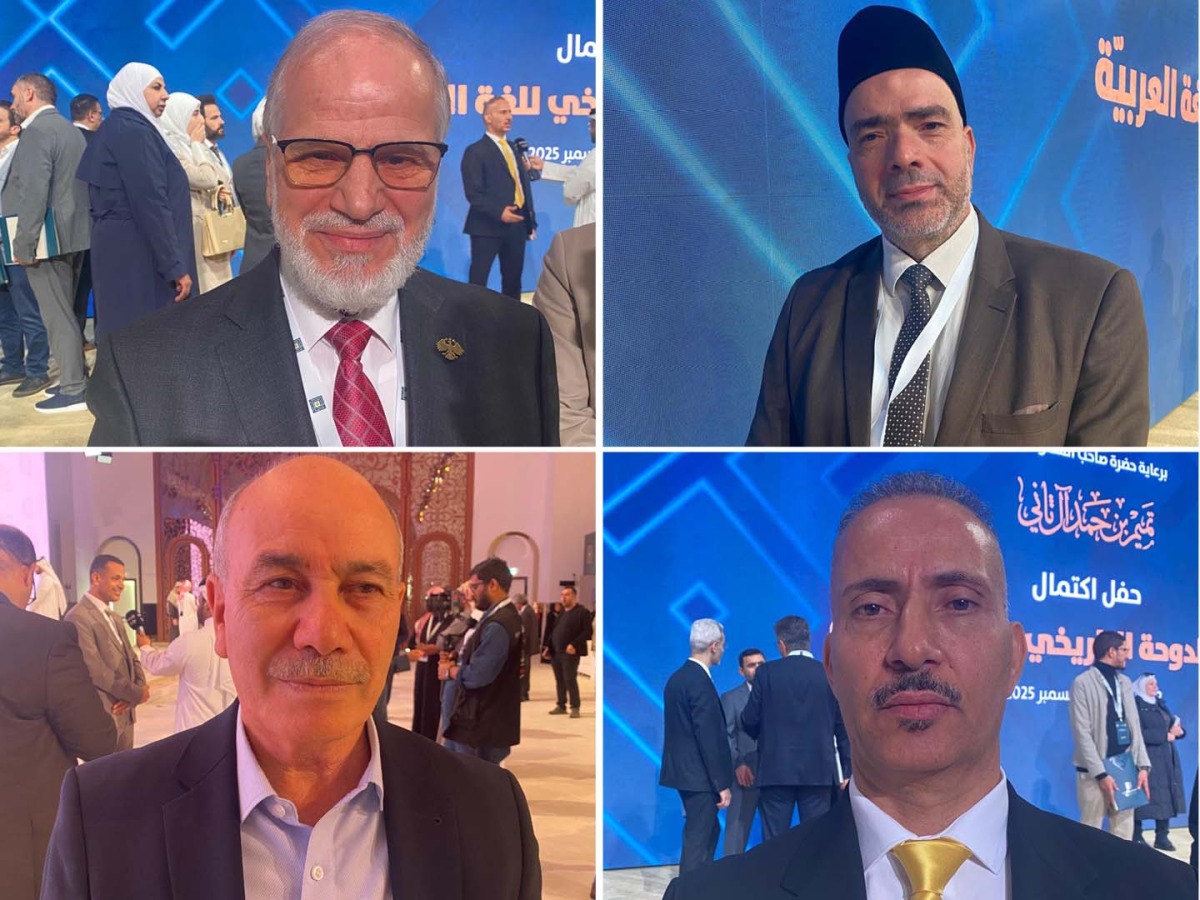
Clockwise from top left: Prof. Dr. Mohammad Hassan Al-Tayyan, Prof. Dr. Mostafa Mohamed Rizk Al-Sawahli, Dr. Moqbel Al-Ahmadi and Dr. Rashid Belhabib
Doha, Qatar: Scholars, researchers, and editors who contributed to the completion of the Doha Historical Dictionary of the Arabic Language have expressed deep appreciation to the State of Qatar for its generous and sustained support of the Arabic language, describing the project as a historic cultural achievement and an unprecedented milestone in Arabic lexicography.
Some of them spoke to The Peninsula at the completion ceremony for the Doha Historical Dictionary of the Arabic Language.
Prof. Dr. Mohammad Hassan Al-Tayyan, a member of the Scientific Council of the Doha Historical Dictionary and professor at the Kuwait International College of Law, said that the completion of the dictionary crowned a demanding scholarly journey that lasted 13 years.
He explained that he was involved from the early stages, participating in both the scientific council and the establishment of editorial teams in Kuwait, in addition to approving lexical entries after they passed through multiple stages of editing, review, correction, and verification.
Dr. Al-Tayyan emphasised that every nation that values its identity must possess a historical dictionary that traces the birth of words, their semantic development, and their usage across different historical contexts.
He noted that some Arabic words appear in hundreds of thousands of textual contexts—poetry, prose, and proverbial expressions, all of which are carefully examined to document new meanings and record them chronologically. He added that the dictionary’s billion-word corpus represents the largest linguistic resource in the history of Arabic and will significantly support artificial intelligence applications by providing reliable, structured linguistic data.
For his part, Prof. Dr. Mostafa Mohamed Rizk Al-Sawahli, Professor of Arabic Literature at the Faculty of Arabic Language, Al-Azhar University, said his involvement in the dictionary spanned a full decade, from 2015 until November 2025. During this period, he worked across all stages of lexicographic production, from preparation and editing to review, proofreading, leading editorial teams, and ultimately final approval.
Dr. Al-Sawahli described the Doha Historical Dictionary as a unique and unprecedented achievement, noting that Arabic previously lacked a complete historical dictionary in the true academic sense. He explained that the dictionary does not merely define words but identifies who used them, when they were used, the textual evidence supporting each meaning, and the degree of reliability of that evidence. This makes it an essential tool for understanding linguistic evolution, as words, like living beings, are born, grow, transform, and sometimes disappear.
He highlighted the dictionary’s exceptional comprehensiveness, stating that it covers Arabic roots and usages to a degree unmatched by earlier dictionaries, including classical works. He also praised its high level of accuracy and documentation, noting that many older sources suffer from textual corruption, misattribution, and linguistic distortions, challenges the Doha Dictionary has successfully addressed through rigorous verification from original sources.
Dr. Moqbel Al-Ahmadi, Editor-in-Chief of the Doha Historical Dictionary, explained that the dictionary reconstructs Arabic lexicography based on chronology.
Unlike traditional dictionaries that focus solely on meaning, the historical dictionary seeks the earliest recorded context for each meaning and traces its semantic development up to the present day. He noted that due to its vast size, approximately 300,000 lexical entries, the dictionary is available through an electronic platform, allowing for continuous review, correction, and expansion while ensuring access to the widest possible audience.
Dr. Rashid Belhabib, Head of the Scientific Committee of the Dictionary, said the project represents a valuable gift to the Arab nation, coinciding with the World Arabic Language Day.
He explained that the dictionary allows readers to explore the “biography” of every Arabic word, from its first recorded use to its contemporary meanings, including linguistic, terminological, scientific, and civilisational dimensions. He added that the dictionary opens the door to major scholarly projects, including the re-evaluation of Arabic dialects, demonstrating that many colloquial expressions long assumed to be non-standard are, in fact, deeply rooted in classical Arabic.