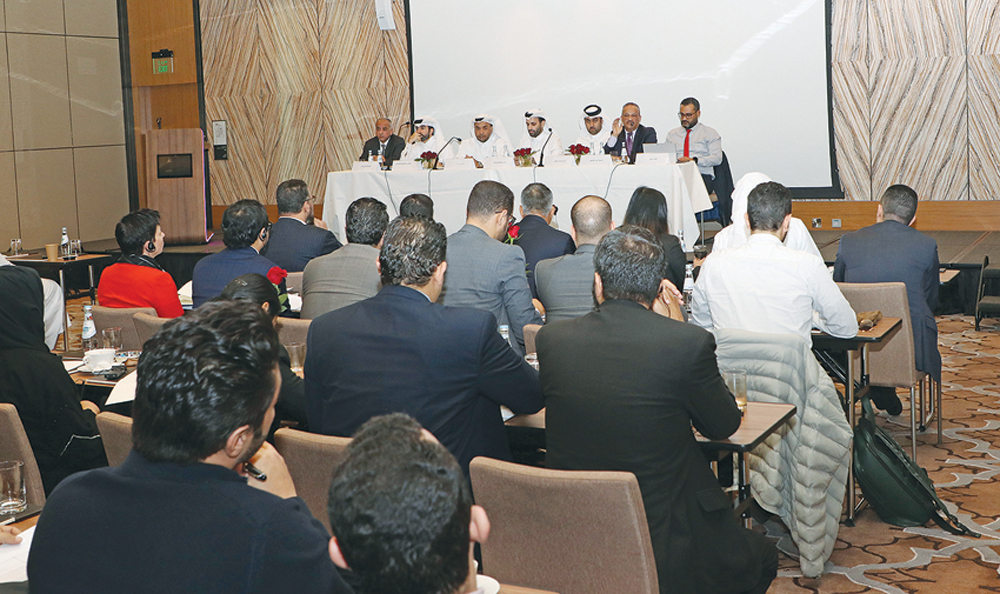
The GTA officials addressing the meeting.
The General Tax Authority (GTA) has held an introductory meeting on the income tax law and its executive regulations, attended by the owners and representatives of the accounting, auditing and financial consulting firms operating in the country.
The meeting included an introductory lecture on the most prominent axes of the income tax law, in addition to a general discussion session to answer companies’ questions and inquiries about the law, its implementation mechanisms, and its tax procedures in place in the authority, reports QNA.
Opening the introductory meeting, GTA Chairman Ahmed bin Issa Al Mohannadi, stressed the importance of continuous cooperation and coordination between the authority and its partners, whether they are assigned or accounting and financial auditing companies, pointing that continuous communication between all parties makes the authority better able to develop work mechanisms and reach them to the best possible level, in order to enhance its role in supporting the national economy, and encourages investment operations in the state.
Al Mohannadi expressed hope for the meeting to allow future communication and interaction between the authority and the accounting and auditing firms, and to give them an opportunity to raise their inquiries and questions related to the income tax law and its executive regulations, and other tax measures that the authority applies in cooperation with its partners in the public and private sectors. He pointed out that GTA also benefits from holding these meetings in knowing and measuring the level of satisfaction with the established tax procedures, and bringing the views that pave the way for advancing the tax work and developing its mechanisms in general.
For his part, Head of the GTA’s Legal Research and Studies Department, Talal Al Emadi, highlighted the most recent developments on the Income Tax Law promulgated by Law No. 24 of 2018 and its executive regulations issued pursuant to Cabinet Decision No. 39 of 2019.
In a visual presentation, he explained and clarified many of the provisions included in the law and its executive regulations, stressing that all the provisions of the law aim to support the country’s economy and interest, which guarantees the state a sustainable development that benefits all parties.
Focusing on what is included in the income tax law, Al Emadi stressed that the current law included several amendments to the previous law, those amendments focused on reforming administrative and procedural systems; supporting tax compliance by taxpayers; and giving more flexibility with regard to granting tax exemptions for the activities of institutions in the main economic sectors and economic zones in a manner that supports growth and economic diversification, which contributes to encouraging and attracting foreign investments.
He also indicated that the tax rate on companies operating in the country or the foreign partner’s share continued as before, at 10 percent of the taxable income during the tax year, adding that this is the least in the world, with some exceptions to the nature of some petrochemical industries related to the exploitation of natural resources.
Al Emadi noted that the law stipulates that the salaries and wages of individuals (citizens and residents) are not subject to any tax, granting exemptions for investments in listed stocks and their profits, interest and bank returns, and the agricultural and fishing sectors as well as air and sea navigation services are exempted on the condition of reciprocity.
He stressed the continued exemption of companies and entities wholly owned by Qatari citizens in accordance with the controls mentioned in the income tax law and the executive regulations, noting that new cases have been added to the groups exempt from the obligation to pay the tax.
The law does not impose a tax on the profits of shares and other incomes arising from it; the benefits and returns of public debt securities and Islamic securities issued in accordance with the provisions of the State’s financial system law and bonds of public bodies and institutions, Al Emadi said adding that total income from craft activities that do not use machines is also tax-exempt.