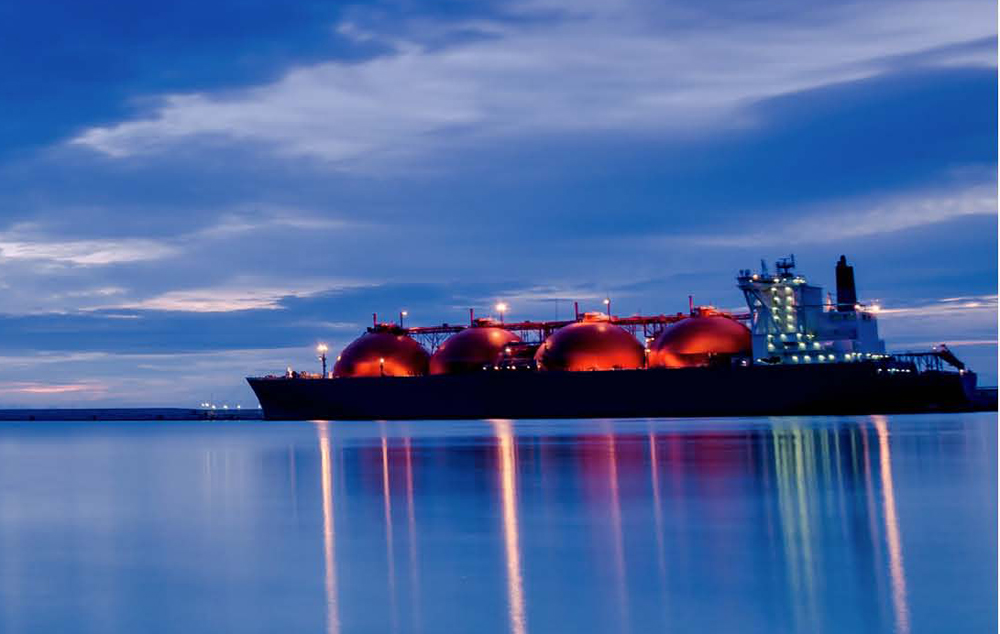
Qatar and Australia, which are currently the leading exporters of liquefied natural gas (LNG) in the world, will continue to be the dominant players in meeting the growing demand for cleaner fuel, said an industry expert.
Demand of natural gas, especially the LNG, will continue to witness solid growth over the next few decades for being a transition fuel. And Qatar, which currently produces about 77 million tonnes per annum (MTA) of LNG is investing heavily to expand its output to 126 MTA by 2027.
The growth in demand for natural gas will be driven by population growth, steady rise in per capita energy consumption, especially in emerging countries, and to replacing coal as a result of growing environmental concerns.
“Qatar and Australia are dominant suppliers of LNG to the world, which are expected to maintain their positions in the future. And then there are new entrants in the suppliers block like the US which (as a result of shale gas revolution) will also become an important provider of natural gas to the world”, Chris Palsson, Head of Consulting and Managing Director, Maritime Insight, Lloyd’s List Intelligence, said in his address at the recently concluded Qatar Maritime and Logistic Summit.
Palsson added: “Much of the growth in LNG production in will go to India, South Korea and Japan and some countries in Europe and South Asia. Australia is almost depending entirely on the Chinese market, while the US looking at the European market, and also trying to tap the Chinese and Indian markets, which will depend on the geopolitical situation.”
The natural gas, being the cleanest form of fossil fuels, has a promising future. Today, the share of natural gas in the global energy mix stands at about 22 percent. By 2050, this is expected to rise to 27 percent, according to the Doha-based Gas Exporting Countries Forum (GECF).
Commenting further on LNG demand growth, Palsson said that Japan and South Korea are some of the major LNG consumers, but most of the demand growth will come from the emerging markets (EMs), such as China and India and East African countries. In addition, there are some countries in Europe where LNG demand growth is picking up.
According to findings of the recently launched Global Gas Outlook 2050 by GECF, the global natural gas demand is expected to increase by about 52 percent from 3,924 billion cubic metres (bcm) in 2018 to 5,966 bcm by 2050, with 1.3 percent CAAGR (compounded average annual growth rate) over the period. Palsson, speaking on global trade trends (2020-30) in their impact on maritime and logistics sector, also said that demand for gas will continue to grow at least for a few decades as renewables alone cannot bridge the gap (created by the phasing out of coal and nuclear power plants) despite their incredible growth. So the marine transport for energy-related commodities will continue to dominate.
“Today, around 78 percent of the global trade is carried by sea (measures in metric tonnes), which is pretty big. And out of that dry bulk and liquid bulk such as LNG and LPG dominate completely. And interestingly around 45 percent of everything carried at sea relates to energy,” noted Palsson.
He also noted that as a result of rising demand for LNG, number of cost-effective and energy-efficient ships will join the existing fleet (of over 500 LNG vessels), which will positively impact the maritime and logistics sector.
Providing an overview of the global energy outlook, he said that today the share of fossil fuels (oil, coal and gas) in the total energy mix is around 83 percent which is expected to come down at 76 percent by 2030.
But the global demand for natural gas will continue to grow, and the demand for coal will remain flat or start fading when the demand for energy consumption will peak by 2030.
Palsson also pointed out that the significant growth in the number of electric vehicles will cause a fall in demand for oil, but it will create more demand for electricity, thus natural gas will be the main uptake of this as wind and solar energy will not be able to fill the gap alone.
He also provided an overview on per capita energy consumption, which significantly varies from country to country.
The trend in per capita energy consumption in the US and Europe is in decline in the recent past few years. But in the coming years there is going to be big surge in demand for electricity from different parts of the world, especially from developing countries.
The world average per capita energy consumption currently stands at 76 gigajoules, but across the board, the range varies significantly between European, Asian and African countries. For instance, the per capita energy consumption in Norway is 371 gigajoules, the US (295), Germany (165) and China (97), but in India (25) and eastern Africa (5) is very low, which show the potential demand growth for electricity in the low energy-consuming countries, especially in the Indian- subcontinent and East African countries, whose population is expected to surge by almost 33 percent over the next 10 years.
“Let’s assume that the energy consumption (per capita) remains unchanged up to 2030, the energy consumption will grow with population alone at 11 percent. And China, India and East Africa will contribute to the growth.
But even a small 5 gigajoules increase in per capita energy consumption in these countries will lift the energy demand growth by up to 30 percent,” noted Palsson.