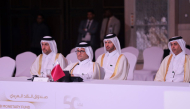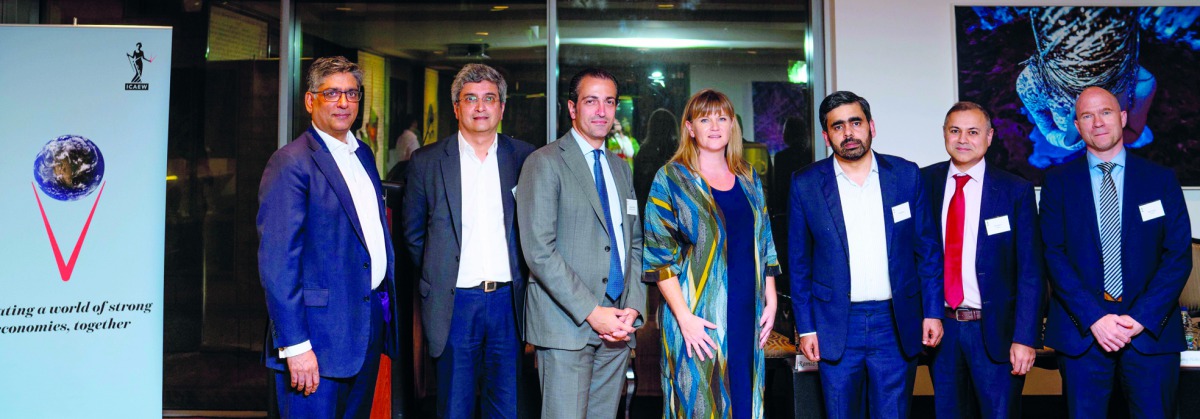
ICAEW members and panelists pose for a group picture.
The GCC economic landscape is expected to continue its recovery over the next 12-18 months as a result of fiscal reforms, new economic visions and rising oil prices.
This was the consensus during accountancy and finance body ICAEW’s Corporate Finance Faculty roundtable on how the region’s economic landscape, deal pipeline and investor appetite will look like in 2019.
ICAEW members and guests gathered in a neighbouring country on November 12, 2018 to discuss the Middle East economic landscape for next year.
Panelists included Kapil Chadda, Vice-Chairman Global Banking, MENAT, HSBC; Anthony Hobeika, CEO, MENA Research Partners; Simi Nehra, Head of Mergers and Acquisitions UAE, KPMG; Anil Menon, Mergers and Acquisitions Leader and Retail Consumer Products Leader, EY; and Ramiz Hasan, Co-Founder and COO, Samena Capital.
Following an introduction by Sam Surrey, Partner at Deloitte Middle East and Chairman of ICAEW Corporate Finance Faculty (CFF) in the Middle East, panellists and invited guests discussed how the GCC economic landscape is evolving and what the effect will be on deal pipeline and investor appetite.
Speakers agreed that the GCC market is currently experiencing a shift from an austerity period to an early stage recovery. All the much-needed austerity measures and economic visions set by GCC governments are now leading the recovery of their respective economies.
Speakers agreed that consumers are the new oil. GCC governments are no longer relying on oil as the primary driving force of the economy, but rather as a means of sustainable long-term economic growth.
Panellists explained that the region’s economic growth is significantly affected by what’s happening in the oil industry and by geopolitical tensions.
Speakers applauded the governments’ efforts and asked for the execution of the reforms to be accelerated, especially at a time in which oil prices are increasing.
“GCC governments were very progressive and quick in implementing the needed economic reforms. A tremendous job has been done in a short term. However, the most important period is now, as oil prices are rising. It’s very important for GCC governments not to be complacent but to maintain the path of fiscal reforms and fiscal adjustment that they have started in order to achieve sustainable economic growth,” said Michael Armstrong, FCA and ICAEW Regional Director for the Middle East, Africa and South Asia (Measa).
In terms of Mergers and Acquisitions (M&A) deals, speakers explained that the region’s Private Equity (PE) industry is fairly new and young but this doesn’t mean PE firms should ignore corporate governance nor transparency. Both are fundamental elements to attract foreign investors and build trust in the region’s PE industry.
Panelists also agreed that the GCC is a niche market for foreign investors. Attracting more foreign investors would require higher geopolitical stability and reduction in the cost of doing business. As risks are high at the moment, foreign investors are reluctant to invest in the GCC region.
Speakers explained that raising money in the region is taking a lot of time as local investors are looking outwards to more developed markets. The top markets for investors are the United States, Europe, China and India. The event was attended by more than 80 ICAEW members and senior business representatives from the major global and regional financial organisations.