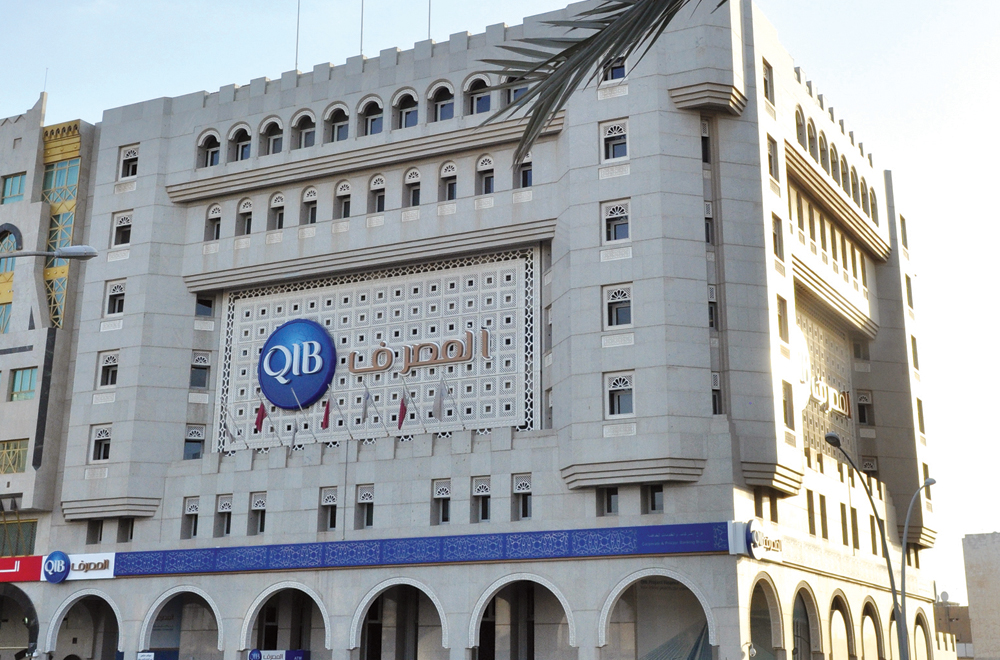
The QIB head office in Doha.
Qatar Islamic Bank (QIB), rated A1/A-/A (all stable) by Moody’s/Standard & Poor’s/Fitch, successfully closed a $750m 5-year Sukuk with a profit rate of 1.95 percent per annum, which is equivalent to a credit spread of 155bps over the 5-year Mid Swap Rate.
The transaction was executed under QIB’s $4bn Trust Certificate Issuance Programme which listed on Euronext Dublin. The profit rate achieved is the lowest ever paid by QIB on their fixed rate Sukuk issuances. This is QIB’s second public issuance in 2020, having issued the first ever Formosa Sukuk earlier this year.
The success of this transaction came on the back of a two-day marketing strategy aimed at updating international and regional investors with QIB’s strategy and financial performance. The management team held a global investor call and multiple one-on-one calls with institutional investors from Asia and Europe prior to placing the Sukuk. Investors took comfort from the bank’s strong credit fundamentals and sound business strategy.
Bassel Gamal, the Chief Executive Officer of the bank, commented “QIB is very pleased with the success of this transaction, which highlights the confidence placed by investors in Qatar, the Bank’s board, management team and its strategic direction. We are proud to have access to a diverse and international investor base, which allows us to implement our funding strategy in a timely and cost efficient manner. The capital markets continue to remain important for us and we appreciate investors’ confidence in our name.”
Investor demand was strong and the orderbook reached $2.2bn (representing 2.9 times oversubscription) from approximately 100 investors. In terms of investor categorization, 40 percent were banks, 31 percent were asset managers, 8 percent were private banks, and 21 percent were sovereign. More importantly, the investor base was diversified geographically, with 44 percent of the Sukuk being allocated to the Middle East, 24 percent to Asia, 17 percent to Europe and 15 percent to other countries
QInvest and Standard Chartered Bank acted as Joint Global Coordinators on the transaction. Citi, Credit Agricole, Dukhan Bank, HSBC, QInvest, QNB Capital and Standard Chartered Bank acted as Joint lead Managers and Joint Bookrunners with Warba Bank as the Co – Manager.