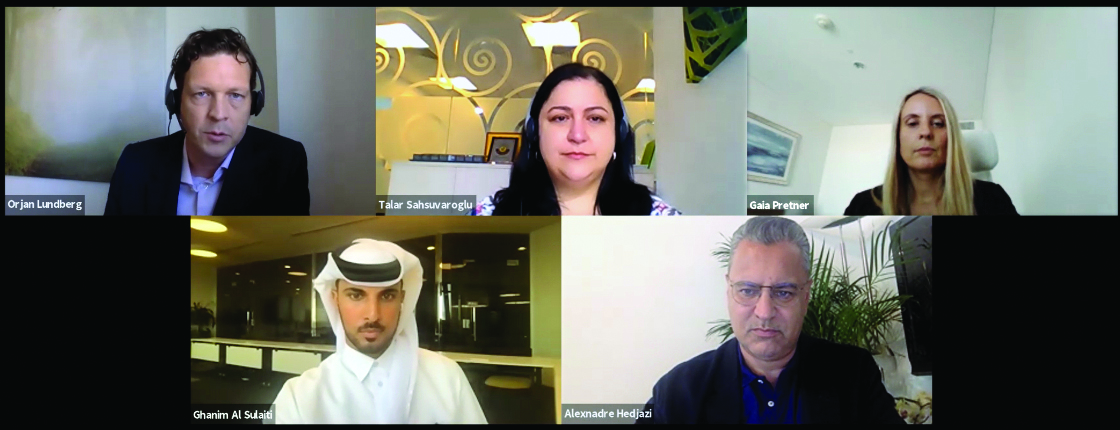
Experts participating in the webinar.
Doha: Josoor Institute, the training and education arm of the Supreme Committee for Delivery & Legacy (SC), recently held a new webinar focused on the circular economy – an economic approach aimed at minimising waste.
Moderated by Orjan Lundberg, Sustainability & Environmental Expert at the SC, speakers discussed different strategies and best practices in implementing sustainable practices in relation to supply chain and waste management in the planning of large events held in urban settings.
Alexandre Hedjazi, Director of the Global Environmental Policy Programme at the University of Geneva, emphasised the role urgency plays in encouraging event planners to unlock innovative solutions. He discussed initiatives that addressed challenges related to providing sustainable critical infrastructures during a large event while ensuring their long-term legacy afterwards.
“Stakeholders need to work together to identify co-benefits that respond to multiple and simultaneous needs and urgencies within an urban setting. Only then, can organisers of large events unlock the social, environmental and economic capital of the ecosystem where the event is taking place and ensure the long-term and sustainable legacy of the event,” said Hedjazi.
Prior to joining the Qatar 2022 project, Gaia Pretner, Sustainable Procurement Manager at FWC Qatar 2022 LLC, was a full time consultant for the sustainability function of EXPO Milan 2015, the universal exposition that attracted more than 20 million visitors in six months with the participation of nearly 140 countries and investment worth more than €3bn.
Pretner shared how circularity was a key part of EXPO Milan 2015. This included the building phase, which saw the conversion of a former industrial area in the city into the main exposition site.
“Sustainable procurement is also a key objective of FWC Sustainability Strategy since it can both contribute to lower the environmental impact of the tournament and encourage the birth and development of new sustainable businesses in the region as a positive legacy” said Gaia about Qatar 2022’s commitment to ensuring that circular economy principles are deployed through the organisation of the event.
Dr. Talar Sahsuvaroglu, SC Sustainability & Environmental Expert, has witnessed Qatar’s growth first-hand. In particular, she has seen the way tournament-related infrastructure has completely revolutionised the way people live in, move around and enjoy the country. For her, one tournament venue, Ras Abu Aboud Stadium, embodies the commitment to sustainability that has been at the forefront of all Qatar 2022 related projects.
An example of a young entrepreneur that has implemented circular economy thinking in his practice is Ghanim Al Sulaiti, who is behind several successful eco-friendly businesses promoting wellbeing through sustainable food and skincare products. “The most difficult part of implementing circular economy to my business was building a green supply chain in a local market that is traditionally very cost sensitive. Raising people’s awareness about the benefits of sustainable economic practices will always be the first and most important step in creating a circular economy, and the World Cup’s commitment to that,” said Al Sulaiti.