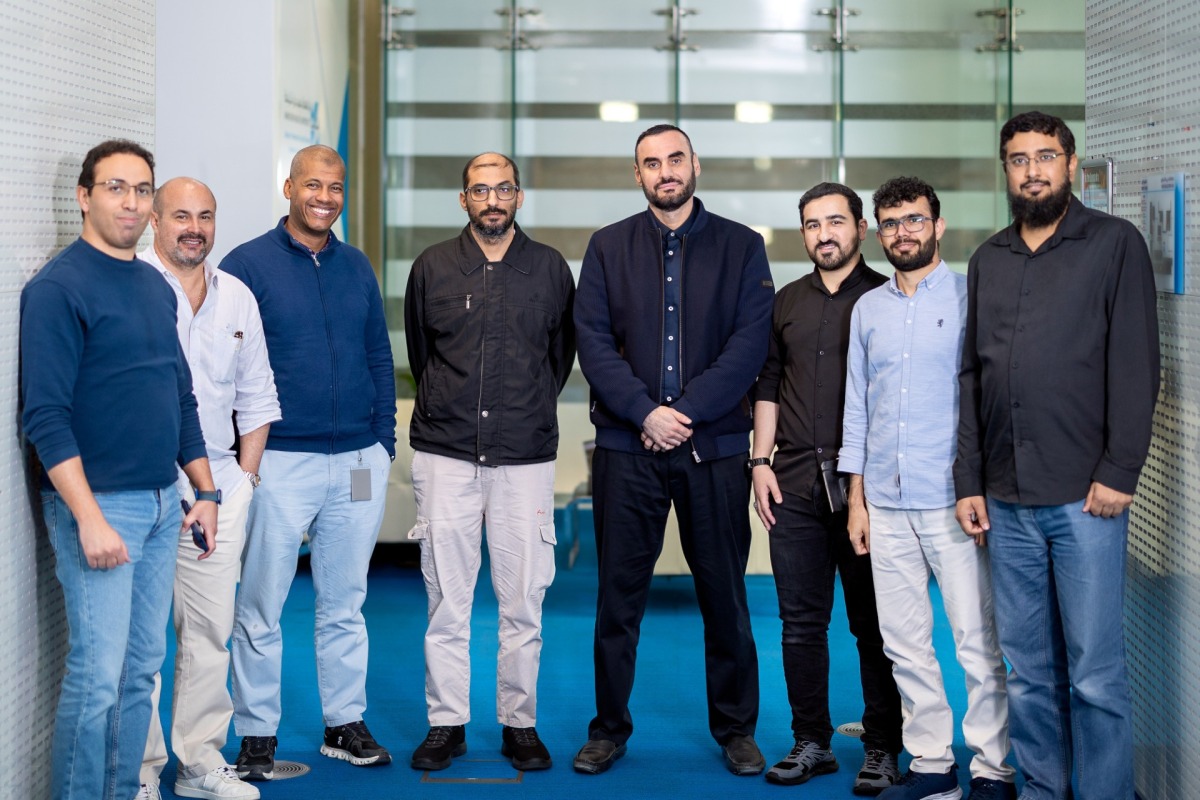
The HIKMA project team.
Doha, Qatar: Hamad Bin Khalifa University (HBKU) has unveiled the Human-Inspired Knowledge by Machine Agents (HIKMA) Project, an initiative that uses artificial intelligence (AI) to generate, review, revise and present scientific papers under ethical human supervision. The project aims to redefine how knowledge is created and shared, positioning Qatar as a pioneer in AI-assisted scholarship.
HIKMA integrates every stage of academic research, from topic generation and automated writing to AI-based review and revision in a single continuous pipeline.
At the centre of the project is HikmaXiv, an open-access digital repository that will serve as the world’s largest archive for AI-generated and human-reviewed research papers. The system is designed to store manuscripts and their underlying datasets, AI-generated revisions, peer-review notes and presentation materials. It creates a transparent record of how machines and humans collaborate in science.
“This is not about replacing scholars, it’s about amplifying them,” said Dr. Mowafa Househ, the project’s supervisor at HBKU’s College of Science and Engineering (CSE). “HIKMA represents the first global experiment where human inspiration and AI work together from the birth of an idea to its public presentation.”
HIKMA’s emergence comes as universities and research labs around the world experiment with AI-driven scientific discovery. Stanford University’s “Agents for Science” conference has shown how autonomous agents can suggest experiments, review and accept AI-co-authoured papers. Sakana AI’s “AI Scientist” focuses on modular paper generation, and the recently published “Robin” system demonstrated how an AI could identify new drug targets in biomedical studies.
Unlike other systems that primarily focus on modular paper generation or specific tasks within the research process, HIKMA integrates a comprehensive set of tools designed to facilitate an end-to-end research experience.
“Others automate a single step, we connect them all,” explained the CSE’s and HIKMA’s lead AI engineer Dr. Zain Tariq. “Our system produces a full academic workflow, from first draft to conference presentation, with human reviewers guiding quality and ethics at every stage.”
The project also plans to support multilingual research, including Arabic-language science, ensuring that global AI innovation does not overlook regional and cultural contexts.