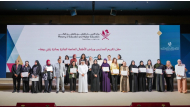
Doha, Qatar: The Fourth National Human Rights Forum concluded yesterday with a comprehensive set of recommendations aimed at strengthening national efforts to combat drugs through a human rights–based approach.
The forum was organised by the National Human Rights Committee (NHRC), in partnership with the Ministry of Interior, under the theme “Human Rights at the Heart of Combating Drugs: Challenges and Prospects for Sustainable Solutions.”
Among its most prominent recommendations was the call to establish a national fund to support and empower drug victims, to expand aftercare services, providing continuous psychological support, promoting economic empowerment for recovering individuals, and protecting them from stigma and discrimination.
The proposed fund would help ensure the full reintegration of recovering individuals into society, including facilitating their access to employment and the labour market.
Chairperson of the National Human Rights Committee H E Maryam bint Abdullah Al Attiyah affirmed that the Fourth National Human Rights Forum laid a practical foundation for a new phase focused on moving from recommendations to implementation and from vision to tangible impact.
She explained that the forum’s outcomes represent an integrated national framework for combating drugs from a human rights perspective, one that balances firmness in enforcement with humanity in treatment, strengthens prevention, consolidates rehabilitation and social reintegration, and preserves human dignity across all policies and measures.
She also highlighted the forum’s recommendation to launch a permanent national platform, in partnership with the National Committee for Combating Drugs, bringing together representatives from government entities, international organisations, civil society institutions, experts, and youth.
This platform would serve as an institutional mechanism to monitor the implementation of recommendations and ensure the sustainability of their impact, emphasising that the success of any national drug policy depends on embedding human rights at its core and fostering effective partnerships in implementation and follow-up.
During the closing session, Secretary-General of the National Human Rights Committee H E Sultan bin Hassan Al Jamali delivered the final communiqué, noting that forum participants highly appreciated the efforts of Qatar in combating drugs and in advancing approaches centred on rehabilitation and social reintegration.
He explained that discussions and deliberations throughout the forum resulted in several key recommendations, including the continuous development of legislation and public policies related to combating drugs and psychotropic substances to ensure their flexibility and responsiveness to emerging forms of transnational drug crimes.
Participants also recommended developing a national indicator for combating drugs based on a human rights approach, as well as adopting a national data governance framework to ensure effective data sharing among relevant authorities.
Al Jamali noted that the recommendations emphasised adopting innovative methods for rehabilitation and social reintegration, treating users and addicts as victims, and governing health policies and programmes to ensure sustainable recovery.
Participants also called for entrenching human rights principles across prevention, enforcement, rehabilitation, and social reintegration measures, and urged the National Human Rights Committee to develop a national guiding principles code to ensure respect for human rights in the context of combating drugs. The communiqué further highlighted the importance of implementing continuous awareness campaigns, training courses, workshops, and art exhibitions in partnership between the NHRC, the Ministry of Interior, and other competent authorities.
The recommendations also called for adopting innovative financial policies to enhance transparency and accountability and redirecting resources generated from related penalties toward prevention, treatment, and reintegration programmes.
Al Jamali added that participants urged activating corporate social responsibility within the private sector by supporting and funding vocational rehabilitation projects for recovering individuals and encouraging companies to provide employment opportunities for them as a means of preventing relapse and achieving economic independence.
The recommendations further underscore the importance of developing educational curricula and activities that incorporate life skills promoting resilience and rejection of drug use, empowering educational institutions with tools for early detection of substance use indicators and addressing such cases through educational and rights-based approaches. They also emphasised enhancing digital safety mechanisms to counter drug targeting and promotion in online spaces.