Doha: Qatar’s second gas boom is about to get underway and any possible economic impact of COVID-19 will not change the long-term outlook for the gas boom.
The current crisis may even work to Qatar’s advantage as potential competitors, particularly in the US, delay or cancel major LNG investments, PwC noted yesterday. PwC said in its ‘Qatar Economy Watch 2020’ that the announcement by Qatar Petroleum that new appraisals had extended estimates of both the geographic scope and volume of North Field came as a surprise to the global energy market.
The field, which was previously thought to be only offshore, has been found to extend at least 10 miles onshore and the reserves had been increased to 1,760tcf of gas and 70bn barrels of condensates (oil mixed in with the gas).
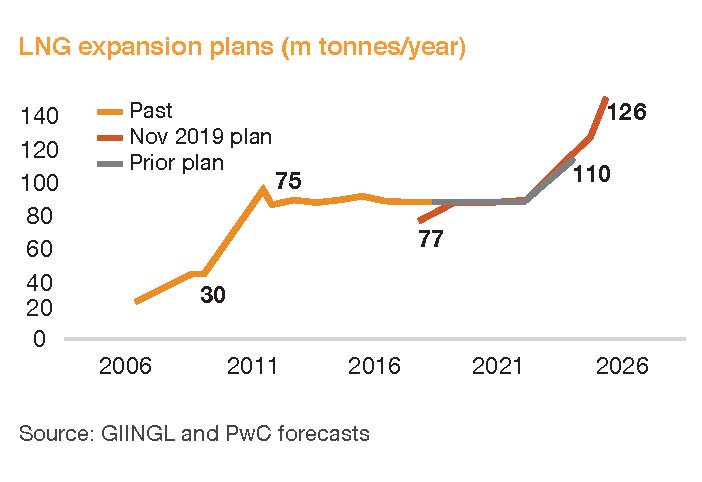
This is a doubling of gas reserves and more than a tripling in oil, compared with Qatar’s most recently published estimates. On the basis of the larger reserves, QP upsized its plans for the North Field Expansion project by 50 percent, to 6 new LNG trains which will add 49m tonnes/year of capacity, about a 64 percent increase on the currently rated capacity of 77m t/yr.
This is the fourth time the project has been upsized since the 12-year moratorium on new projects was lifted in 2017.
The previous LNG expansion phase in 2007-11 provided significant opportunities for firms across many sectors involved directly in the project implementation or indirectly providing services.
Once in place, the boost to Qatar’s fiscal revenue provided wider spillover benefits to the non-oil economy through government spending. Similar impacts are expected in the new expansion phase, which is of a similar magnitude.
Even at current production levels, analysis from the IMF and ratings agencies give Qatar the lowest breakeven oil price in the region and the Minister of Finance H E Ali Sharif Al Emadi has said the breakeven price should fall further to under $40 after 2022, even before the new LNG capacity comes online.
The revenue from the LNG expansion therefore provides clear visibility for Qatar’s longterm finances that enables local firms to develop their postCOVID-19 business plans with minimal risks related to potential changes in tax or spending policy, unlike in other Gulf states where significant changes are required to balance budgets.
The PwC report noted that although Qatar has seen a sharp contraction in economic activity in recent months, as have most states in the region and globally, government policies have mitigated the impact on firms and employees and a phased easing of restrictions has been implemented since June 2020.
It outlined four main pillars crucial for an economy to become a resilient knowledgebased one-Localised skills and human capital; Intelligent and secured information infrastructure; forward-looking policies and regulations and clustered innovation system. ‘Knowledge-based economy’ is key to understanding several important trends in Qatar’s ongoing development and the motivations behind them.
This will become increasingly important in the coming decades as the Fourth Industrial Revolution builds up pace and knowledge-based technologies, such as artificial intelligence, transform the economy. In order to assess where Qatar stands in terms of developing a knowledge-based economy, a conceptual framework is needed to understand what this requires.
Bassam Hajhamad, PwC Qatar Country Senior Partner, said: “Qatar’s economy is being impacted by a dual shock with the decline of the economic activity due to COVID-19 pandemic across various sectors and the immense shock of lower energy prices. When it comes to the impact of the oil market, Qatar is better situated than other hydrocarbon exporters - thanks to its natural gas reserves - and should be better positioned to weather these shocks. The current environment presents both opportunities and challenges to Qatar. It accelerates existing moves on national digitisation and localisation, as part of developing a more resilient knowledge-based economy. This knowledge-based economy addresses Qatar’s aspirations to be one of the nations leading with “Digital Innovation” to create high-quality and meaningful jobs for its local citizens and residents.”