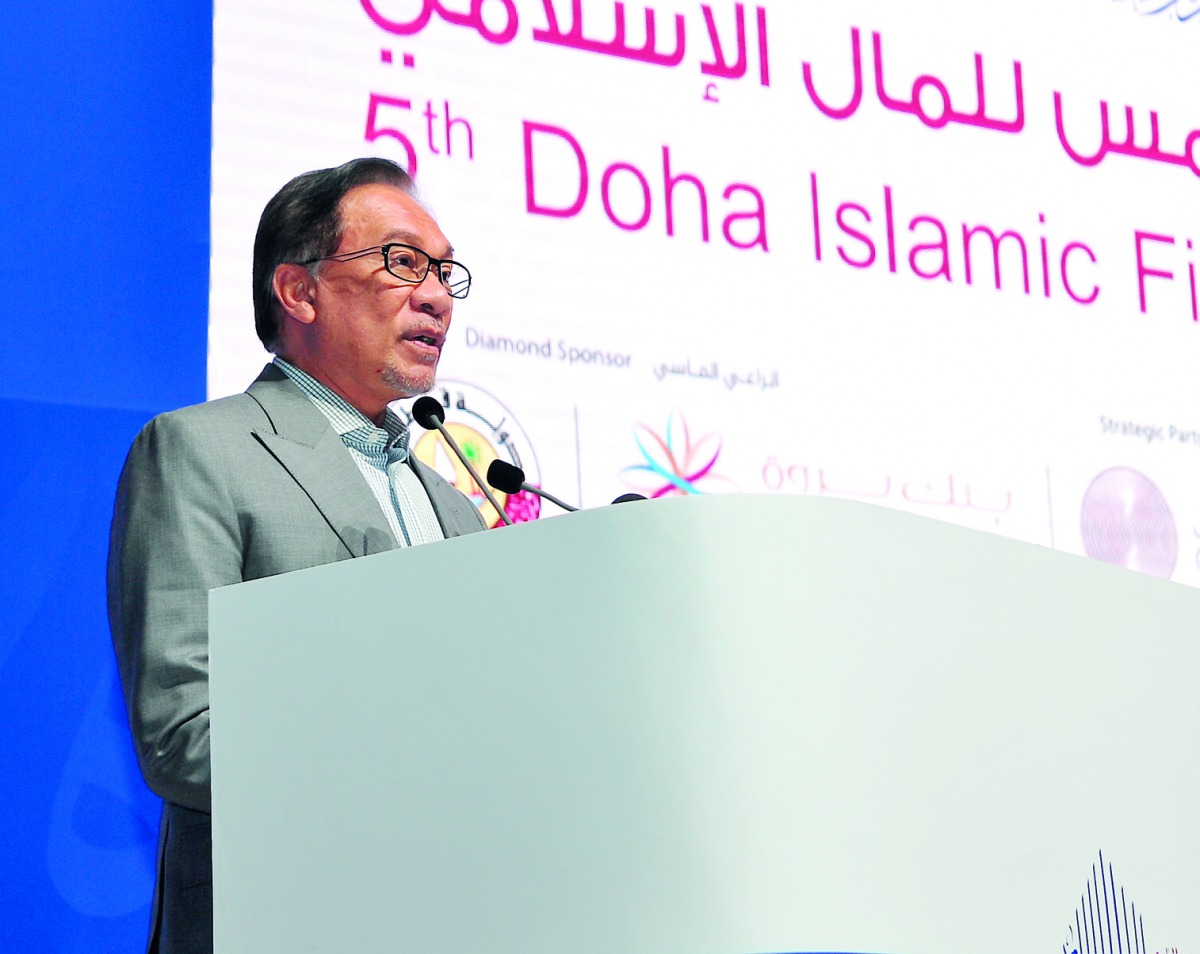
Islamic finance can play big role in confronting social and economic challenges such as growing inequality, poverty reduction, and the empowerment of marginalised people in the world, said Anwar Ibrahim (pictured), the former Deputy Prime Minister and Finance Minister of Malaysia, in his keynote address at the 5th edition of Doha Islamic Finance Conference, yesterday.
Ibrahim, the de facto co-leader with Prime Minister Mahathir Mohamad in the Government of Malaysia, provided a comprehensive outlook highlighting the opportunities of Shariah-compliant banking and financial industry.
During his address he also highlighted the fourth industrial revolution and the rise of intelligent computing systems (such as technologies based-on algorithm, AI and blockchain) which will bring about remarkable and unprecedented changes in all facets of life.
“In 2009 the combined wealth of the richest 380 people equaled the wealth of the bottom 50 percent of humanity. By 2017 just 42 billionaires commanded as much wealth as the poorest half of the world’s people,” said Ibrahim.
Commenting about the growing economic inequality and concentration of wealth among fewer hands, he added: “A British House of Commons report recently predicted that by 2030 the richest one percent would own two thirds of global wealth.
“Personal debt is again on the rise and the net household wealth of most households is falling. Food banks increasing hunger and child poverty are now openly part of the normal fabric of the richest western nations.”
He said that the rise in inequality shares some portion of the blame in understanding the rise of populism and extreme nationalism. “There is a dotted line link from this to violence and war.”
He congratulated the organisers of the Conference which will help explore the ways to deepen the understanding of the intersection of Islamic finance with the “zeitgeist of our times” or the spirit of the age.
He noted that Internet and technology is seen to be a great equalizer – leveling the playing field between corporations and customers, enterprises and startups, citizens and governments, but cautioned against embracing everything that is new, without fully appreciating the clear and present dangers embedded in the digital economy as it has been created.
He cited the examples of ‘surveillance capitalism” and 2016 American election and other elections that were allegedly compromised through the use of social media platforms once considered almost universally good and beneficial.
“The meteoric rise of technology companies and their fantastic increase in market capitalization has been met with an almost equally fantastic drop in popularity. As the veil is lifted on business models built on poor stewardship of personal data, major technology companies find themselves the target of people’s hatred and ire instead of love and adulation.
“Oh what a difference a year or two makes.So we need to look at technology with a critical eye. Lines of code are not value neutral,” said Ibrahim who was removed from his post and eventually jailed for charges that he denied and the prosecution which was widely criticised by human rights groups and several foreign governments, including the US, UK and Australia.
He said: “Islamic finance industry is venturing into this wild-west world of technology. How do we navigate the landscape and avoid the traps that have already been laid bare before us? First – we must never become complacent in asking ourselves what are the problems that we are trying to solve?
“Here I am not referring to the technical aspects of sharia compliant loans and bonds and transactions, though certainly we must continue to forge ahead in developing products that are relevant and profitable. I am concerned about a more fundamental set of problems we face as humanity.”
He also noted that across the majority Muslim world there are signs of hope and distress. Millions are emerging from poverty to form a vibrant middle class of merchants and entrepreneurs.
Millions still are displaced in their own countries or have been scattered around the world as refugees. Muslim communities seek security and stability. Families yearn for good education for their children and healthcare which is adequate given the advances in technology and medicine in the modern era.
He also said that Islamic institutions that deal with access to capital, economic empowerment and innovation and yet there are no distinctive policies, no empirically grounded programmes that we can turn to or recommend as Islamic solutions for the alleviation of poverty, eradication of hunger, access to quality education, support of families and building of sustainable communities.
“We see in nation after nation that inequality is increasing but we have nothing more to offer than lip service to the general idea of distributive justice. These are the defining issues of our times and our way of thinking grounded in enduring moral precepts has nothing practical and pragmatic to offer to decision makers,” he added.
He said that the Islamic finance industry, which has grown by leaps and bounds in the past few years and established itself as a credible player in the global financial system, can play a role in confronting the challenge of inequality, inclusion, and poverty reduction.
“Out of 1.6 billion Muslims in the world an estimated 14 percent use banks. Many are unable or unwilling to engage with conventional interest-based financial institutions due to religious convictions, educational difficulties or geographical problems. Islamic finance can, and must, overcome these issues if it is to reach its transformative potential. There is massive potential to provide financial education and basic services to the unbanked and underbanked”, he added.
“Innovation must be a central tenet of any successful banking strategy. Whether Islamic or conventional, customers seek faster, more personalized services from banks delivered seamlessly through multiple channels. Millennials as customers have demonstrated a disdain for traditional banking products and to remain relevant, competitive and profitable, this industry must respond to the customer’s rapidly evolving preferences and demands and make innovation an organizing and operating principle.”
He suggested not be dismissive of the concerns about privacy and surveillance which is undermining faith and confidence in the conventional digital economy. There are ways to provide sophisticated, AI-based products without compromising on fundamental principles and abusing customer’s trust. Let us be among those striving to develop a better, more sustainable business model.
Ibrahim said that the Maqasid al-Sharia can be a touchstone in broadening the definition of what falls under the umbrella of sharia compliant and in doing so we can assert the ethical component and not just the legal one. The global financial system has been rocked by the 1MDB scandal in which untold billions have been siphoned out of the national coffers of Malaysia.
This could not have been possible without the tacit involvement and approval of brand name banks in the major financial centers of the world. Preservation of property – being one of the higher objectives – necessitates that our institutions and our regulations are beyond reproach and have well developed mechanisms for addressing the excesses and potential abuses of power and position.
“We have to learn how to negotiate the future on the basis of the kind of people the kind of societies we want to be. We have to teach our bankers, economists and young people as well as our digital technologists how to ask informed intelligent questions and mine the Muslim heritage of ideas to move us nearer to the moral and ethical base of Islamic anything,” he added.
“I urge you to be innovative and exhaustive in your deliberations. Do not just accept what is happening. Become part of making a better future grounded in justice and equity for all, irrespective of Muslim or not, for that is the true significance of being Islamic.”