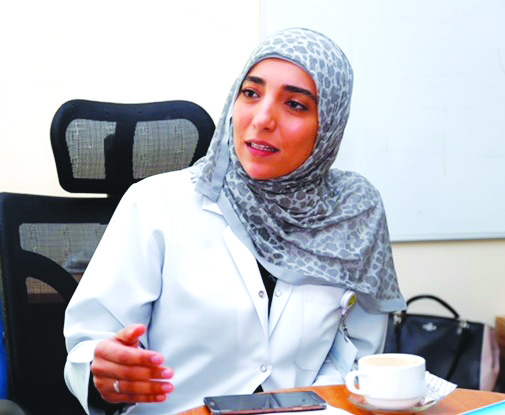
Dr Sona Fayed Tahtamouni.
DOHA: Each Year Hamad Medical Corporation’s (HMC) Early Intervention Program receives at lealest 40 new referrals of patients with Down Syndrome and experts say that early intervention and rehabilitation are key to helping children with the condition thrive.
At present, there are 73 children with Down Syndrome under the age of three receiving care through the Early Intervention Program at the Child Development Center and Therapy Services, Rumailah Hospital.
Down syndrome is a genetic condition caused by the presence of all, or a partial extra copy of, chromosome 21. The condition, which is the most common chromosome abnormality, is typically associated with characteristic physical features, some health and developmental challenges, and some level of intellectual disability.
The World Health Organisation estimates that the incidence of Down syndrome is between 1 in 1,000 live births worldwide. Approximately 3,000 to 5,000 children worldwide are born with Down syndrome each year.
While individuals with Down syndrome are more likely to have certain medical conditions such as congenital heart defects, hearing and vision problems, and gastrointestinal issues, many of these conditions are now treatable. Today, most individuals with Down syndrome lead healthy lives, enjoying a higher life expectancy than ever before.
Dr Sona Fayed Tahtamouni, Paediatric Consultant, Child Development Center and Therapy Services, explained: “Children with Down Syndrome nearly always have physical and intellectual disabilities. Therefore, they generally reach developmental milestones at a later age.
“These children have an increased risk of certain health problems, including congenital heart defects, epilepsy, leukemia, thyroid diseases, and hearing and vision disorders. They may also have a weak immune function. Regular screening for health problems common in people with Down syndrome is recommended throughout the individual’s life.”
Dr. Tahtamouni maintained that the quality of life for individuals with Down Syndrome can be improved by meeting their healthcare needs and stressed the importance of early intervention programs. “Children with Down Syndrome can lead a normal life if their parents and caregivers ensure their healthcare needs are met.
“ For example, by having regular check-ups with health professionals to monitor their mental and physical health and providing timely intervention with physiotherapy, occupational therapy, speech therapy, counseling or special education when required,” she said.
To mark the World Down Syndrome Day, observed globally tomorrow, HMC is organising a family day for patients and their families at Bayt Al Dhiyafah in Hamad Bin Khalifa Medical City. Awareness events are also planned across the main lobbies of Women’s Hospital, Hamad General Hospital, Rumailah Hospital, Al Khor Hospital, Qatar Rehabilitation Institute, and the Women’s Wellness and Research Center. The Ministry of Development Planning and Statistics will also participate, providing gifts to children.