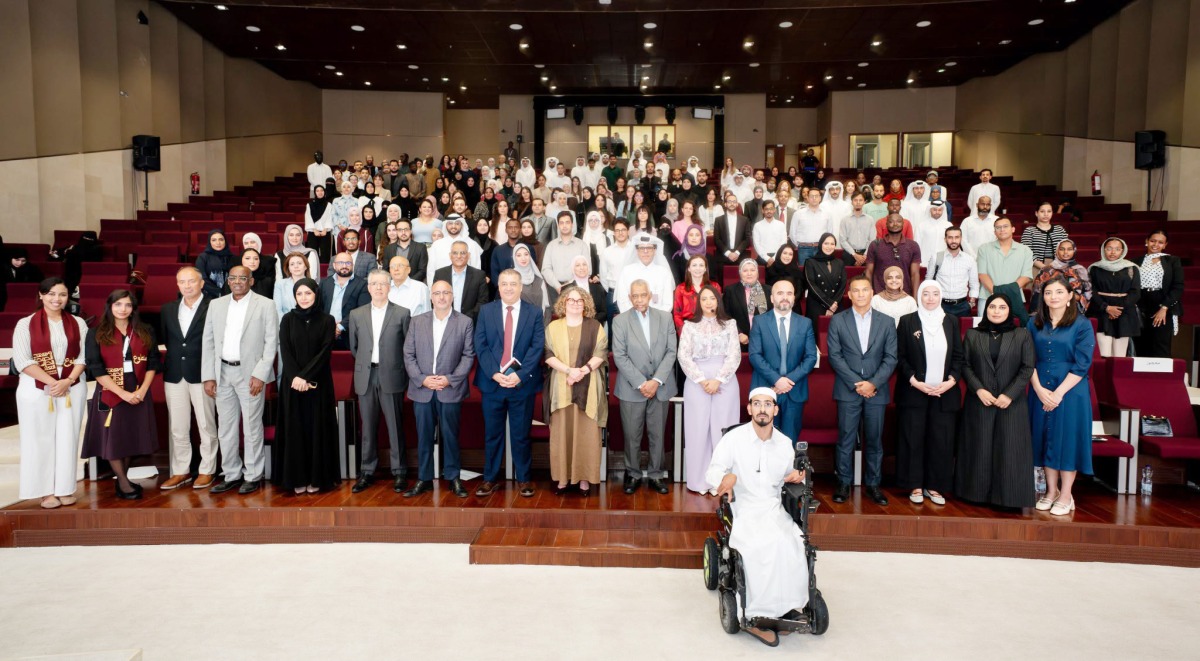
Doha, Qatar: The Doha Institute for Graduate Studies (DI) held an orientation session on Monday, August 17, 2026, to welcome students admitted to its PhD and master’s programmes for the 2026–2027 academic year.
The session brought together around 249 newly admitted students enrolled in the Institute’s 19 master’s and 8 PhD programmes. Of these, 154 students are joining the School of Social Sciences and Humanities (SOSH), 85 the School of Economics, Administration and Public Policy (SEAPP), 2 the PhD programme, and 8 the Doha Residence Programme in Advanced Arabic.
President of the Doha Institute for Graduate Studies Dr. Abdelwahab El-Affendi welcomed the new students, wishing them “every success and accomplishment in their academic journey.” He emphasised that, despite “the difficult times the region is going through,” the Institute continues to advance and develop. He highlighted that challenges test the mettle of nations and individuals and bring out the best in their qualities and values, stressing that “knowledge is the best weapon” in confronting such challenges, adding that preparing coming generations for the future and for different eventualities is among the objectives for which the Institute, and similar institutions in Qatar, were established.
El-Affendi highlighted a number of achievements the Doha Institute has made throughout its journey, including obtaining international accreditations following its local licensure, launching its PhD track, and attracting leading academic and administrative talent. He also pointed to growing demand for the Institute’s programmes, as well as the development of its facilities and the provision of state-of-the-art technologies. He affirmed that, before and after these achievements, the Institute has established an international reputation and standing in less than a decade. He noted the growing ties with leading universities in the East and West through memoranda of understanding, student and academic exchange agreements, and research partnerships.
The President stressed that these achievements “were not accomplished through inaction and wishful thinking, but through hard work and creative energies.” He called on new students to contribute to these efforts by “setting an example in seriousness, integrity, and responsibility,” emphasising that their efforts and contributions are central to the Institute’s continued success.
In conclusion, El-Affendi gave several recommendations to the new students, urging them to familiarise themselves with the DI’s policies and to understand their rights and responsibilities, communicate with academic advisors and faculty members when facing any difficulties, make use of the part-time study option when needed, and uphold academic integrity. He also encouraged them to use artificial intelligence responsibly and in accordance with the Institute’s policies.