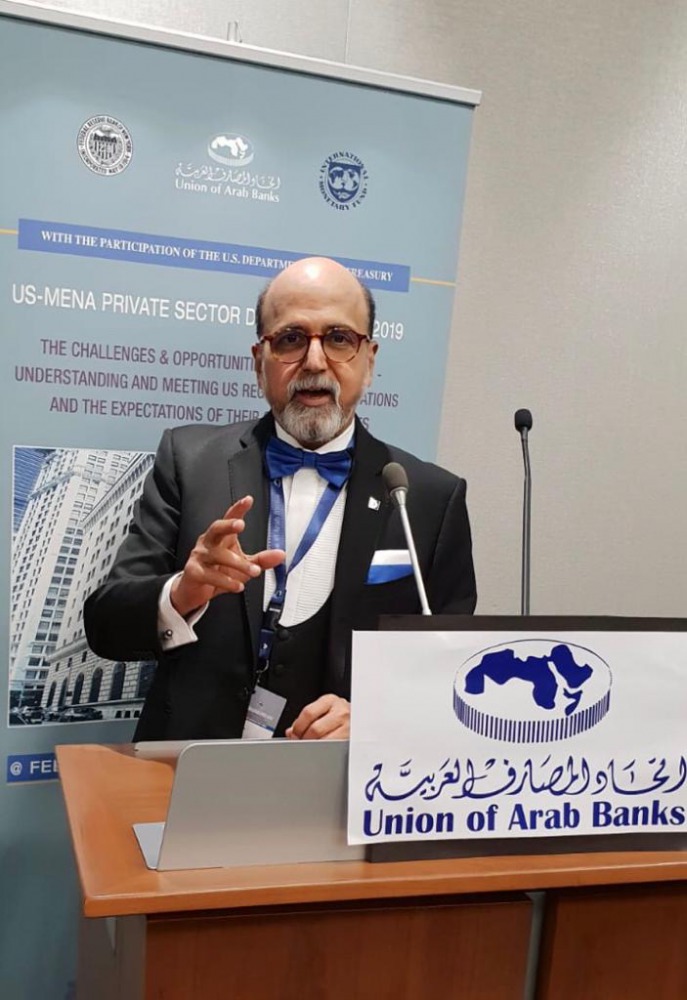
Dr. R Seetharaman, CEO of Doha Bank, speaking at the event in New York hosted by Union of Arab Banks and the Federal Reserve Bank of New York on Tuesday.
DOHA: Despite the complex nature of challenges facing the financial institutions in the Mena region, they are expected to make more investments in technology over the next two years, noted Dr R Seetharaman, CEO of Doha Bank at an event in New York, recently.
The Union of Arab Banks and the Federal Reserve Bank of New York hosted the US- MENA PSD 2019 at the Federal Reserve Bank of New York, New York on October 15 2019 on the theme “The Challenges and Opportunities for MENA Banks – Understanding and Meeting US Regulatory Expectations and the Expectations of their Correspondents.”
Dr Seetharaman gave insight on risk based approach to sanctions compliance. He said “In the global fight against financial crime, each world region faces unique challenges, and those faced by the Middle East are some of the most complex. Rightly, compliance with AML/CFT legislation is a priority for banks, payment service providers and other NFIs (Non-financial institutions) in the Middle East. By deploying a risk-based approach to client classification, financial institutions can determine the correct level of due diligence on a case-by-case basis, enabling them to tap into a wider market. 63 percent of financial institutions in the Mena region expect to make more technology investments over the next two years. Technology support is vital in implementing Risk Based Approach to Sanctions Compliance. The potential of emerging new technologies, in the form of Artificial Intelligence (AI), Robotics Process Automation (RPA) and block chain needs be leveraged to further automate routine AML and KYC processes and reduce associated regulatory cost pressures.”
He highlighted the key challenges facing financial institutions in the Middle East. He said “Growing influence and scrutiny by Financial Action Task Force (FATF), Rising size and number of fines, Customer Due Diligence challenges and the disruption of FinTech and RegTech firms are the major challenges faced by the regional financial institutions.”
He also gave insight on the Correspondent Banking Landscape. He said “The overall reduced risk appetite after crisis, Perceived or assessed risk and increased compliance cost for high risk clients. Insufficient Due Diligence information available and Lack of confidence in respondent bank’s ability to manage risk. Sanctions on countries or individual banks. Regulatory pressure, Rising fines and penalties, enhanced corporate and personal accountability and growing reputational concerns. There is also decline in correspondent banking activity as at end of 2018.” He also highlighted the impact of US AML rules on Foreign Financial Institutions and key initiatives on correspondent banking.
Dr Seetharaman highlighted on reforms brought by Qatar. He said “In June 2017, the United States and Qatar signed an agreement aimed at combating the financing of terrorism. In 2017 a legal framework on local classifications was established to identify persons and entities involved in the financing of terrorism.