GCC’s economic outlook is stable, as oil prices are expected to hover around $60 per barrel. Infrastructure investment is expected to increase further, and higher oil production will support greater growth in the six countries, according to World Bank.
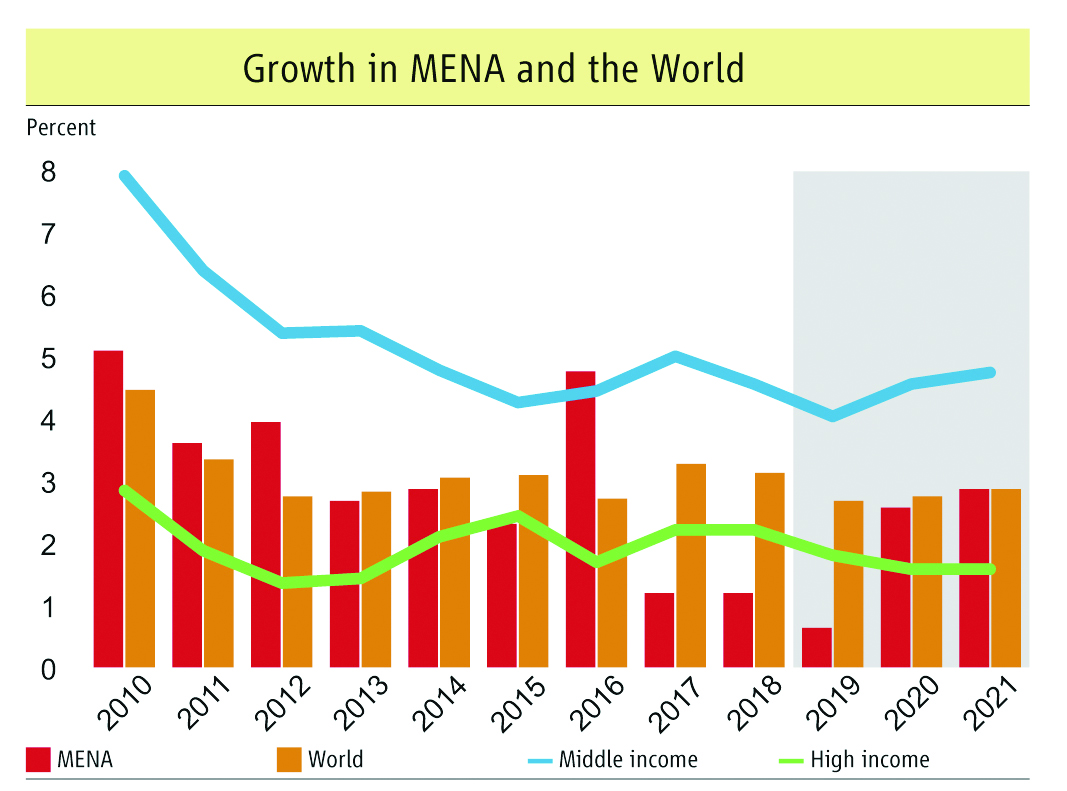
World Bank’s ‘Mena economic update for October’ noted that on average, growth in the GCC is expected to reach 2.2 percent in 2020 and 2.7 percent in 2021. However, fundamental challenges persist as the countries remain dependent on oil exports; although discussions aimed at diversifying their economies have started to gain steam.
On the growth prospects for energy exporters in the Mena region, the WB noted the market expects oil price to hover around $57 per barrel through the end of 2021. This projection is slightly higher than the ‘pre-oil attack’, due to concerns about supply, but is still below April’s projection. More fundamentally, technology breakthroughs in shale oil and alternative energy production will likely keep oil prices low in the future. In the meantime, growth in global oil demand has steadily declined over the past few years.. This poses fundamental challenges to both the short-term and long-term prospects for Mena oil exporters directly and indirectly for Mena oil importers because of their economic connections with neighboring countries.
A boost in non-oil activities in the Gulf Cooperation Council countries, most prominently in construction, partially offset the dampening effect on the region’s numbers from Iran’s economic contraction.
The WB economists noted the GCC countries have made efforts to add economic activities other than oil. Qatar economy has benefited from infrastructure projects related to 2022 World Cup in Qatar. Construction, however, is winding down as preparations for the event nearing completion.
According to WB, the Mena region needs bolder and deeper economic reforms. The report noted that it is time for Mena countries to focus on both demonopolizing their markets and harnessing the collective domestic demand of their economies to achieve export-led growth regionally and internationally.
“Most Mena countries have relatively small markets. But together the region has more than 400 million people, about twice as many as Western Europe. Moreover, while Europe’s population growth is virtually stagnant, the population in the Mena region is projected to nearly double by 2050. But as sensible as a move to regional markets might be, it will be difficult to achieve. Mena countries have always preferred to go-it-alone—the region is the least-integrated in the world, despite the potential gains from removing barriers to the flow of goods and services within Mena countries.” Policymakers, private businesses, and economists, among others, are increasingly demanding that state owned enterprises (SOEs) be competitive and create value—as do private corporations. The demand is justified because SOEs are major contributors to both developed and developing economies. According to the International Finance Corporation (IFC), SOEs account for 20 percent of global investment and contribute up to 40 percent of domestic output. SOE contributions are more prominent in developing economies, including in the Mena. In fact, in Mena, SOEs are fundamental to the economic architecture of the region. They operate in a range of sectors—such as hydrocarbon and electricity, transportation, telecommunications, postal services, manufacturing, finance, and real estate.
World Bank economists expect real GDP growth for the Mena region to average 0.6 percent in 2019, lower than the 1.2 percent growth in 2018. Sluggish performance is expected in 2019, the result of voluntary oil production cuts and weak external demand.