Doha: Oil prices fell more than 2 percent on Friday, as concerns about Chinese cities in lockdown due to coronavirus outbreaks tempered a rally driven by strong import data from the world’s biggest crude importer. Brent fell $1.32, or 2.3 percent, to settle at $55.10 a barrel on Friday, while US West Texas Intermediate crude settled down $1.21, or 2.3 percent, at $52.36 a barrel. WTI, which hit its highest price in nearly a year earlier in the week, posted its first weekly decline in three weeks, down 1.6 percent on the week.
While producers are facing unparalleled challenges balancing supply and demand equations with calculations involving vaccine rollouts versus lockdowns, financial contracts have been boosted by strong equities and a weaker dollar, which makes oil cheaper, along with strong Chinese demand. However, these positives were called into question on Friday as the dollar rose, and China instituted lockdown measures.
Crude imports into China were up 7.3 percent in 2020, with record arrivals in two out of four quarters as refineries increased runs and low prices prompted stockpiling, customs data showed on Thursday. However, China reported the highest number of daily COVID-19 cases in more than 10 months on Friday, capping a week that has resulted in more than 28 million people under lockdown as it suffered its first coronavirus death on the mainland since May.
A nearly $2 trillion COVID-19 relief package in the US unveiled by President-elect Joe Biden may increase oil demand from the world’s biggest crude consumer. Biden campaigned last year on a promise to take the pandemic more seriously than President Donald Trump. The relief package aims to fulfil that pledge with an influx of resources for the COVID-19 response and economic recovery. However, some analysts said the move might not be enough to stoke demand.
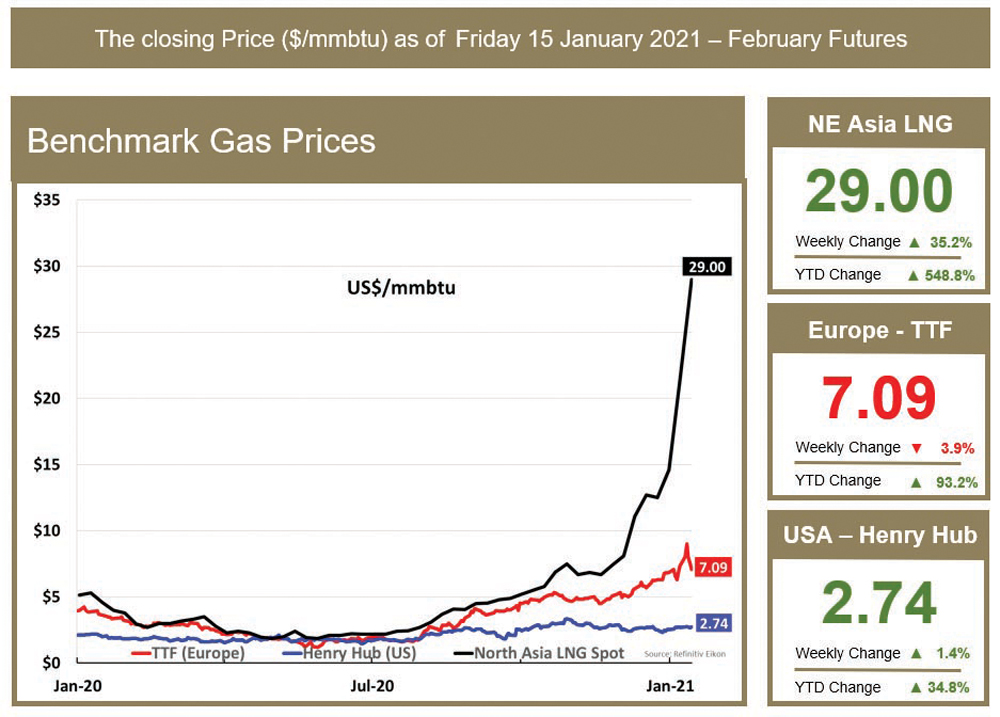
Asian spot prices of LNG rose to record levels early last week as freezing temperatures created a gas shortage, before easing towards the end of the week, with traders anticipating warmer weather.
The average LNG price for February delivery into North-East Asia was estimated at $29 per million British thermal units (mmBtu), up $7.55 from the previous week. However, cargoes for March delivery are estimated to be between $8-$14 per mmBtu.
On Wednesday, spot LNG prices rose to a record high of $32.50 per mmBtu, according to price agency S&P Global Platts, which publishes the Japan-Korea-Marker (JKM) that is used as a reference point for spot deals in the region. Freezing temperatures across Asia and Europe have been driving cargo prices to record highs and pushing up the cost of shipping the fuel globally as buyers grapple with tight inventories and a shortage of tankers.
In Japan, inventory was at such critical levels that one utility bought the remainder of any LNG left in tankers after they discharge at ports around Asia. Japan’s Kyushu Electric is also asking other utilities to supply any excess LNG supplies and to swap delivery schedules where possible.
Still, with warmer weather expected over the next few weeks, prices have started to reduce as more supply enters the market. Royal Dutch Shell said this week that cargoes had resumed from its Prelude floating LNG project off Australia, after being offline for nearly a year.
Production issues in Malaysia and Qatar have also been resolved with more supply expected while high prices have prompted at least two tanker diversions to Asia.