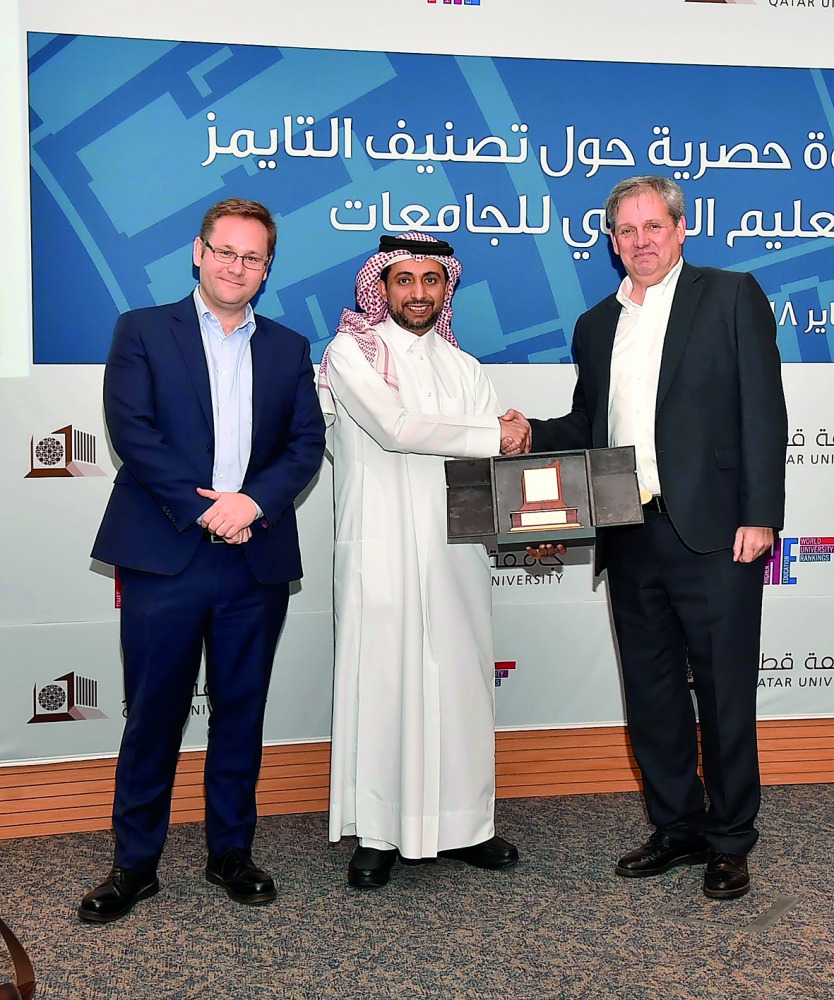
From left: Phil Baty, Dr Hassan Al Derham and Trevor Barratt.
DOHA: Qatar University (QU) in partnership with Times Higher Education (THE) yesterday hosted the “THE World University Rankings Data Masterclass”, which discussed how the World University Rankings are built and which data are collected.
The masterclass also looked at the performance data of universities in the Arab world and on how rankings and performance indicators can evolve to best meet the developmental needs of institutions in the region. THE ranking methodologies and future plans for teaching excellence was also discussed.
The event drew the participation of several presidents, faculty, experts, and researchers of universities from Qatar, Iran, Oman, South Africa, Turkey, and the United Kingdom. Attending the event were QU President Dr Hassan Al Derham, QU leadership, deans, heads of departments, program directors, faculty members, and staff.
A presentation by Trevor Barratt, Managing Director of Times Higher Education, detailed THE’s data credentials and the data for the World University Ranking — Performance Data from universities (via THE), Reputation Data from academics (via THE) and Bibliometric Data from academics (via Elsevier).
Barratt highlighted the eleven ranking subjects which include arts and humanities; social sciences; business and economics; clinical, pre-clinical and health; law; education; life sciences; physical sciences; engineering and technology; computer science, and psychology.
He noted that the academic reputation survey increased from 143,484 votes in 2016 to 144,863 votes in 2017. He also highlighted that the THE World University Rankings 2018 Scopus Dataset includes 12,431,514 total publications and 62 million citations.
The presentation also showcased the results of the THE World University Rankings 2018 and 2016-17, the characteristics of a world class university, and the Arab Ranking 2018.
Following was a session on teaching excellence metrics led by Phil Baty, Editorial Director, Global Rankings, Times Higher Education.
In his presentation, Baty noted that the THE World University Rankings are very heavily focused on research. It is right to focus on research for the world university ranking, he said, adding, “but of course we recognise the importance of the teaching mission, and we recognise some universities have no mission to research, and those who do of course take their teaching role extremely seriously. So, we forged a new partnership with the Wall Street Journal to develop a new teaching-led ranking.”
On the sidelines of the masterclass, QU hosted on January 15 a gala dinner at the Ritz-Carlton, Doha. The ceremony featured the screening of a short video on QU and a presentation on “QU Overall Ranking Results” delivered by Mr Cesar Wazen, Director of QU Scholarships and Partnerships Office.
In his remarks, QU President Dr Hassan Al Derham said: “Qatar University recognizes the importance of international rankings such as the Times Higher Education rankings, which include clear and highly accurate indicators and various details related to universities’ work and role.”
Dr Al Derham also highlighted the negative impact of the illegal blockade imposed on Qatar on all areas including the academic field and family relations. He noted that QU has accommodated the national students who have been affected by the Qatar-Gulf crisis and that the University did not end the service of any faculty member due to his/her nationality.”
Phil Baty said: “We are a very global business and our role is to help universities improve through data analytics and through face-to-face meetings to discuss the issues that matter to institutions. We have a great relationship with Qatar University and Qatar is a very good hub to have international discussions about the needs and policy-environment for universities in the Middle East region.”