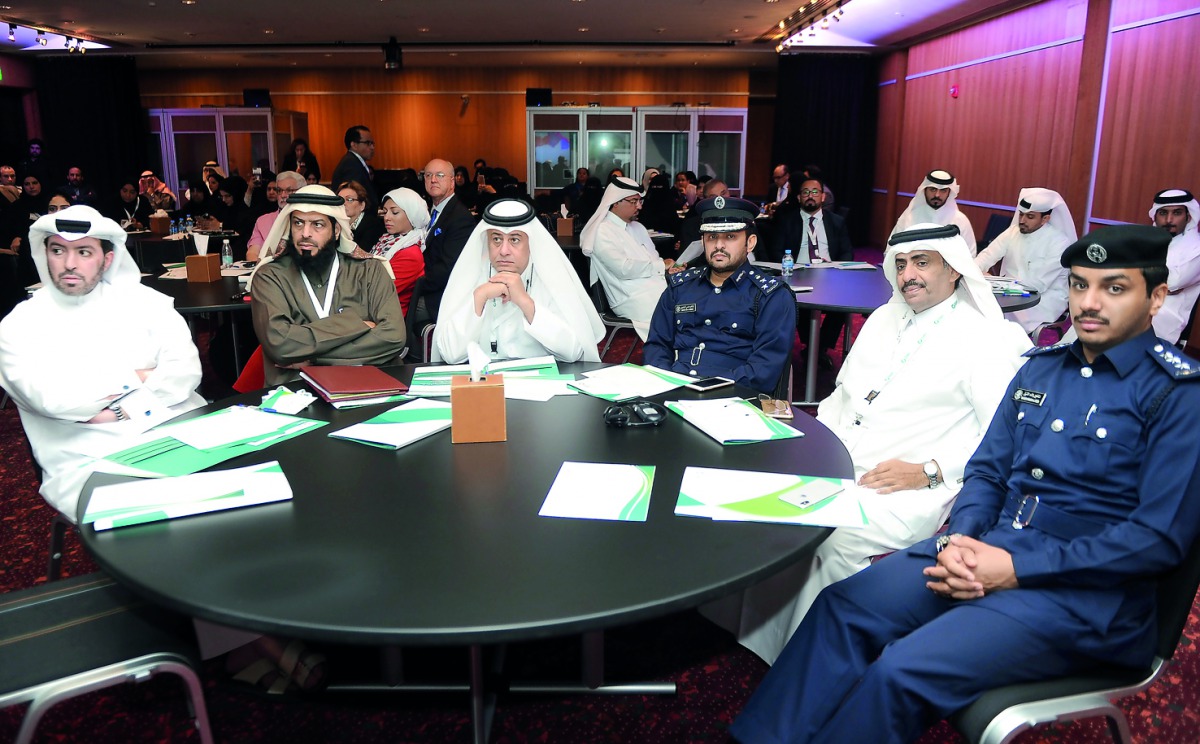
Participants during the opening session of the seminar titled, ‘Qatari Families: Strengths and Challenges’, by Doha International Family Institute at QNCC yesterday. Pic: Abdul Basit / The Peninsula
DOHA: The Doha International Family Institute (DIFI), a member of Qatar Foundation (QF), in collaboration with the Ministry of Administrative Development, Labour and Social Affairs, yesterday started its two-day public seminar titled ‘Qatari Families: Strengths and Challenges’, at the Qatar National Convention Centre.
The seminar discussed the findings of a study on Qatari families, as part of a larger DIFI research project on Arab family strengths in Qatar, Jordan, and Tunisia.
In her opening speech, Noor Al Malki Al Jehani, Executive Director of the Doha International Family Institute, stressed that DIFI is committed to its ambitious research programme in supporting family policy-making in Qatar specifically and in the Arab world in general.
Al-Jehani referred to the Universal Declaration of Human Rights, which considers the family as the natural and fundamental group unit of society and is entitled to protection by society and the State.
In reference to this, she highlighted Qatar National Vision 2030 second pillar of Social Development states that Qatar aspires to advance and develop the social dimensions of its society by nurturing Qatari citizens capable of dealing effectively and flexible with the requirements of the age they live in, and by preserving a strong and coherent family that enjoys support, care and social protection.She added that to strengthen and protect families, a consistent set of supportive interventions must be adopted by the family, community and state.
She revealed researches confirm the importance of understanding the social and cultural context in which families live, which is supportive or frustrating for the family and lessens its role.
“Interventions and policies that neglect the social and cultural context of families often fail to achieve their goals, so imported solutions and ready-made policies often fail even if they have been successful in their communities of origin,” she explained.
Al Jehani assured that “the outputs, opinions, and recommendations of this seminar will be an extension of an extensive field study to be carried out by the DIFI this year in order to gain more in-depth look at the characteristics of Qatari families”
Director of Family Affairs Department at Ministry of Administrative Development, Labor and Social Affairs, Najat Al Abdullah said the State of Qatar has given great importance to the family and the welfare of its young to provide suitable conditions for the development of its members, as guaranteed by the constitution and national legislation, which maximize the role of the family and achieve its interests.
She added that the Qatar National Vision 2030 pillar related to social development and protection aims to maintain a cohesive and strong family that cares for its children and is committed to ethics, religion, and ideals.
She added that the State of Qatar is witnessing an unprecedented leap in the family field, which imposes great responsibility on entities which take care of families so that their members can defend their rights and participate in the development of their communities. In addition, she said, the Ministry has taken care of the issues of family and childhood and has organized many activities and events that focused on how the community is aware of family rights.
Al Abdullah expressed her hope that by attending this seminar, the experts will be able to produce a strategic vision, innovative methods that comply with the nature of the Qatari community.
The two-day seminar included the following four-panel discussions: ‘Marital Relationships’, ‘Parenting’, ‘Culture’, and ‘Financial Aspects’.