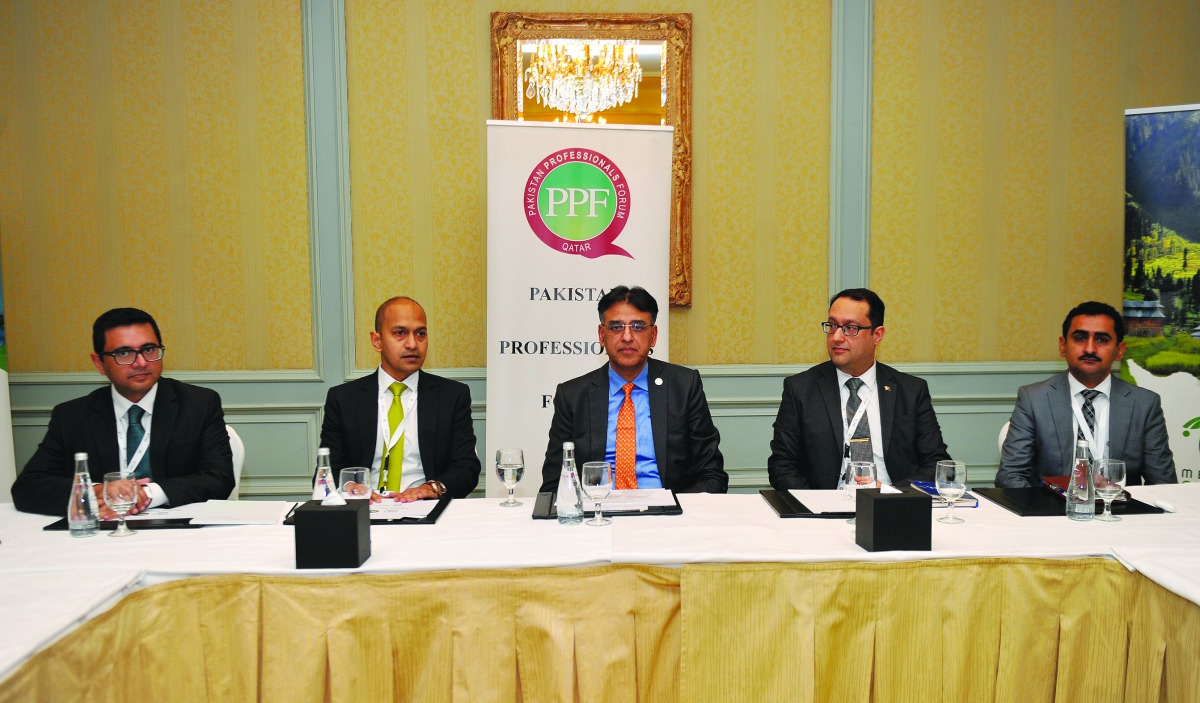
Asad Umar (centre) Finance Minister of Pakistan, Murad Baseer, (second right) Deputy Head of Mission Pakistan Embassy Doha, and other officials during the meeting with Pakistani Professionals at Four Seasons Doha, yesterday. Pic: Abdul Basit / The Peninsu
With fast growing demand and expanding gas receiving capacity in Pakistan, the South Asian nation is expected to source more liquefied natural gas (LNG) from Qatar, said the country’s visiting Finance Minister Asad Umar yesterday.
The minister noted that Qatar is a friendly country. It is already the largest destination for Pakistan’s gas imports, and as Qatar is expanding its LNG production capacity to 110 million tonnes per annum (mtpa), it will continue to be the largest source for Pakistan’s gas imports.
“Currently Pakistan has two LNG terminals. As our demand for gas is growing rapidly, there are three additional terminals being planned which are lead by private consortia—one by Shell and another by ExxonMobil; and the third one is emerging, which is expected to be lead by Mitsubishi. They are being developed to import more gas,” the minister told The Peninsula on the sidelines of an event.
He added: “Pakistan is trying to move towards deregulating its energy market; so most of the decisions are going to be taken by private companies based on competition. However, since Qatar is expanding its LNG output in a big way, I’m sure it will continue to be one of the most attractive sources for Pakistan’s gas import.” The minister noted that Qatar is already the largest supplier of gas to Pakistan, and Qatar has a big power project in his country which has been developed by a Qatari and Chinese joint venture.
The minister met with top Qatari government officials including the Prime Minister and Minister of Interior, and the Minister of Finance, and reviewed bilateral relations and ways to boost cooperation in a greater detail.
He also invited Qatari investors to take advantage of the biggest economic opportunity being created in Pakistan though the famous China-Pakistan Economic Corridor (CPEC) and the special economic zones.
“With world-class connectivity with China, the upcoming ambitious Gwadar port city, coupled with a very-very attractive labour cost and raw materials for a number of industries, Pakistan is going to be the base for regional and global operations,” noted Umar.
He stressed that Pakistani and Qatari economies are complementary to each other, which have great potential to grow and expand, but he noted that “trade need to be two-way, more meaningful and balance ” for mutual benefits.
“Right now Pakistan is hardly exporting anything to Qatar compared to other countries in the region. Given the size of over 150,000 Pakistani-community in Qatar, there is a great potential to grow. We are not only attracting Qatari investment to Pakistan, we want Pakistani businesses in Qatar as well.” Reiterating about the huge investment opportunities in Gwadar port city, the minister said that it is not only about China. It is being developed in cooperation with China, but the port city is going to be the pivotal point of CPEC. It is attracting a lot of global investors from several other countries.
“Some of the big investments are coming from countries in the Middle East, which include the development of a big refinery complex. Qatar is also one of the countries from the region to invest in the project,” he said.
Asked about the major bottlenecks in attracting investments in Pakistan, the minister said that in the past “policy in inconsistency” has been one of the major apprehensions, but with the new government in power, these obstacles are being addressed.
“The Prime Minister (Imran Khan) is personally addressing these issues. He is setting up an office in the PM Secretariat to personally lead the board for investment promotion and resolving issues in this regard,” said Umar, one of the senior cabinet members of Khan’s government.
Asked if Pakistan is working to have currency swap agreement with Qatar to boost trade in local currencies, he said: “We have already started doing that with China now, but would be happy to explore that possibility with other countries, including Qatar, if they agree.” Pakistan has been struggling with acute shortage of foreign reserves, and recently devalued its currency (rupee) as part of efforts to reduce its yawning Current Account Deficit (CAD).
“The currency devaluation has brought big improvements in our macroeconomic fundamentals over the past four months. The average CAD per month, which was $2bn per month, has dropped to half, but it is still very high. We do not want it more than 2 percent of the GDP. In addition, imports have declined, and exports, FDI and remittances are growing. We want to sustain this,” said the minister, who was here to participate at the Doha Forum.