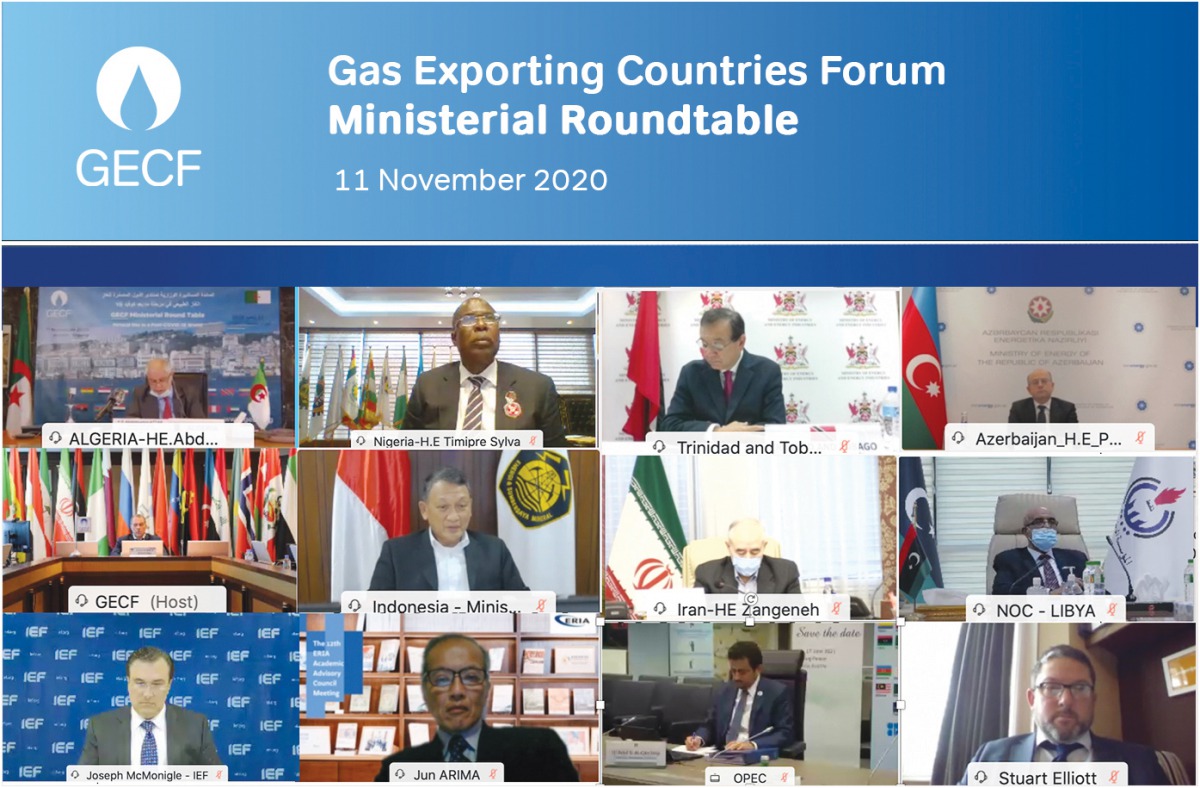
Ministers and other top officials during the online high-level dialogue.
Doha: It’s available in abundance, flexible enough to reach far-flung corners of the globe, less polluting to the environment, and yet the full promise of natural gas will unfold once the world is past the coronavirus pandemic, according to energy ministers of the leading gas exporting countries at a Ministerial Roundtable held recently.
As a sideline event to the 22nd Ministerial Meeting under the auspices of Algeria which took place on Thursday, the virtually-held high-level dialogue aimed to confront the array of challenges brought on by COVID-19 and the opportunities that are expected to propel natural gas to the top of the global energy mix by 2050.
The gathering of policymakers from the 20-member grouping featured two separate themes of short- and long-term perspectives, with the first session held under the title of “Natural Gas in a post-COVID-19 world: A short-term view”, and the second entitled “Natural gas: a transition fuel or a destination?” The former was moderated by Stuart Elliot of S&P Global Platts whilst the latter was steered by Dr. Bassam Fattouh of Oxford Institute for Energy Studies.
In his opening speech, H E Abdelmadjid Attar, the Minister of Energy of Algeria, which holds the 2020 Presidency of the GECF Ministerial Meeting, said: “I wish to underline the important role of natural gas in satisfying world energy needs. Natural gas is widely available. It is clean. It improves air quality, emits much less carbon dioxide than coal. It is flexible. These qualities of natural gas are recognized by many, if not all.
“We need to ensure that the pandemic will not hinder progress on these two challenges. I wish to encourage the gas industry to strengthen its efforts in dealing with the issue of methane emission. This is important for natural gas to play a more important role in the energy transition that the world has engaged in,” explained Attar, while adding that Algeria’s vast gas resource will witness $20bn worth of investment in the next years.
GECF Secretary-General H E Dr. Yury Sentyurin advanced these comments by noting that natural gas is an energy option that achieves a harmonious balance between the environmental, social, and economic dimensions of sustainable development.
“GECF members are committed to strengthen global energy security as reliable suppliers of natural gas in order to meet the world’s growing energy demand. They showcased remarkable determination in their fulfilment of all contractual obligations to the customers. This indicates confidence in the strength of their economies and abilities to absorb major economic crises, notwithstanding numerous challenges and decline in revenues,” said Dr. Sentyurin.
The sense of optimism is not without merit. Latest figures obtained from the GECF’s reputable Global Gas Outlook 2050 publication show that natural gas is growing at its fastest-ever rate and will become the largest global primary energy source by 2050, from 23 percent today to 28 percent.
Long-term demand is expected to grow by a remarkable 50 percent, from 3,950 billion cubic metres (bcm) in 2019 to 5,920 bcm in 2050. Asia Pacific, North America, and the Middle East will carry more than 75 percent of this expected spur in demand.
Also speaking during the event, H E Senator the Honourable Franklin Khan, the Minister of Energy and Energy Industries of Trinidad and Tobago, said: “COVID-19 has forced us to embrace three ‘I’s of introspection, innovation, and insulation. We need to be introspective by continually examining our existing systems and processes to ensure they operate at maximum efficiency.
“We need to be innovative in developing and quickly adopting new technology in our operations and business processes. And we need to insulate our fragile economies by ensuring that as far as possible we become self-sufficient to protect us from external market shocks and supply chain disruptions,” he added.
Abulgasem Shengher, Member of the Management Board on Upstream at Libya’s National Oil Corporation, who was leading the Libyan Delegate at the 22nd GECF Ministerial Meeting, reiterated the positive sentiments shared by the participants during the event. “We strongly believe that the industry will go back to normal or at least to a new normal rather than undergoing severe restructuring. Leveraging digital technologies, bringing in automation, and improved strategic scenario-based planning are key as the industry comes out of the coronavirus crisis,” he added.