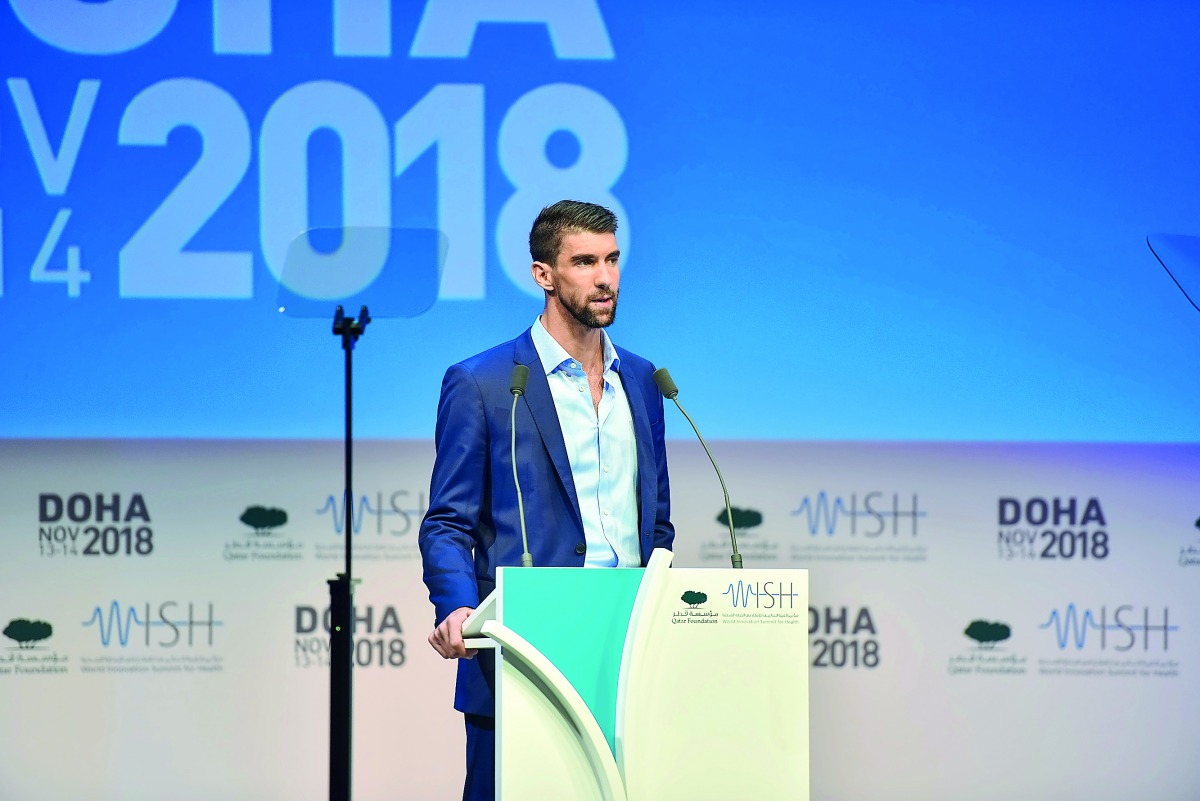
American swimming legend Michael Phelps addressing the World Innovation Summit for Health (WISH) at the Qatar National Convention Center in Doha yesterday.
DOHA: Swimming legend Michael Phelps, the greatest Olympian ever, yesterday said the decision to seek professional help to combat deep bouts of depression ‘saved’ his life.
The 33-year-old from Baltimore yesterday even conceded winning an Olympic medal was easy compared to battling depression.
“It wasn’t easy for me (to open up about the issue) but it was necessary. The decision I made to seek professional help saved my life,” Phelps, the most decorated Olympian with 23 gold medals, said yesterday.
“That’s why I stand here in front of you today. It’s an honour to thank the healthcare community. I am grateful for the chance (offered to me) to play my part in opening up the conversation about anxiety and depression and removing the stigma over this issue,” the retired American swimming giant said.
“To me, self awareness and vulnerability is empowerment. I know it can be a big challenge for people to discuss and to confront mental health challenges. I understand it can seem like an insurmountable barrier to getting help and support that is needed,” he added.
“As I started opening up and talking about my mental health challenges, I found strength, not vulnerability. I realised it is okay to not be okay,” Phelps said.
“Four years ago, things were happening in my life which indirectly led me to stand on this stage in Qatar in front some of the world’s leading healthcare experts. I was a world champion swimmer. I had been competing for 18 years and I don’t think I would be boasting if I said I had become pretty good at this sport in which I had devoted a huge amount of my life.
“I enjoyed great professional success up until the point. But in 2014, none of that mattered. I was down on myself that I spent five days in my room and frankly I didn’t want to be alive. I saw myself as worthless and someone who let down so many people that I cared most about. But having reached rock bottom, I started to ask for help. And it was one of the best decisions of my life,” Phelps recalled.
“When depression hits, it can be debilitating. I can feel that nothing really matters. Sometimes my greatest accomplishment was just getting out of bed. Compare that with winning a gold medal was very easy,” Phelps said.
“As an athlete, I was always thought to be strong and to never show weakness and to push through any obstacle. There was no room for negative emotions and at times my depression would overpower me. In the end I was lucky and thought it was okay that I sit down with a therapist and talk,” he said on day two of the 2018 edition of the World Innovation Summit for Health (WISH), an initiative of Qatar Foundation.
“In sharing my journey I want others to know that you are not alone. You do not need to suffer in silence. It’s okay to not be okay. Thanks to seeking professional help, I have a better understanding of myself. I still have tough days but I have the tools and the understanding to manage them now.
“I stand here no less the champion, no less the athlete, no less the person who dared to dream big and to work hard. The medals I have won are very special. They pale in comparison to the efforts that myself or all of you are doing to save lives, by empowering people to seek the help and support they need in addressing the issues of mental health,” Phelps said.
“Our mind can overpower anything. You know it’s not true. We need help from time to time. I struggled asking for help and I think once 2014 hit, I went through that huge depression spell where I didn’t want to be alive. For me, it was just so easy to open up because I wanted to find a different way. I wanted to find something different to allow myself to grow as a human being,” Phelps said.
A Q&A with Phelps after his keynote speech at Qatar National Convention Centre:
Q: You say after every major Olympics you went into a state of depression. What really happened?
A: As an Olympian we get ready for competition once every four years. Once we are done with that meet, we don’t know what to do. We don’t know where to go. We don’t know who to talk to. We don’t know anything. It’s like ‘we are back to square one and now what?’. It was almost like we were lost. I was extremely lost. For me as a kid growing up, I’d say I basically lived in a bubble until I was about 30 years old and I decided to learn how to communicate, learn these other lessons that I didn’t have the chance to learn.
Q: How much of an unusual life did you have while you were trying to reach your professional peak at a young age?
A: Going through this process was something I dreamed of. I wanted to be an Olympic champion. I wanted to win gold medals and be a world record holder. That’s what I prepared myself for.
I guess when you are going through that process, you don’t know other challenges and the things that are going to happen along the way. I was taught to focus on what I was doing and not worry about anything else that was happening in my life. So over time, everything just added up inside and I didn’t know how to handle it. That’s what sent me into spiral of depression and it was the toughest time of my life.
Q: Have you got better at helping people with mental health issues?
A: I believe we have made a lot of good changes over the last few years in allowing people to open up and talk about this. I think for a long time it was just so easy to brush issues under the rug. I would be the first one to say there are people sitting in this room that have gone through similar things that I have gone through. That’s what makes us human.
Q: Did it take a while for you to speak about it?
A: I always made the joke that I learned to communicate at 30 but it’s true. I was so laser focused on what I was doing in the pool that I wasn’t paying attention to anything else that was going on in my life.
For a long time I was under the impression that I was being judged if I was showing a weakness or if I was not perfect. That was a struggle and I was finally able to reach a point where I said: “You know what? This is who I am. This is how I am gonna be. I am learning to grow and change and if you don’t like who I am, then sorry”.
Q: Is masculinity an issue with male athletes who may not open up about such issues?
A: There are a lot of male athletes who are struggling with it. You’ll hear me say this a ton of times that it’s okay to not be okay. I think that’s something that everybody should understand. I use myself as an example. I have been through a handful of pretty big depression spells.
I know that it’s not just going to go away. These are things I am going to have throughout my life and when they do come up, I have to rise and know how to handle them and manage them. That’s the hardest process to learn. But it has also been one of most powerful processes to learn. For me, it’s about sharpening up those tools that show I can be as prepared as I possibly can be.
Q: Would your successes been any different if you had known then what you know now?
A: I wouldn’t change anything that happened in my career - the good, the bad or the ugly. I wouldn’t change it because it has made me who I am today. I don’t think my career would have gone as smooth as it did if I had known things I know now.
Q: In short, would you say that you suffered from mental issues?
A: Of course. Without a doubt! It’s something that I still struggle with. I flew to Qatar to talk about this issue so it shows we are making success in talking about this. Four or five years ago, nobody would have ever brought it up. It’s fun for me to be able to see people talking about it and see what people are doing to make that change.
Who knows where we can take this but my goal is to save as many lives as we can. For me that’s way more exciting than winning an Olympic gold medal.
I want people to understand that it is okay to not be okay.