DOHA: With the massive amount of waste produced from the construction industry, a senior environmentalist and waste management expert has suggested that construction life cycle must account for Waste Management that goes beyond “Reduce, Reuse, Recycle”.
The expert also noted that the construction byproducts require smart and immediate management to ensure they do not all end up in landfills.
Waste as a byproduct of building modern cities is a growing challenge for builders. It requires very specific plans to reduce any impact on the environment. However, waste management and proper disposal can sometimes be overwhelming.
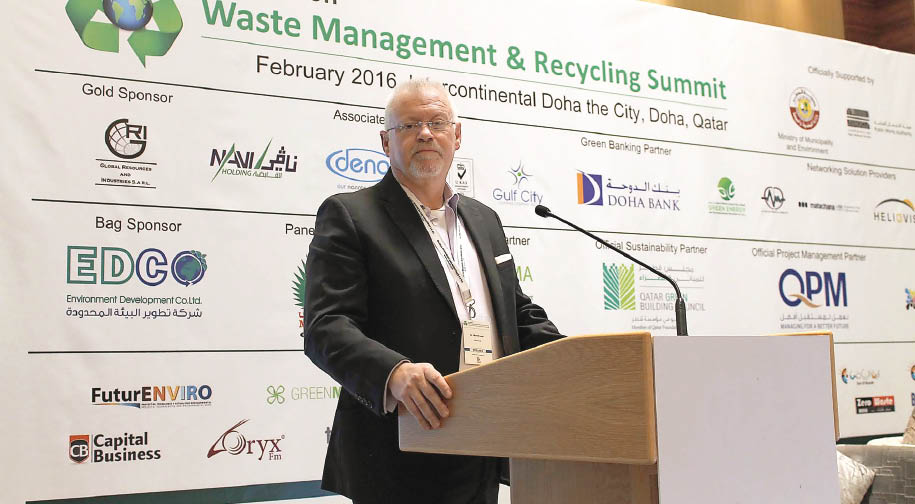
Dr Mark Evans of Qatar Project Management (QPM), said: “Humans as a species, and this is true everywhere around the world, are traditionally not good at managing waste. It requires effort combined with education to make a difference and reduce the impact of our actions on the environment.”
Dr Mark, who is seconded to Qatar Rail’s PMC Major Stations Department as Environmental and Sustainability Manager, was speaking at the recently concluded 6th Waste Management and Recycling Summit in Doha.
To put this in context, he cited the example of ‘The Great Pacific Garbage Patch’, comprising plastic particulates suspended at or just below the surface, covering an area the size of the US state of Texas. Ocean currents cause these particles to stay within this region and bring even more debris to the garbage patch every year.
He said that this is an exaggerated but very real consequence of irresponsible waste disposal and there are many correlations in the construction business. Each year, millions of tonnes of debris and waste are generated as a by product of global construction and development projects. They require smart and sustainable solution.
Evans said the key to progress is to change the way we look at waste management.
“Waste issues are just one segment of an overall project lifecycle assessment and plan. They should be core components of the wider project sustainability and development agenda. From a builder’s perspective this should account for managing the construction process so resource utilisation is minimal, and that waste is segregated properly. It should be reused where possible, or disposed of responsibly,” he said.
“There is of course an omnipresent gap between theory and practice everywhere in the world,” added Evans. “The key to ensuring compliance is in being consistent during toolbox talks with the workers, because work forces and people change. This calls for being repetitive and delivering the message consistently.”
Evans believes legislation forcing builders to adhere to ideal waste management processes, even if it uses taxation or penalties to curb reckless behavior, are not as powerful as the proactive responsibility that can be demonstrated by developers.
The Peninsula