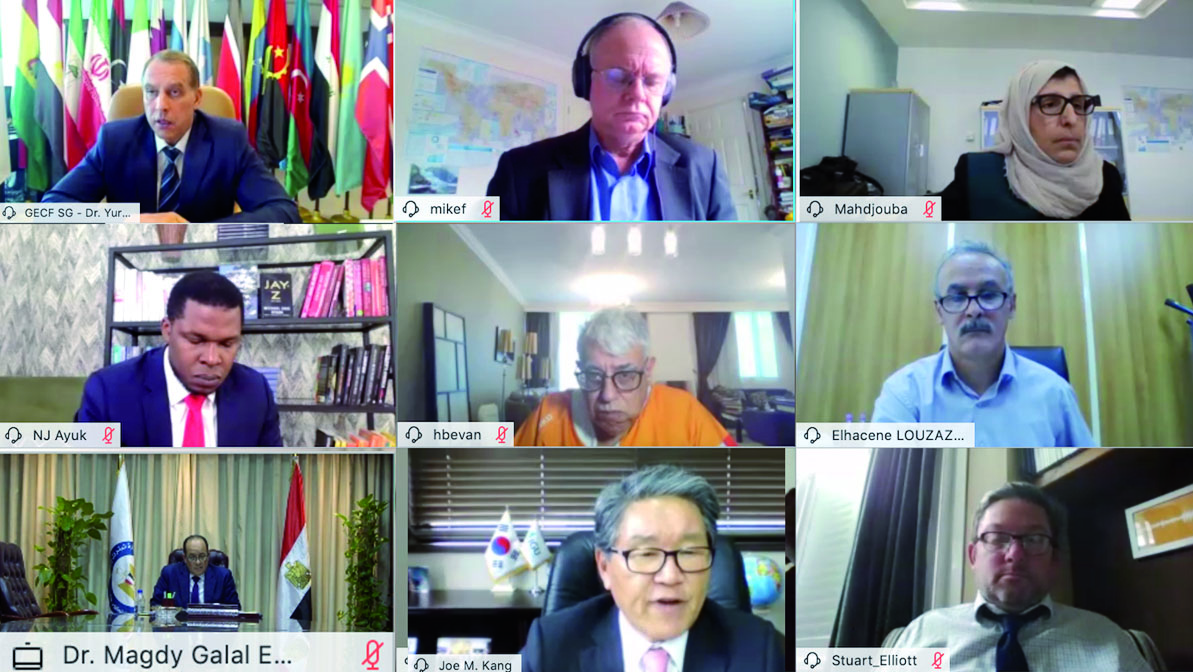
The energy industry leaders attending 3rd GECF Annual Workshop.
Doha: Increased cooperation between producers and buyers, digitalisation across the value-chain, investment in infrastructure and research and development in innovative technologies will play a pivotal role in positioning natural gas as a fuel of choice for the 21st century global economy.
These were some of the key messages of the distinguished line-up of international gas industry leaders and panellists who participated in the 3rd GECF Annual Workshop on Promotion of Natural Gas Demand.
The widely attended workshop, held virtually, was organised by the GECF (Gas Exporting Countries Forum) at a critical time for the gas industry . The speakers opined that natural gas is the fuel that can achieve the UN Sustainable Development Goals and the objectives of Paris Agreement as its credentials far outweigh that of other energy sources such as coal and oil.
Welcoming the audience, the GECF Secretary General Yury Sentyurin outlined the salient points that leverage gas industry’s growth and highlighted the Forum’s efforts in promotion of natural gas, in line with the GECF Statute, the GECF Long-Term Strategy, and the Declaration of Malabo at the conclusion the 5th GECF Summit of Heads of States and Governments.
“We recognise the vital role that natural gas has to play in energy transition and sustainable development as we strive for energy security for all nations. Now more than ever, there must be a spirit of collective collaboration amongst industry players in order to sustain existing markets, and more so to create new promising ones,” said Secretary General Sentyurin.
The keynote speakers included the President of International Gas Union (IGU), Joe M. Kang, the Executive Chairman of African Energy Chamber, N. J. Ayuk, the Chairman of Egyptian Natural Gas Holding Company (EGAS), Magdy Galal, and Vice President LNG Marketing & Trading of Petronas, Mr Shamsairi Mohd Ibrahim. The session was followed by two immersive panel sessions.
In his intervention, Kang referred to the messages published in the IGU’s latest report, ‘Gas Technology and Innovation for a Sustainable Future’, and focused his remarks on the potential that technology can offer in reducing greenhouse gas emissions and improving energy access. He also highlighted the urgency of investment decisions to be made if this potential is to be realised.
Ayuk thanked the GECF for bringing the natural gas agenda to Africa, particularly by hosting the Forum’s Summit in Equatorial Guinea, and thereby in Africa for the first time, in 2019.
Speaking on behalf of Petronas, Ibrahim pointed out that the rising number of LNG importing countries from merely 15 in 2005 to 39 countries in 2019 shows that LNG is well positioned to prosper as the most significant source of energy in the future. He also highlighted some creative LNG solutions including LNG bunkering, virtual pipeline system, small-scale break-bulking and vertical integration that will create new and niche markets.
The GECF Gas Market Analysis Department Head Mahdjouba Belaifa spoke about the GECF’s role in aligning many voices as one voice. She highlighted some of the proposed actions after the workshops such as reinforcement of dialogue, role of R&D, fair access to technology, engagement of policymakers in advocacy for fair policies towards natural gas, the role of social media to sensitise various segments of the public, as well as digital technologies to improve productivity.