DOHA: The Opec Reference Basket (ORB) surged by almost 7 percent in September to average above $77/b for the first time since October 2014. Global crude oil prices continued their upward trend throughout the month bolstered by robust market fundamentals as well as a higher geopolitical risk premium.
ORB is a weighted average of prices for petroleum blends produced by Opec members. It is used as an important benchmark for crude oil prices.
Opec monthly oil market report for October noted oil prices were supported by relatively healthy global oil demand and growing concerns over global oil supply shortages, along with a continuous decline in US crude oil inventories, which have fallen for five straight weeks by more than 20 mb to reach a level of 394.1 mb during the week ending 14 September.
Crude oil physical benchmarks also traded higher in September but by varying magnitudes. While Dated Brent and Dubai increased by $6.16 and $4.75 m-o-m, respectively, WTI spot prices rose by only $2.21 m-o-m in September.
All ORB component values increased sharply along with their respective crude oil benchmarks, particularly Dated Brent and Dubai. Physical crude oil differentials also experienced an improvement, buoyed by strong demand and worries over tighter oil supplies.
Futures oil prices have surged in September, driven by growing concerns over global oil supply shortages from several regions and by a higher geopolitical tensions. Oil futures prices were also supported by a steady decline in US crude oil inventories, which have fallen for five straight weeks by more than 20 mb to reach 394.1 mb during the week ending 14 September.
NYMEX WTI futures rose at a lower rate compared to ICE Brent or DME Oman, due to rising US crude oil supply and the start of the US refinery maintenance season. In September, ICE Brent rose by $5.27, or 7.1 percent, to $79.11/b, while NYMEX WTI increased by $2.24, or 3.3 percent, to average $70.08/b. Y-t-d, ICE Brent is $20.23, or 38.5 percent, higher at $72.74/b, while NYMEX WTI increased by $17.43, or 35.3 percent, to $66.79/b, compared to the same period a year earlier.
DME Oman prices soared to record-high levels against other international crude oil benchmarks in late September, due to strong demand from Asian refiners and particularly from Chinese independent refiners amid low end-of-month liquidity. DME Oman rose by $6.08, or 8.4 percent, over the month to settle at $78.75/b on a monthly average basis. Y-t-d, DME Oman was up by $19.25, or 37.6 percent, at $70.48/b compared to the same period a year earlier.
Hedge funds and other money managers cut their combined net long positions in futures and options linked to NYMEX WTI, despite the surge in crude oil futures prices. However they increased their combined net long positions linked to ICE Brent. Managed money activities were more bullish in global oil benchmark Brent compared with US WTI, owing to record-high US oil production that is expected to keep pressure on oil prices.
World oil demand is projected to increase by 1.54 mb/d in 2018, a downward revision of around 80 tb/d from the previous month’s report. Total global oil consumption for the year is expected to average 98.79 mb/d.
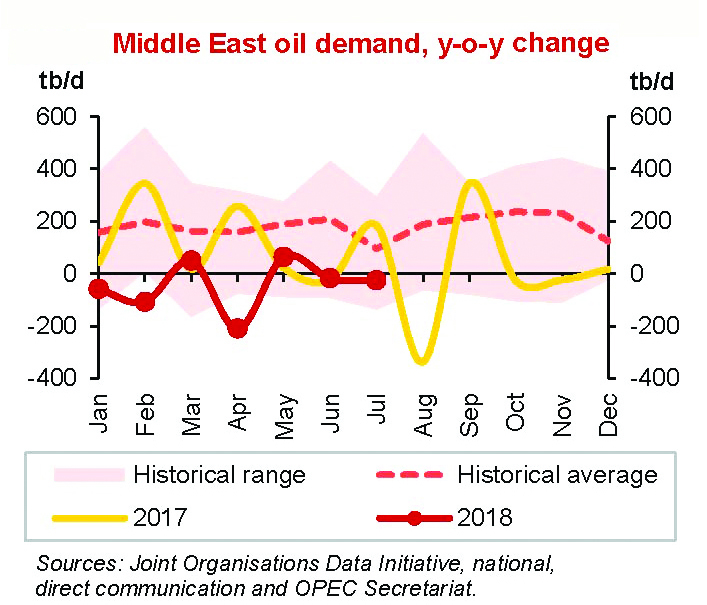
Looking forward, oil demand growth in the Middle East region is anticipated to continue to be tilted to the downside for the remainder of 2018, with uncertainties surrounding demand growth data in the region, as substitution by other fuels and subsidy reduction policies are assumed to limit the demand growth potential. In 2019, oil demand growth is expected to improve from the levels seen in the current year, primarily as a result of steady economic conditions, coupled with a low base line of comparison. In the Middle East, oil demand is now expected to decline by 15 tb/d in 2018, while 2019 is forecast to show growth of around 70 tb/d.