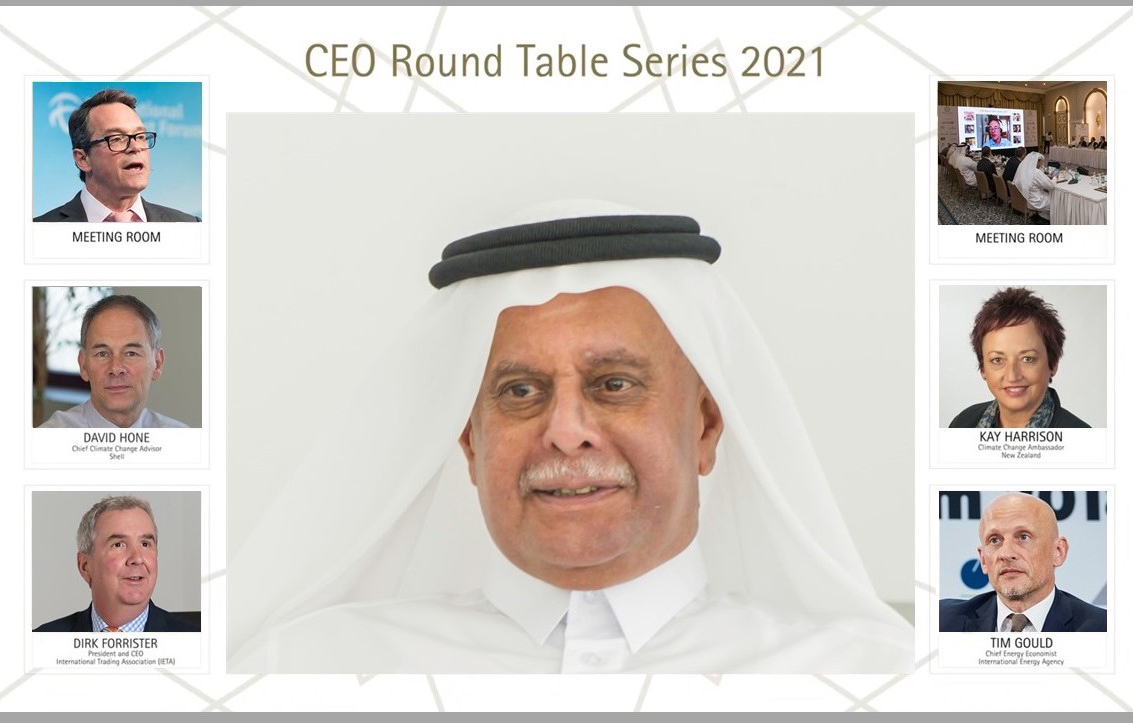
H E Abdullah bin Hamad Al-Attiyah, Chairman of the Board of Trustees at the Al-Attiyah Foundation with other officials and experts during the CEO Round Table series.
Doha: CEOs and scientists came together to share and explore a plan of action against climate change at the quarterly Roundtable hosted by the Abdullah Bin Hamad Al-Attiyah International Foundation for Energy and Sustainable Development.
The roundtable, titled ‘Race to Net-Zero’, featured esteemed guest speakers; Dirk Forrister, President and CEO, International Emissions Trading Association (IETA); Tim Gould, Chief Energy Economist, International Energy Agency (IEA); Kay Harrison, Climate Change Ambassador for New Zealand; and David Hone, Chief Climate Change Advisor at Shell.
The event, held in Doha on September 8 and moderated by Reuters editor at large Axel Threlfall, underlines the Foundation’s commitment to the global imperative to take action against climate change and highlights its ability to facilitate dialogue between those who can make a difference in their respective fields of work.
The experts discussed the growing momentum in the push towards carbon neutrality and how to transition to a net-zero energy system by 2050 while ensuring stable and affordable energy supplies, providing universal energy access, and enabling robust economic growth.
The speakers agreed that a total transformation of how we produce, transport and consume energy needs to be changed with great urgency.
This includes, from today, no investment in new fossil fuel supply projects, and no further final investment decisions for new unabated coal plants. By 2035, there should be no sales of new internal combustion engine passenger cars, and by 2040, the global electricity sector should have already reached net-zero emissions.
In the near term, the net-zero pathway requires the immediate and massive deployment of all available clean and efficient energy technologies, combined with a major global push towards advanced batteries, hydrogen electrolysers, and carbon capture and storage. Together, these three technology areas can make vital contributions to the reductions in CO2 emissions between 2030 and 2050.
The high-level gathering comes at a decisive moment for international efforts to tackle the climate crisis, the greatest challenge of our times. The 26th Conference of the Parties (COP26) of the United Nations Framework Convention on Climate Change is being held this November in Glasgow, where global leaders are expected to reaffirm their net-zero ambitions and provide updated roadmaps on how they intend to reach their lofty targets.
H E Abdullah bin Hamad Al -Attiyah, Chairman of the Board of Trustees at the Al-Attiyah Foundation and former Deputy Prime Minister and Minister of Industry and Energy of Qatar, highlighted the importance of hosting the Roundtable in the build up to COP26 and expressed his happiness about the return of the Roundtable event series after the coronavirus pandemic.
“It gave me great pleasure to host the Al-Attiyah Foundation Roundtable once again. The guest speakers offered their valuable insights at critical point in time, just two months before global leaders and major stakeholders gather for the UN Climate Change Conference in Glasgow. Expectations for the conference are high and many are eager to see the progress we’ve made towards the objectives of the Paris Agreement,” he said.
Kay Harrison, Climate Change Ambassador for New Zealand, said: “It was a great privilege to be part of this conversation, sharing ideas with leaders from academia and industry. Progress towards the goals of the Paris Agreement will not be achieved by a handful of countries like New Zealand individually stepping up.”
“Governments, cities, towns and local communities around the world all have key roles to play. That is the international system at work.”