DOHA: With energy production more than 2.5 times as large as its demand, the Middle East has the highest energy self-sufficiency ratio in the world. The region produced nearly 15 percent of global energy in 2016, an increase from just over 13 percent for the previous five years. This growth is largely driven by oil and gas, where the Middle East produced 34 percent of global oil, and nearly 17 percent of the world’s gas. The Middle East’s global share of natural gas production has increased every year since 1997.
With 33 percent of the Middle East’s natural gas production, Iran maintained its position as the region’s largest producer of natural gas in 2016, closely followed by Qatar at 30 percent of the regional production. Iran’s natural gas production increased by 9 percent in 2016, indicating faster growth compared to the 5 percent increase seen in 2015, IEA’s ‘World Energy Balance Report 2018’ noted.
Meanwhile, natural gas production in Qatar was fairly steady with 1 percent growth in 2016 compared to 3 percent in 2015. In 2016, the major growth in oil production was seen in Iran and Iraq, with 33 percent and 28 percent respectively. Other notable growth in oil production was seen in Qatar and Kuwait, each with 4 percent. Oil production continued to decline in Syria (-5 percent) in 2016, though not as drastically as in 2015 - with a nearly 40 percent decline. Similarly, Yemen also saw a dramatic deterioration of oil production, with a 39 percent drop due to political unrest and the halting of oil and gas activities in 2015.
Alongside increasing its production, the Middle East is also the fastest growing region in terms of Total Primary Energy Supply (TPES). Over the period from 1971 to 2016, TPES grew on average by 7 percent per year. In 2016, this supply is almost exclusively based on oil and natural gas. Natural gas has partially displaced oil, more than doubling its share between 1971 and 2016.
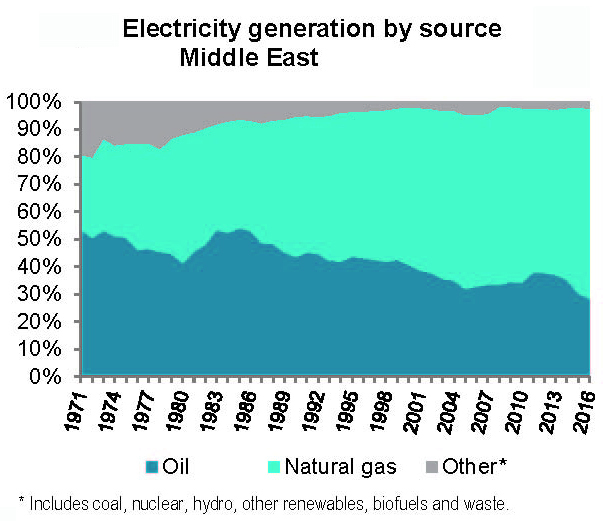
Key factors driving the rapid development of natural gas in the Middle East are power generation and the petrochemical sector. This is illustrated by the share of oil in electricity production continuing to shrink, starting with 54 percent in 1971 and reaching 28 percent in 2016.
In contrast, the share of natural gas in electricity production continually increased, from 27 percent to 69 percent in the same period. In 2016, natural gas continued to provide almost all the electricity generated in Qatar, Bahrain, the United Arab Emirates, and in Oman. In Iran and Jordan, natural gas’s share in electricity generation reached over 80 percent in 2016. In Jordan, this change has come swiftly, with natural gas generating just 48 percent of the electricity in 2015, as a result of the government promoting the fuel swap.
Over the last four decades, total final consumption expanded in all sectors, particularly industry and transport, which increased twenty fold. In 2016 oil accounted for 95 percent, 37 percent and 16 percent of final consumption in transport, industry and residential, respectively.
Oil is responsible for 47 percent of total energy consumption in the Middle East. Also in 2016, natural gas met 55 percent and 47 percent of final consumption in industry and residential, respectively.
Electricity tripled its share in final energy consumption from 5.6 percent in 1971 to 15.5 percent in 2016.