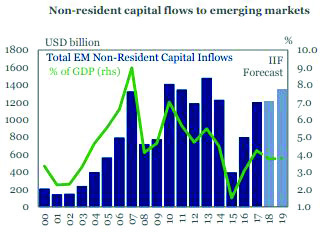
DOHA: Given the more challenging landscape, with a stronger US dollar and rising US rates, the Institute of International Finance (IIF) has cut its forecasts for non-resident portfolio flows to Emerging Markets (EMs). Banking and FDI flows however should be resilient.
IIF has cut its forecasts for 2018 EM non-resident capital inflows by $43bn to $1 trillion — flat from 2017— but upped its 2019 forecast slightly to $1.35trillion.
“We now see total non-resident capital flows stable at $1.2trillion in 2018, but still expect these to increase to $1.35trillion in 2019. The rising differential between EM and mature market growth remains supportive”, the IIF noted in its latest report. It anticipates a second consecutive year of EM reserve accumulation—some $220bn, mainly in China.
The IIF is more sanguine on both FDI and banking flows—non-resident FDI inflows should come in close to $525bn this year, highest since 2015, while the pickup in global trade volumes has prompted a notable increase in cross-border banking flows to EM. Looking ahead, while the rising differential between EM and mature market growth should support non-debt flows, downside risks are still high—notably, external refinancing risk in the event of sustained USD strength, a hit to EM exports from a rise in trade barriers and election risk, particularly for Mexico, Brazil and Turkey.
The impact of US tax reform on FDI flows is likely to be limited,, and there is scope for higher EM resident outflows as growing middle class populations seek portfolio diversification. Net capital outflows from China set to remain moderate in 2018-19; election risk remains significant in both Brazil and Mexico, while political risk has abated for South Africa; Turkey and Argentina face growing challenges; sanctions raise risk premia for Russia; rising oil prices have been supportive for flows to some GCC economies; and India is still seeing strong inflows.
Portfolio flows to EMs have become considerably more volatile this year, posing a significant challenge for EM policymakers in a rising-rate environment. Swings in investor sentiment have become more abrupt and bigger in scale, with uncertainty over the trajectory of the US dollar and US rates resulting in mini “boom-bust” cycles for portfolio flows. Rate differentials have become wider: the 10yr Treasury-Bund spread, for example, is at its widest in almost 30 years.
Whatever the drivers—the increase in US inflation expectations, the boost to US growth from fiscal stimulus —a renewed focus on rising US rates and sustained US dollar strength would weigh on the outlook for EM currencies and portfolio debt flows. Moreover, such an abrupt change to consensus forecasts of a soft US dollar is likely to add to market volatility—another reason for EM portfolio debt investors to be wary.
With Fed policy seen as increasingly divergent from that of other major central banks, the main driver of the April slump in EM portfolio flows appears to have been the breach of 3 percent by 10-yr US Treasury yields.
Indeed, international investors withdrew over $6.1bn from EM debt markets between April 16 and May 4 alone. While EM equity flows were also hit, the pullback was less sharp, with $3.1bn in equity outflows during the same period. On a more worrisome note, the pace of debt outflows was sharper than that seen during the May 2013 taper tantrum, suggesting an increased sensitivity of EM portfolio debt flows to changes in US rates. Outflows were mostly from EM Asia, while other regions have continued to attract modest inflows. However, in contrast to the taper tantrum, EM external bond spreads have narrowed in recent months—even with hard-currency debt issuance at record levels, making them look relatively expensive.