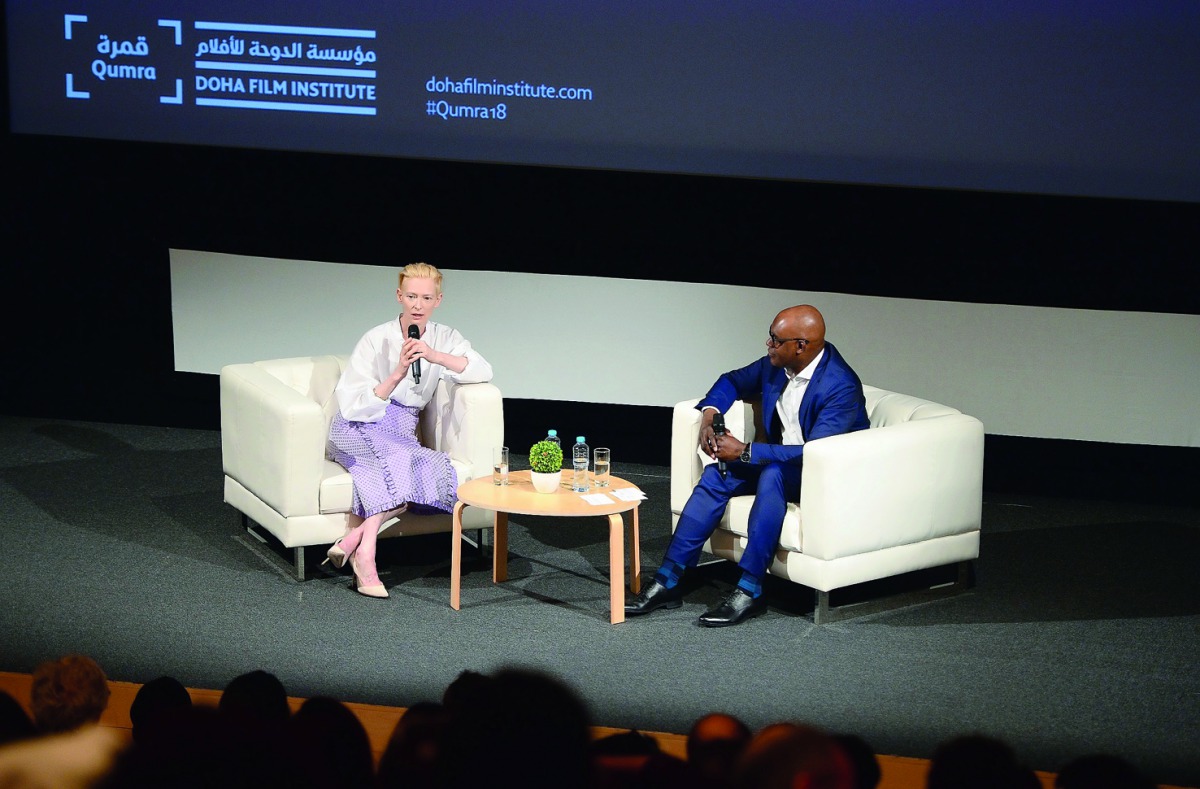
Oscar-winning actress Tilda Swinton addressing people at the Museum of Islamic Art Auditorium.
DOHA: Oscar-winning actress Tilda Swinton has underscored the inherent power of cinema as a ‘free state’ which enables filmmakers and viewers to be what they want to be regardless of gender, race or age.
Swinton was addressing a packed Museum of Islamic Art (MIA) Auditorium on Friday kicking off the series of masterclasses for young filmmakers at the fourth edition of Qumra organised by Doha Film Institute (DFI). “I think the wonderful thing about art-cinema in particular-is that it is a free state, for us to be free of gender, nationhood, race or age. I think the glory of filmmaking is that we can all be whatever we want to be,” said Swinton at the two-hour long masterclass moderated Cameron Bailey, Artistic Director of the Toronto International Film Festival.
Urging filmmakers to make cinema as free as possible, she said the best use of cinema as a free state is “to approach it with absolute carte blanche so that we don’t have to carry our own sense of identity into a frame.”
She was reminded of a poignant and enlightening moment in her life when her son, then nine-year-old, asked, “What were people’s dreams like before cinema?” It was this question that sparked in her the idea of cinema as a free state and enabled her to define her own imprint without pretention. The engaging masterclass delved into defining moments in Swinton’s illustrious career as an actor and writer spanning over three decades, taking the audience on a nostalgic journey into some of the most important films she made through clips from We Need to Talk About Kevin, The Chronicles of Narnia, Orlando, Only Lovers Left Alive, Michael Clayton, and Okja.
Looking back, she revealed writing was her first love and that it was not her dream to be on screen. “I never intended to be an actor. I still don’t think of myself as an actor. I came from the world of art and writing and went to university as a writer. I certainly wanted to be a film writer not a film performer,” she said, adding she just found herself drawn into performing with friends in theatrical productions.
She said performing is one way of writing in collaboration with filmmakers.
“When I write, I write alone, but when I make films it is a conversation with filmmakers. I want to work with really communicative filmmakers. To perform with really communicative filmmakers who are interested in such a dynamic [of working with] the performer has really been a blessing,” she said.
Prior to the masterclass, Swinton had interacted with the audience following Thursday’s screening of Okja, one of the films she starred in which was directed by Bong Joon-ho.
She said the film “is about human and animal liberation. It is about wise, childish, innocent love, and how Mija’s (the protagonist) trust is tested and chipped away by everyone. Maybe that is the kernel of the film.”
Swinton is one of the Qumra Masters this year. She joins Oscar winning British costume designer Sandy Powell, OBE); Oscar nominated director Bennett Miller; Venice Golden Lion winning Russian director and writer Andrey Zvyagintsev; Cannes Palme d’Or winning Thai filmmaker and visual artist Apichatpong Weerasethakul; and the only documentary director to win the Berlinale Golden Bear, Italian director Gianfranco Rosi in providing mentoring sessions, one-on-one meetings and masterclasses to nurture the talent associated with 34 selected Qumra projects from 25 countries that are in development and post-production stages.