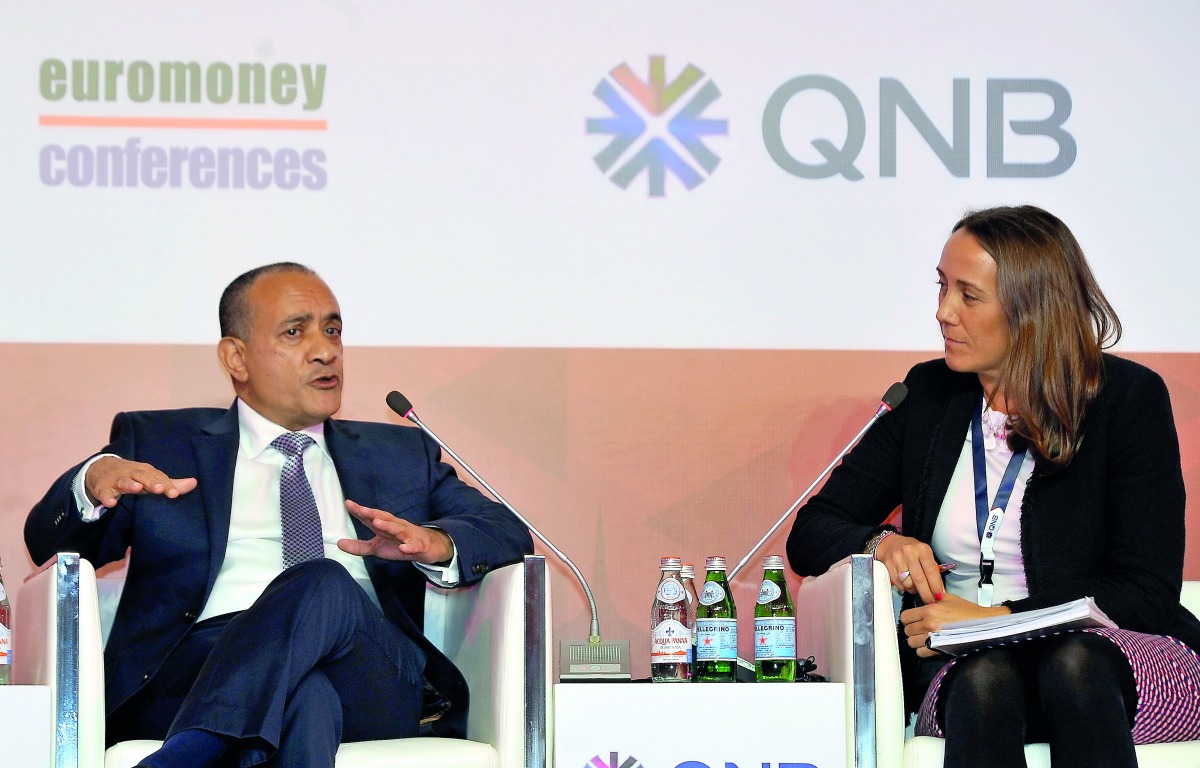
Joseph Abraham (left), Group Chief Executive Officer of Commercial Bank, being interviewed at the opening session of the Euromoney Conference 2018 at the St Regis Hotel in Doha yesterday. Pic: Salim Matramkot / The Peninsula
Commercial Bank, one of the leading banking and financial services providers in Qatar, is upbeat and positive about the strong growth of the Qatari economy and the performance of the banking sector in general and Commercial Bank in particular, noted a top official of the Bank at a high profile event here yesterday.
Joseph Abraham, Chief Executive Officer of the Commercial Bank Group, speaking on the opening day of the ‘Euromoney Qatar Conference’ said that Qatar is one of the strongest economies among the GCC countries, and the bank is very optimistic about the positive outlook of the economy which is going to create huge opportunities for business and investments.
“We are optimistic on Qatar, which is one of the strongest economies in the region… The spending in the infrastructure projects, including for the upcoming FIFA World Cup; the gas expansion project; and scores of other projects, are going to further accelerate the pace of economic growth and investments in the country,” said Abraham.
He added: “We already heard H E the Minister of Finance saying that the coming year (2019) Qatar will have a surplus budget, which is expected to be deployed in the economy. All that positive indicators will have multiplier effects in most sectors of the local economy, including the banking sector.”
Speaking about the Commercial Bank’s growth strategy, he said that the introduction of cutting-edge technology, establishment of an in-house technology and innovation centre, and full control over operations and processes will enable the Bank to have competitive advantage over others within the industry.
The Bank, which is the lead sponsor of the conference, has established a subsidiary—‘Commercial Bank Innovation Service’— at Qatar Financial Centre, transferring its business process outsourcing services back to Qatar from India. The objective is to have full control over its technology and operations. This will also enable the Bank to apply latest technology in developing new products and introducing innovative processes, including robotic process automation and AI in to its core banking services.
On the possibility of hiring services of local fintech providers, Abraham said Commercial Bank is open to work with anyone depending on the benefits and the value of the given technology to the bank. “We are working with an offshore payment fintech which provides us access to global payment mechanism,” said the CEO. Asked about the Bank’s future business plan, he said that Commercial Bank is committed to Turkey, where it has presence, and also to Oman, which is a strategic trading partner of Qatar.
“We have a very clear five-year growth strategy, and we are moving accordingly. As part of the plan, we will continue to grow in government and public sector to support the Qatari economy,” Abraham added.
“We are investing in technology to constantly automate our processes to provide a better experience for our customers. And we are also investing in our subsidiary in Turkey. Under the five-year plan, we are going to invest about $300m of capital.” The Bank is also working closely with the National Bank of Oman as the Sultanate is part of the strategic linkage between Qatar and Turkey.
“We believe that there is a lot of opportunity to build on and act as a bank to manage the capital, trade and investment flows arising as a result of deepening an expanding cooperation among these countries,” he said.
He also said that as part of the strategy, the Bank is also reducing its exposure to the real estate sector and increasing its public sector portfolio, and both the segments have registered up to 2 percent change.
On SME-financing he said that enterprise financing is important part of the Bank’s business, and it is working in close cooperation with Qatar Development Bank to develop more products.
Commenting on the future risks to global banking and financial system, especially with regard to the pervasive use of technology and growing cyber threat, he said that as the technology is applied all over the world, so the transmission of technology-related risks move very quickly. Therefore, the cyber risks are going to rise and the impact is anticipated to be greater, which may create a “new sort of disruption in the banking and financial system”.